NSRCVS News - April 15, 2020

logo.jpg
deer.jpg

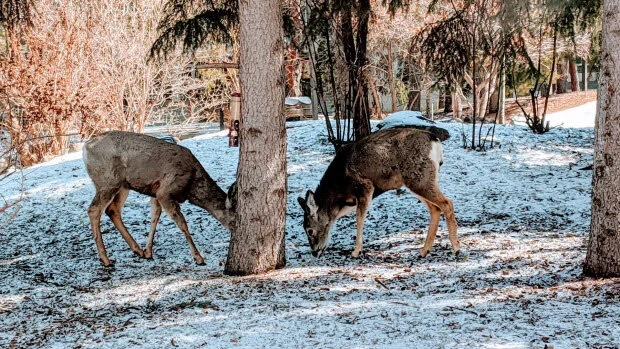
Special unDeergraduates at U of A
Students and faculty are staying away from the University of Alberta because of the pandemic, but that does not mean the campus is empty. Classes at the university were moved online on March 16. If nature abhors a vacuum, then this and other photos by Michael Gravel of deer at the Business/Arts quad at the university are evidence https://edmonton.ctvnews.ca/undeergraduates-special-visitors-at-the-u-of-a-campus-1.4893059
 
The city has a thriving wildlife population, including porcupines, beavers, badgers, chickadees, American white pelicans, great horned owls, Canadian toads, peregrine falcons, and shrews. The city is potentially home to as many as 178 species of birds, 47 mammals, 27 species of fish, two kinds of reptiles, five amphibians, 487 kinds of plants including two kinds of carnivorous plants and 221 different kinds of fungi.
 
According to Edmonton’s 2008 Biodiversity Report, the city’s natural areas in the river valley and tablelands provide high quality habitat for native species, and semi-natural steppingstones and linkages throughout developed areas offer additional support for wildlife movement and ecological processes like pollination.
 
Although Edmonton’s biodiversity and natural habitats have decreased with time and continue to face significant challenges, the entire complex of Edmonton’s natural areas form a functional ecological network that supports local plant and animal species and provides essential ecosystem services. Learn more at https://www.edmonton.ca/city_government/documents/PDF/BIO_DIVERSITY_REPORT_-_high_res_August2008.pdf

ow;s.jpg

New life throughout the river valley
Bob and Louisa sent photos of three Great Horned owlets being raised in the river valley near Beverly. Bob said, “It’s been a real treat for Louisa and me to see this wonderful affirmation of life in the midst of this strange and baffling time of COVID-19.”
 
An owlet is a young baby owl, typically a recently hatched bird that has not yet developed its full mature plumage and is still dependent on its parents for feeding, care, and security. The great horned owl nests earlier than all other birds in Alberta except for grey jays. Two to three eggs are laid in late February and early March in old nests built by hawks or crows
 
Alberta's largest eared owl, the great horned owl is common throughout Alberta, and is the Provincial Bird. It is readily identified by its large size and prominent "horns" pointed toward the sides of the head. In flight, the ear tufts are held flat against the head.
 
Prey includes large insects, mice, rabbits, domestic and game birds. Hunting begins at dusk, but on dark days the owl may hunt in the afternoon. Learn more at https://www.ealt.ca/species-spotlight-list/great-horned-owl

crocus.jpg

Prairie Crocus our announcement of spring
As soon as the snow melts, you will want to start looking for this harbinger of spring. The prairie crocus has pale blue or purple flowers arising from the woody rootstock that appear early in spring. The whole plant is covered with woolly-white hairs. This furry little perennial is not a crocus, which is in the Lily family. It is really an anemone, in the Buttercup family.
 
Prairie crocus grows in northern latitudes all around the world. In Canada, it occurs in the Yukon and Northwest Territories, and from B.C. east to Manitoba. Its prairie population has declined greatly since pioneer days because it grows in native prairie sod, most of which has been ploughed or cultivated.
 
This plant first emerges from the ground as a hairy flower bud; the furry leaves are hard to see at this point. When the purple sepals open, they reveal bright yellow stamens inside. The flowers open in sunshine and close again in the evening and in cloudy weather.
 
Just in case being hairy is not a strong enough defense, the plant has poisonous properties. It contains a poisonous alkaloid, an irritant that can cause inflammation and blistering. This irritant can be a problem to domestic sheep when they eat the flowers, but it seems to be ignored by deer, elk and ground squirrels which eat the prairie crocus in the early spring. Learn more at
http://plantwatch.naturealberta.ca/choose-your-plants/prairie-crocus/

Share river valley event, job posting, or news
If you have a river valley event, job posting, or news that you would like to see published in this newsletter, please send the info to nsrivervalley@gmail.com
 
Sincerely yours,
Harvey Voogd
North Saskatchewan River Valley Conservation Society
780.691.1712
nsrivervalley@gmail.com
https://www.facebook.com/NSRVCS/
http://www.edmontonrivervalley.org/

NSRVCS News - April 8, 2020

logo.jpg
beaverlodge.jpg

How do beavers build their houses
Beavers build and maintain houses called lodges. There are two main types, the conical lodge and the bank lodge. In the river valley, beavers build the bank lodge. It is typically excavated into the bank of a large stream, river, or lake where the water is too deep or fast moving to build the classic conical lodge.
 
Within each lodge beavers will hollow out a chamber where they sleep, eat, groom each other, and the baby kits are born and nursed each spring. Beddings of grasses, reeds and wood chips are changed regularly. In order to breathe fresh air beavers do not apply mud to the peak of the lodge, creating a ventilation shaft.
 
Each lodge contains at least two water-filled tunnels leading from the chamber to the water so the beavers can enter and exit the lodge underwater without being spotted by predators. The walls of the lodge are very strong due to layers of mud and sticks and are extremely insulated. Even with sub-zero outside temperatures it will not drop below freezing inside the lodge due to retained body heat from the family of beavers.
 
In cold climates, beavers will stockpile sticks underwater each fall because they do not hibernate. They live on these sticks because once ice forms they will no longer have access to trees on the land. Beavers remain inside their lodge all winter except when they swim under the ice to their food cache for a stick to nibble on. Learn more at https://www.beaversolutions.com/beaver-facts-education/beaver-behavior-and-biology/

pussy willows.jpg

What are pussy willows
Brighten this time of physical distancing and self-isolation by keeping an eye out on your river valley rambles for the first signs of spring among our native plants. The willow flower, known as the pussy willow, are among the very first to bloom. They signal the last throes of winter and the brink of spring.
 
At the tail end of winter, fuzzy nubs start to appear along the branches of pussy willows. These soft silver tufts, as well as the plant itself, are named for their resemblance to tiny cats’ paws. They feel so much like fur that young children often wonder if they are animals instead of plants. What are those little nubs? Are they seeds? Fruits? And why are they fuzzy?
 
They're flowers just before they fully bloom. The soft coating of hairs acts as insulation to protect these early bloomers from cold temperatures. The species most called pussy willow, Salix discolor, is a small, shrubby species of willow that can be found dotting wetlands and moist woods throughout much of North America. Read more at https://www.bbg.org/news/what_are_pussy_willows_anyway

coyote.jpg

Wonder what Edmonton coyotes eat
The Edmonton Urban Coyote Project http://www.edmontonurbancoyotes.ca/ studies coyotes in our city and river valley. Led by Colleen Cassady St. Clair, it collects information on coyote diet, movement and habitat selection, and knowledge and perception of residents about coyotes.
 
Questions include does poor diet and human food sources such as garbage and compost increase susceptibility to parasites and diseases? Do diseased animals make more use of residential areas during the day? Is there a link between coyotes in conflict with people and a diet of less protein and more processed food?
 
USA research found coyotes eat everything from fruits to cat. Cats made up 20 percent of urban coyotes’ diet. Fallen fruit were an important source of summer food and they also hunted rabbits, gophers and squirrels. Listen to this 3-minute podcast at
https://player.fm/series/series-1274742/coyotes-eat-everything-from-fruits-to-cats

geese.jpg

Why do migrating geese honk
One can’t help but notice migrating birds while walking in the river valley at this time of year, particularly Canada geese. Researchers think that the honking sound geese make as they fly is used to help maintain the integrity of the flock, and to co-ordinate position shifts with the V-formation in which they fly
 
When geese fly in formation, they create their own unique form of teamwork. As each bird flaps its wings, it creates uplift for the bird immediately following. By flying in their ‘V', the whole flock adds at least 71% more flying range than if each bird flew on its own. Geese honk from behind to encourage those up front to keep up their speed.
 
When a goose falls out of formation, it suddenly feels the drag and resistance of trying to go it alone and quickly gets back into formation to take advantage of the lifting power of the bird in front. When the lead goose gets tired, it rotates back in the ‘V', and another goose flies point. Learn more at https://www.hww.ca/en/wildlife/birds/canada-goose.html

Share river valley event, job posting, or news
If you have a river valley event, job posting, or news that you would like to see published in this newsletter, please send the info to nsrivervalley@gmail.com
 
Sincerely yours,
Harvey Voogd
North Saskatchewan River Valley Conservation Society
780.691.1712
nsrivervalley@gmail.com
https://www.facebook.com/NSRVCS/
http://www.edmontonrivervalley.org/

NSRVCS News - April 2, 2020

logo.jpg
paintings.jpg

Paintings from the river’s edge
Riverdale resident, Richard Dixon is a professional fine artist of 32 years experience. His upcoming publication features paintings created as a method of sharing the beauty and wonder of the river valley through which many travel, but few really stop to experience.
 
“The featured scene is a short walk from my home along the river,” said Dixon. “After my first spinal surgery of many, the ability to walk to this site was my goal in learning to walk, move my arms and speak. It took a year to walk there, 5 minutes away, and another year to be able to carry an easel to the site to paint the scene. The new growth of life being a representation of my own new life.”
 
“Watching individual trees grow from saplings to become 30 foots poplars in which live generations of robins and sparrows. Following geese and coyote families through the years. Living with the magpies, ravens and crows as they crate their unique sounds of life. The valley is a living world to which the city’s human residents have access at their doorstep, only if they are willing to experience it.” See his work at http://www.edmontonrivervalley.com/richard.html

fox.png

This mammal found everywhere in Canada
Red foxes are resourceful and have earned a reputation for being cunning and intelligent. They adapt to living in many environments, including busy cities, and have excellent senses of vision, smell and touch. Foxes use scent-marking to communicate to other foxes. These scents can often smell skunky.
 
The red fox has a litter of one to ten pups between March and May every year. The young are born blind and can’t open their eyes until they’re about two weeks old. After a month, fox pups are weaned off their mother’s milk and start eating pre-chewed food. After seven months, young red foxes can hunt on their own and leave their parents in search of their own territory. Foxes have been known to travel up to 250 km to find a suitable home.
 
Foxes only use dens when they are breeding. When the red fox is not breeding, it sleeps in the open and keeps warm by wrapping itself with its long bushy tail. Unlike other mammals, the red fox can hear low-frequency sounds which help them hunt small animals, even when they’re underground!
 
The red fox preys primarily on small animals such as voles, mice, lemmings, hares and rabbits. They also like the taste of chicken and have been called chicken thieves by many farmers. The red fox doesn’t just eat meat, though. It also likes to eat plants, fruits and berries. Learn more at https://www.canadiangeographic.ca/article/animal-facts-red-fox

lodgepole.jpg

Alberta’s provincial tree - lodgepole pine
This tree recognized by its tall, straight, narrow crown can grow up to 30 meters and live up to 200 years. One of the most drought-tolerant of our native conifers, it is found on a wide range of soils.
 
These trees provide excellent habitat for birds, small mammals, insects, and other animals. Birds not only build nests in trees, but woodpeckers hollow out nesting cavities in dead trees. These and other birds use lodgepole pines as a source of food, probing underneath the bark to discover juicy insects. Lodgepole stands also provide important, spacious habitat for larger mammals such as deer, moose, elk, and bears.
 
Lodgepole pine colonizes recently burned areas because of an abundant seed supply in the closed cones. Most stands are created as a result of fire, as the heat melts the resin bonds on the cones, allowing for seed dispersal. Large, pure stands are common, and their density sometimes restricts normal growth. Some stands have over 100,000 trees per hectare.
 
First Nations Peoples found a use for every part of the tree. As the name implies, these trees were used as poles to support lodges and teepees. The wood was considered a good fuel sources as it is very resinous and burns even when it is green. Lodgepole pine resin was used to waterproof canoes, baskets and moccasins, and as a natural glue. Coil baskets were fashioned from the roots. Read more at http://plantwatch.naturealberta.ca/choose-your-plants/lodgepole-pine/

Share river valley event, job posting, or news
If you have a river valley event, job posting, or news that you would like to see published in this newsletter, please send the info to nsrivervalley@gmail.com
 
Sincerely yours,
Harvey Voogd
North Saskatchewan River Valley Conservation Society
780.691.1712
nsrivervalley@gmail.com
https://www.facebook.com/NSRVCS/
http://www.edmontonrivervalley.org/