NSRVCS News - November 19, 2020

logo.jpg
skiing.jpg


Private golf courses open for free winter public use
Both the Highlands and Royal Mayfair river valley golf courses are available for free public use during the winter Both private courses lease their properties from the City as this land is publicly owned by Edmontonians.

I walk regularly with my dog through the Highlands course which is also used for cross-country skiing and tobogganing. I have not yet been to Royal Mayfair, though word is it is absolutely the prettiest spot to ski in Edmonton with gently rolling hills and a sheltered path through forest glades.

Particularly during this pandemic, more space for Edmontonians to enjoy winter in the river valley is appreciated. Exercise your right to bright sunshine, cold weather and the white snow of our Ribbon of Green. Recent winter history for the Royal Mayfair course at https://edmontonjournal.com/news/local-news/elise-stolte-best-kept-ski-secret-public-benefit-not-so-public-at-mayfair-golf-course

promenade.jpg

Touch the water promenade feedback wanted
The City is exploring ways to improve access to the central river valley with Touch the Water Promenade. If the project moves forward, it will include opportunities to celebrate heritage, encourage recreation and connect people with nature.

Touch the Water focuses on a central stretch of the north bank along the North Saskatchewan River Valley in two connected areas. One area is adjacent to the Rossdale neighbourhood and the other is upstream of the river, along River Valley Road to Government House Park.

Two concepts have been developed for how people might use or experience the space that runs along that stretch of the river because Edmontonians have said they want improved access to the river valley and the river itself.

From November 9 to 30, City is seeking feedback on what parts of the draft concept design options you like best, what is missing and what should be improved. Engage at https://www.edmonton.ca/projects_plans/parks_recreation/north-shore-promenade.aspx?utm_source=virtualaddress&utm_campaign=touchthewater

coyote.jpg

Edmonton explores ban on feeding wildlife
Residents surrounding Edmonton’s river valley are urging the city to clamp down on feeding wildlife as coyote interactions increase.

If approved by council, fines up to $500 could be doled out for feeding coyotes, other wildlife on public property, as well as wildlife on private property that leads to a public safety risk or nuisance condition in the neighbourhood. A fine could also be levied for not properly managing wildlife attractants on private property, such as compost bins or fallen fruit, that lead to a public safety risk.

City officials told council’s community and public services committee the proposed bylaw amendments are meant to address extreme situations and not meant to dissuade the practice of bird feeding. These new restrictions and associated fines would better allow enforcement officers to respond to calls for service and deal with nuisance conditions associated with wildlife and human behaviour.

The city doesn’t have any bylaws explicitly pertaining to feeding of wildlife, which isn’t in line with many other municipalities with diverse wildlife. In Calgary, causing distress or harm to any wildlife in a park, including feeding, is subject to a minimum $200 fine. Read more at https://edmontonjournal.com/news/local-news/feeding-wildlife-bylaw

beach.jpg

kisiskâciwanisîpiy, or when is a beach
In an evocative call-and-response audio collaboration, the 2020-21 and 2019-20 UofA English & Film Studies Writers-in-Residence J.R. Carpenter and Darrin Hagen offer images, memories, and impressions from along the banks of kisiskâciwanisîpiy, the North Saskatchewan River.

Darrin has received seven Sterling Awards for his work in theatre. His writing debut was the award-winning memoir The Edmonton Queen. Darrin was honoured as an Edmontonian of the Century for the city’s centennial.

J.R. writes and works across live performance, print, and digital media. Her web-based work The Gathering Cloud won the New Media Writing Prize in 2016. Her print collection An Ocean of Static was highly commended by the Forward Prizes 2018. Enjoy this audio piece at
https://www.youtube.com/watch?v=Xk8sTZrx6AU&feature=youtu.be

valley.jpg

River valley concern or question
If you have a river valley concern or question, contact us at nsrivervalley@gmail.com
Your friends and neighbours can sign up for this newsletter at https://www.edmontonrivervalley.org/
If you have a photo, information, news or event about Edmonton’s river valley and think it should be in this newsletter, email it to nsrivervalley@gmail.com

Sincerely yours,
Harvey Voogd
North Saskatchewan River Valley Conservation Society
nsrivervalley@gmail.com
https://www.edmontonrivervalley.org/
Facebook @NSRVCS
Instagram @nsrvcs

NSRVCS News - November 12, 2020

logo.jpg
Alex.jpg

In remembrance of Alex Decoteau
Alex Decoteau became the first Aboriginal Police Officer in Canada when he joined the Edmonton Police Service in 1909. He was well known for his athleticism, as he was a spectacular long-distance runner.

He won most major western Canadian races between 1909 and 1916, and even earned a place on Canada’s Olympic team to compete in the 5000-metre race in Stockholm in 1912. In fact, Decoteau won races so frequently that he was eventually given the trophies to keep.

At the start of WWI in 1916, Decoteau enlisted in the Canadian Army. He first served with the 202nd Infantry Battalion, then later with the 49th Battalion. After arriving in France in 1917, Decoteau was killed in the Battle of Passchendaele.

The City named a park in honour of the passion he had for his community, and how he strived to serve it in any way he could. Alex Decoteau park is located on the northwest corner of 105 St & 102 Ave. Learn more about Alex Decoteau by a digital comic and two videos produced by the Edmonton Police Service at https://www.edmontonpolice.ca/AboutEPS/LegacyOfHeroes/Issue1

mural.jpg

New murals pop up under river valley bridge
Edmontonians have a new mural piece to check out in the river valley. Some colourful murals have been painted under the James MacDonald Bridge, done by Vancouver artists Nelson Garcia and Xochitl Leal. The newest piece is a large cat, alongside wildlife found in the river valley, from beavers, magpies, and deer.

“We’ve taken a space that was very drab and not super attractive and made it kind of into a little feature,” said Natalie Bunting, treasurer with the Rossdale Community League. “You actually see people stop with their kids and talk about the different animals and take lots of pictures. Hopefully, Edmonton is enjoying it.”

The two-phase artwork is approximately 7,000-square-feet in size. The first phase was completed in 2019. See more at https://edmonton.ctvnews.ca/new-murals-pop-up-under-bridge-in-river-valley-1.5169381?cache=

buffalo.jpg

Buffalo in the river valley
Buffalo helped make Fort Edmonton the most important trading post on the North Saskatchewan River. To the south and east enormous herds of plains buffalo provided the large quantities of meat and pemmican that were essential to those engaged in the trade. Edmonton became a major supply point for pemmican. The post itself consumed huge quantities of buffalo meat. The naturalist Dr. James Hector reported that 526 pounds of fresh meat were consumed daily by the 109 inhabitants in February 1858.

The buffalo normally sought shelter from the winter storms of the open plains in the parkland and the woodland fringe around Edmonton. The artist Paul Kane commented on the thousands of buffalo that ranged close to the fort, noting that several were shot within a few hundred yards of it, and in mid-December he found a herd of perhaps ten thousand along the river only ten miles from Edmonton.

Though the Blackfoot Indians traded at Edmonton and Rocky Mountain House, they did so erratically and unreliably. Because of the availability of buffalo, the Blackfoot tribes were remarkably successful in preserving their fierce independence of the fur trade.

City Ward 10 has been given the Blackfoot name Ipiihkoohkanipiaohtsi in honour of this history. This word reflects the traditional lands where the Blackfoot Nation performed Buffalo Rounds. It is known that bison would migrate up to 300 km north of the North Saskatchewan River to the safety of artesian wells to gather for the winter. Learn more at https://allaboutbison.com/natives/blackfeet/

sun.jpg

Know someone who should get this weekly newsletter
Sign up for this newsletter at https://www.edmontonrivervalley.org/

If you have a photo, news, an event, volunteer or employment opportunity involving Edmonton’s river valley and want to see it in this newsletter, please email the material to nsrivervalley@gmail.com

Sincerely yours,
Harvey Voogd
North Saskatchewan River Valley Conservation Society
nsrivervalley@gmail.com
https://www.edmontonrivervalley.org/
Facebook @NSRVCS
Instagram @nsrvcs

NSRVCS News - November 5, 2020

logo.jpg
photo.jpg

Photo worthy viewpoints in the river valley
A favourite part of travel for many people is finding great views, maybe views you’ve seen shared on Instagram or the internet and capturing them with a camera to savour the memory forever. Of course, this year is not a normal time for travel, and maybe you’re left craving those views and Instagram-worthy spots.

The truth is, there is no better time to explore your own backyard. Edmonton’s river valley is home to a multitude of great views and vistas. River Valley Alliance staff, ambassadors and photographer friends have put together a list of some of the best viewpoints the river valley has to offer. See photos and locations at https://rivervalley.ab.ca/news/photo-worthy-viewpoints-in-the-river-valley/

emily.jpg

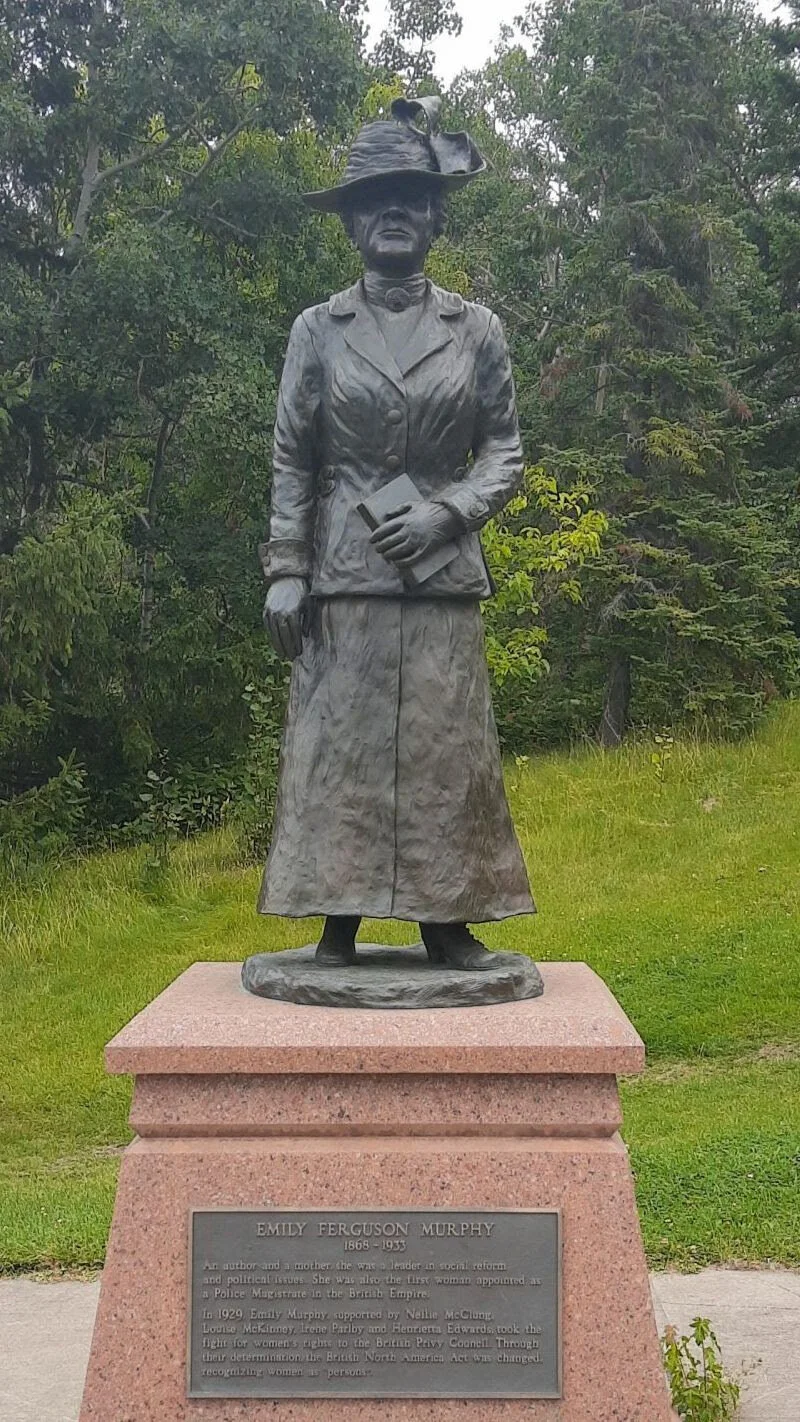
Other side of Emily Murphy
Shortly after entering Emily Murphy Park, which sits on the banks of the North Saskatchewan River between Groat Bridge and the main campus of the University of Alberta, there is a dark grey statue of Emily Ferguson Murphy, who lived from 1868 to 1933.

In many ways this is a very conventional historical monument. It reminds present day citizens of the lead role she played as a member of the Famous Five, and their successful fight to have women declared “persons” in Canada and therefore eligible to serve in the Senate. Each of the Famous Five have a park named after them in Edmonton’s North Saskatchewan River Valley.

Like so many historical figures, the life of Emily Murphy is being re-examined and re-evaluated. Increasingly, historians have begun to shed light on her beliefs about racial superiority and eugenics. Since the 1980s, historians have shown how many first wave feminists like Murphy fought for equal rights for predominantly white women, or more precisely, white, educated, upper-class, Protestant women. Read more at https://citymuseumedmonton.ca/2020/10/21/the-other-side-of-emily-murphy/

trail.jpg

Gold Bar park to Rundle park trail
This trail lets you enjoy two gorgeous footbridges over the North Saskatchewan River, with sweeping views both east and west, plus easy strolls in two well-treed parks. This walk could make a great adventure day for the whole family and dog. It is also a great bike ride.

For an extra long adventure, you could extend the route from Gold Bar park up the ravine to Tiger Goldstick park, or cross the Rundle footbridge to Strathcona Science park for further exploration.

Ainsworth Dyer Memorial Bridge is named after one of four Canadian soldiers who were killed in a friendly fire incident in Afghanistan. There is a monument to Dyer and his fellow soldiers once you cross the bridge.

At the Rundle park footbridge, turn around to head back the way you came, walk to the middle to get more river views, or continue onwards by crossing the bridge into Strathcona Science Park. Parking and directions at https://rivervalley.ab.ca/trail-treks/trail-trek-how-to-gold-bar-park-to-rundle-park/

gull.jpg

This gull really likes French fries
There are many types of gulls in Alberta, but the most abundant is the ring-billed gull. There is one thing we all know about this gull; it really likes French fries. It is rare to see a fast-food restaurant without a pack of gulls in the parking lot, squabbling over food scraps.

The ring-billed gull is a strong, acrobatic flyer that has been known to snatch food from human hands while in flight. In addition to human food the bird eats earthworms, rodents, fish, bird eggs, and grains.

The ring-billed gull is a commuter, nesting along lake shores and open fields, and making its way in and out of the city daily. Like Canada geese, they fly together in groups in a V-formation. In the fall some of these gulls will still be seen in Edmonton into October or early November. Learn more at https://www.allaboutbirds.org/guide/Ring-billed_Gull/overview

beaver.jpg

Know someone who should get this weekly newsletter
Sign up for this newsletter at https://www.edmontonrivervalley.org/

If you have a photo, news, an event, volunteer or employment opportunity involving Edmonton’s river valley and want to see it in this newsletter, please email the material to nsrivervalley@gmail.com

Sincerely yours,
Harvey Voogd
North Saskatchewan River Valley Conservation Society
nsrivervalley@gmail.com
https://www.edmontonrivervalley.org/
Facebook @NSRVCS
Instagram @nsrvcs