NSRVCS Newsletter - February 25, 2021

logo.jpg
gondola.jpg

Defend river valley from unnecessary gondola
City Council voted 8 to 5 to approve a legally non-binding Gondola Agreement Framework with Prairie Sky Gondola, which keeps alive the private company’s scheme for a 2.5km gondola, cutting through Edmonton’s river valley, from Whyte Avenue to downtown.

An opinion piece published before the vote made several arguments against the plan. It said the mono-cable gondola will add a non-essential, redundant transportation corridor to an area well served by many transportation crossings including the new Walterdale Bridge.

The city plan is designed to address climate change and add tree canopy and green space. Green jobs and blue and green infrastructure are at the base of most economic-recovery plans that address climate change. The gondola will not help with these core ambitions.

The company states it does not need any City money, but degradation of the river valley will occur. A gondola will add 13 towers, one as high as 37 metres, with 10 by 10 metre bases to a part of the city prized for its beauty. At one site within Queen Elizabeth Park’s spruce and aspen forest, a key link in the region’s wildlife corridor, heavy equipment will be needed to anchor a tower to bedrock to protect it from a sliding hill.

The mono-cable style of gondola typically requires a cutline, like Banff and Jasper. But even if it can get over most trees, nonstop bobbing of carriages down the slope of Queen Elizabeth Park is sure to disrupt the quiet pleasure in viewing the park’s old growth forest from the other side of the river. Read more https://edmontonjournal.com/opinion/columnists/opinion-defend-edmontons-river-valley-from-an-unnecessary-gondola

biodiversity.jpg

WildEdmonton: monitoring urban biodiversity with remote cameras
Ever wonder what is really going in Edmonton’s river valley? Find out what is happening at night or at other times when people are not around. Learn about what creatures live among us and where they roam.

The North Saskatchewan River Valley Conservation Society (NSRVCS) invites you to participate in an online presentation by Colleen Cassady St. Clair titled WildEdmonton: A protocol and preliminary findings for monitoring urban biodiversity with remote cameras. The event will be March 15 at 5:30pm. Please RSVP to nsrivervalley@gmail.com

After your RSVP is received, you will be sent the Zoom contact information necessary to participate in the event. NSRVCS’ AGM will immediately follow the presentation and feature a brief overview of the society’s activities in 2020.

Colleen is a professor of Biological Sciences at the University of Alberta. She studies how animal behaviour contributes to both problems and solutions related to conservation biology. Her current and recent projects address biodiversity in Edmonton, sources of conflict and coexistence with urban coyotes, the importance of personality in habituation in elk, and mitigating train strikes on grizzly bears in the mountain parks. https://edmontonurbancoyotes.ca/

coal.jpg

Coal policy and the North Saskatchewan River
Edmonton’s drinking water comes from the North Saskatchewan River so coal mining upstream and its impact on the North Saskatchewan River watershed is a concern to all residents.

Minister of Energy Sonya Savage announced public consultations with Albertans on a modern coal policy for Alberta will begin on March 29. Savage said “I have directed my department officials to bring forward a comprehensive consultation plan that is by Albertans and for Albertans. The details of the process will be announced before consultations begin.”

According to the Minister, “With the input of Albertans, a modern coal policy will protect the areas Albertans cherish while allowing responsible resource development in the appropriate places.”

Albertans interested in receiving regular updates about the process, future consultation sessions and how to participate can submit their contact information to https://www.alberta.ca/coal-policy-development-engagement.aspx

strawberry.jpg

O-day’min the heart of Edmonton
O-day’min, the new name of the city’s downtown ward means strawberry, or heart berry and represents the heart of Edmonton, amiskwaciwâskahikan.

The stem of the heart represents the North Saskatchewan River, the vessels are the waterways, while the veins make up the blood (people). The roots (veins) of the strawberry represent the different cultures that now make up the city.

The O-day’min is a traditional medicine that guided the Anishinaabe (people with the shared culture and language of the Algonquian tribes) understanding of the deep connection between mind, body, spirit, and emotions.

Anishinaabe peoples are found across Canada, and in Alberta have been referred to as the Saulteaux. The O’Chiese First Nation near Rocky Mountain House is home to Anishinaabe peoples. Strawberry teachings at https://wabano.com/wp-content/uploads/2020/08/Strawberry-Teachings-_-ENG-_-FR.pdf

squirrel.jpg

River valley contributions or question
If you have a river valley concern or question, contact us at nsrivervalley@gmail.com
Your friends and neighbours can sign up for this newsletter at https://www.edmontonrivervalley.org/
If you have a photo, information, news or event about Edmonton’s river valley and think it should be in this newsletter, email it to nsrivervalley@gmail.com

Sincerely yours,
Harvey Voogd
North Saskatchewan River Valley Conservation Society
nsrivervalley@gmail.com
https://www.edmontonrivervalley.org/
Facebook @NSRVCS
Instagram @nsrvcs

NSRVCS Newsletter - February 18, 2021

logo.jpg
silver.jpg

Silver Skate Festival in Hawrelak Park
This festival at Edmonton’s Hawrelak Park, February 12-21, is looking a little different, but there is still much to do and to see. There are snow sculptures, two cross country ski trails and lots of room for snowshoeing.

Thanks to the creative mind of local artist, Steven Teeuwsen, you can take a magical walk through Hawrelak’s paths, dotted with his crystal lanterns. These metal and wood art displays are inspired by the pop-up look of paper lanterns and are lit in a way which creates beautiful shapes and patterns of light on the snow.

It would not be Silver Skate without a little pond skating. Hawrelak has the biggest pond rink in the city and offers tons of room for learning or zipping by at your fastest speeds. You are guaranteed space for social distancing, plenty of room for lacing up, and ample parking. Festival information https://www.todocanada.ca/14-things-to-do-during-2021-silver-skate-festival-in-edmonton/

coltsfoot.jpg

Coltsfoot harbinger of spring
This wild edible plant is unusual in that the flowers bloom and die before the appearance of any leaves, which earned Coltsfoot the name "son before the father" in earlier times. Before the introduction of matches, the felt-like covering of the plant, wrapped in a rag, and dipped in a solution of saltpetre, was excellent tinder after being dried in the sun.

Coltsfoot is a low growing perennial plant. It has large, deep green leaves but the plant has no main stem. The leaf petiole holds the leaves 10 to 20 cm above the soil, often forming a complete canopy covering the soil. Coltsfoot flowers often before the last of the snow melts. Flower heads have even been known to push through snow.

Coltsfoot flowers can be eaten tossed into salads to add a wonderful aromatic flavour or fill a jar with the flowers and add honey to make a remedy to help calm a cough or to sweeten a bitter herbal tea. Coltsfoot sorbet recipe https://www.ediblewildfood.com/coltsfoot.aspx

forest heights.jpg

Forest Heights known for trees and view
Forest Heights, a neighbourhood in southeast Edmonton, overlooking the North Saskatchewan River was officially made part of Edmonton in 1913. The neighbourhood was used as agricultural land until the 1940s when housing demands after the Second World War pushed for the area to be developed into a residential sector.

True to the name, the neighbourhood has massive elm trees that canopy the streets which make walking around feel like you are entirely cut off from the rest of the city. It is also home of the Edmonton Jewish Cemetery. Abraham Cristall, known as Edmonton’s first Jewish citizen, purchased the land located at 7622-101 Ave on May 26, 1907, to develop the cemetery.

Although technically not part of Forest Heights, Capilano Ravine cuts into the residential area, and consists of a park area which many residents traverse for walks. The City of Edmonton Archives contains pictures of a 1935 ski jump located in Capilano Ravine. Forest Heights during this time was mostly farmland, which means this ski jump was likely in the middle of natural and undeveloped land. Learn more at https://citymuseumedmonton.ca/2021/01/27/forest-heights-a-hidden-pocket-of-history/

skate.jpg

River valley contributions or question
If you have a river valley concern or question, contact us at nsrivervalley@gmail.com
Your friends and neighbours can sign up for this newsletter at https://www.edmontonrivervalley.org/
If you have a photo, information, news or event about Edmonton’s river valley and think it should be in this newsletter, email it to nsrivervalley@gmail.com

Sincerely yours,
Harvey Voogd
North Saskatchewan River Valley Conservation Society
nsrivervalley@gmail.com
https://www.edmontonrivervalley.org/
Facebook @NSRVCS
Instagram @nsrvcs

NSRVCS Newsletter - February 10, 2021

logo.jpg
gondola.jpg

Gondola wants river valley land lease
Council’s Urban Planning Committee will consider a Gondola Agreement Framework at its February 16 meeting. Last year on February 3, 2020, City Council passed a motion that Administration work with Prairie Sky Gondola to determine the feasibility of a gondola in the River Valley, with the work to be guided by the following governing principles.

No public funding request and all financial risk borne by proponents. Open books to the city for validation on a confidential and proprietary basis. A robust engagement plan for community and Indigenous stakeholders. Mutually beneficial integration with public transit. Minimized ecological footprint. Providing surety, including monetary security, with respect to service continuity or demobilization. An examination of the implications of using air rights and of an emergency response plan for first responders.

Prairie Sky is back requesting the opportunity to lease land to build five stations at the following locations: Downtown, Ortona Armoury, Rossdale, End of Steel Park, and Whyte Avenue through the river valley.

It is expressly understood that the proposed framework is not a legally binding document. It is a statement of mutually agreed upon principles and an expression of a mutual intent to engage in negotiations to enter into legally binding agreements based upon the principles set out herein. To date, a robust community engagement plan has not occurred.

Read the proposed Gondola Agreement Framework between the City of Edmonton and Prairie Sky Gondola at https://pub-edmonton.escribemeetings.com/filestream.ashx?DocumentId=79801

dragon.jpg

River valley dragons
The Year of the Ox is upon us, officially kicking off on Feb. 12, but there are now nine dragons in the river valley at the Edmonton Chinese Garden, located in Louise McKinney Riverfront Park just off Grierson Hill.

"We are the gem of the river valley," says Wing Choy, president of the Edmonton Chinese Garden Society, established in 2000. Since the garden opened in 2007, the not-for-profit society has added a friendship gate, monument, zodiac statues, and now a Nine Dragon Wall.

"It is one of the biggest dragon walls in North America. It's magnificent!" says Choy. At 17 metres long, five metres high and weighing 106,000 kilograms, the wall built in the summer of 2020 is an imposing addition to the garden. The wall cost $500,000 but Choy says they are now trying to raise $200,000 for a roof.

Choy believes this outdoor space offers tranquillity, good energy and feng shui, especially from the top of the bridge in the middle of the rock pond. Dragon wall video at https://www.cbc.ca/news/canada/edmonton/lunar-new-year-wing-choy-cheryl-wang-year-of-the-ox-chinese-1.5899965

ice age.jpg

Ice age in Edmonton
Even with the arrival of somewhat unpredictable electricity and the burgeoning popularity of refrigeration in the 1920s, many citizens and businesses clung fiercely to their insulated cubicle iceboxes. “Ice is the Safe Form of Home Refrigeration,” declared an Arctic Ice Company advertisement in the June 30th, 1927 edition of the Edmonton Journal. “Ice is the simple, natural way to secure the proper low temperatures of your refrigerator. Ice costs less than any refrigerating method and never goes out of order.”

The “ice age” in Edmonton began at the turn of the century with the establishment of the Edmonton Ice Company and the City Ice Company, followed by the Arctic Ice Company and the Twin City Ice Company, in 1912. They were headquartered on the Ross Flats (today’s Rossdale) on 100 Street between 97 and 98 Avenues, with storehouses for ice and stables for horses and delivery wagons.

A 1912 article extolling the virtues of the new Arctic Ice Company said: The ice taken from the North Saskatchewan was “as pure as nature can make it. Coming as it does from the snow-fed stream of the surrounding country, filtered through the immense gravel beds along the river, and fed from thousands of pure springs, the water is as limpid and as translucent as a diamond.”

Learn more and see photos of harvesting ice from the frozen North Saskatchewan River at
https://citymuseumedmonton.ca/2021/02/03/the-ice-age-in-edmonton/?

metis.jpg

Metis and the river valley
Métis history in Alberta originated with the fur trade when French and Scottish fur traders married Indigenous women. From 1670 to 1821 the Métis populations grew regionally, typically around fur-trading posts. After a few generations, descendants of these marriages formed a distinct culture.

Fort Edmonton spawned a large Métis population that was involved in an annual buffalo hunt for many years. These Métis helped to establish the nearby settlements of Lac Ste. Anne and St. Albert. The fur-trade was an economic boom for the Métis as it opened the fur and buffalo meat trades to private Métis traders, however it also exposed them to a flood of European and Canadian colonists seeking to profit and disenfranchise the Metis from their lands.

Métis cultures and communities survived with farming, ranching, fishing, and industry replacing their traditional economy of fur-trading as the main economic activity, though trapping and hunting have remained important in the Rocky Mountain and Boreal Forest regions.

As the fur trade slowed, Métis people developed farms on river lots close to Fort Edmonton. Metis was chosen as the new name of Ward 6 because of the history of the Metis in this region, as well as the river lot system historically used in this area of Edmonton. Learn more at
https://en.wikipedia.org/wiki/M%C3%A9tis_in_Alberta

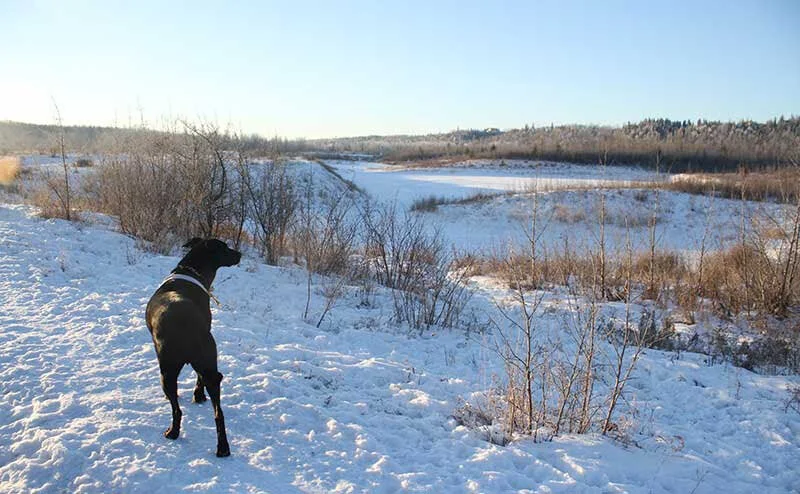
dog.jpg

River valley contributions or question
If you have a river valley concern or question, contact us at nsrivervalley@gmail.com
Your friends and neighbours can sign up for this newsletter at https://www.edmontonrivervalley.org/
If you have a photo, information, news or event about Edmonton’s river valley and think it should be in this newsletter, email it to nsrivervalley@gmail.com

Sincerely yours,
Harvey Voogd
North Saskatchewan River Valley Conservation Society
nsrivervalley@gmail.com
https://www.edmontonrivervalley.org/
Facebook @NSRVCS
Instagram @nsrvcs