NSRVCS Newsletter - August 5, 2021

logo.jpg
babies.jpg

Anirniq ward honours those who never made it home
Between 1950 and 1960 when a tuberculosis epidemic ravaged the Inuit after it was brought to the Artic, many were flown to Edmonton for treatment at medical facilities built specifically for Indigenous peoples.

It was in those hospitals that many faced prejudiced medical attention, including shock treatments, experiments, and sterilization. Adults, children, and babies were separated from their families and on average spent 2½ years living in these hospitals.

Many people died and were never reunited with their families. Even in death, many were buried in unmarked graves and their families were never notified. Tuberculosis took the breath and spirit of many who were brought to the Charles Camsell Indian hospital which is in the ward.

Anirniq is Inuktut for breath of life or spirit. The name was given to honour those who never made it home. Watch a video on the naming of Dene ward https://www.youtube.com/watch?v=7EPyVhA_uaQ

sparrow.jpg

Female bird attracted to the ability of the male to learn
A rich, russet-and-gray bird with bold streaks down its white chest, the Song Sparrow is found throughout most of North America, but birds of different areas can look surprisingly different. Despite the large differences in size and coloration across its range, genetic divergence is low.

Song Sparrows seem to have a clear idea of what makes a good nest. Field researchers working for many years on the same parcels of land have noticed that some choice spots, the base of a rose bush, or a particular hollow under a hummock of grass, get used repeatedly, even when entirely new birds take over the territory.

The Song Sparrow, like most other North American breeding birds, uses increasing day length as a cue for when to come into breeding condition. Other cues can be important too, such as local temperature and food abundance.

Like many other songbirds, the male Song Sparrow uses its song to attract mates as well as defend its territory. Laboratory studies have shown that the female Song Sparrow is attracted not just to the song itself, but to how well it reflects the ability of the male to learn. Learn more at https://www.allaboutbirds.org/guide/Song_Sparrow/overview

muttart.jpg

Muttart Conservatory a horticultural wonder
The Muttart Conservatory has reopened after being closed to the public in July 2019 for a $13.3 million rehabilitation to replace aging facility systems, followed by closure in response to pandemic public health orders. Built in 1976, it has attracted visitors for over 42 years

Muttart Conservatory describes itself as Edmonton's premier horticultural attraction. Its pyramids are nestled in the river valley and features more than 700 species of plants in 3 climate regulated biomes; arid, temperate, and tropical and a feature biome located within its pyramids. More information at https://www.edmonton.ca/attractions_events/muttart-conservatory

feedback.jpg

Frieda says thank you for sending me the newsletter. I find the stories about the river valley very interesting.

Photo by Justin Wondga

Photo by Justin Wondga

River valley concern or contribution
If you have a river valley concern or question, contact us at nsrivervalley@gmail.com
Your friends and neighbours can sign up for this newsletter on our web site.
If you have a photo, information, or event about Edmonton’s river valley and think it should be in this newsletter, email it to us.

Sincerely yours,
Harvey Voogd
North Saskatchewan River Valley Conservation Society
780.691.1712

NSRVCS Newsletter - July 30, 2021

logo.jpg
Dene.jpg

Dene ward honours continent’s largest Indigenous language group
Dene is the biggest Indigenous language group in North America, stretching from Alaska to New Mexico. The North Saskatchewan River was one of the main highways long before Europeans came out this way. Dene travelled all over North America. Edmonton was one of the areas people would stop and camp and then continue their journey.

Dene people in Alberta include the Athabasca Chipewyan First Nation, the Cold Lake First Nations, and Dene Tha First Nation. Dene people are spread across Canada with the largest concentration of Dene language speakers living in Saskatchewan. Dene languages became one of the official languages of the Northwest Territories in 1990.

Dene means people and refers to the various tribes and people, Indigenous and non-Indigenous, that settled along the North Saskatchewan River and who live there now. Many Dene tribes settled along the shores of the river, including the area where Edmonton now sits. Watch a video on the naming of Dene ward at https://www.cbc.ca/player/play/1874146371557

frog.jpg

This amphibian darkens when cold to absorb more heat
The Wood Frog is the most widely distributed amphibian in Canada and is found in every province and territory. Although found in tundra to the north and occasionally in grasslands in the west, it is commonly associated with moist woodlands and vernal woodland pools, including in Edmonton’s river valley.

Wood Frogs are the earliest breeders in most of their range, often beginning to call when there is still ice on the ponds in spring. The egg mass of up to 2000 eggs is attached to submerged vegetation. Most of the egg masses in a population will be laid within a few days and clustered together so their combined dark colouration warms them and speeds hatching. The tadpoles transform after 44-85 days.

Wood Frogs are freeze tolerant and hibernate under logs or leaf litter on the forest floor. They can change colour rapidly from very dark to very light and will darken when cold to absorb more heat. Learn more at https://www.naturewatch.ca/frogwatch/wood-frog/

peony.jpg

Edmonton peony garden was a major tourist attraction
Prominent Edmonton physician James Frederick Brander came to Edmonton from Nova Scotia in 1921 and, along with his father George, soon established a peony garden in the Bonnie Doon area on an empty plot of land that George couldn’t stand to see go to waste.

The Silver Heights Peony Garden, located at 93 Avenue and 85 Street in Bonnie Doon, was a major tourist attraction and source of most of the peonies in Alberta from 1923 until the 1940s. Father and son proved that the soil and climate conditions in the area were ideal for the peony, which had previously been regarded as exotic and too delicate for the frigid north.

The first planting was small, but in later years as many as 5000 roots arrived from Holland in a single shipment. Altogether, 200 named varieties were grown and, in full flowering time, an estimated quarter of a million blooms could be seen.

When George Brander died in 1933, his family continued the Peony Gardens until the Second World War made such large-scale flower operations impractical. The plants were dug up, divided into 50,000 roots, and sold to gardening aficionados around Edmonton.

In 2002, Fort Edmonton Park completed a recreation of the peony garden, which included 26 varieties of peonies. Read about the horticultural significance of the Silver Heights Peony Garden at https://www.fortedmontonpark.ca/learn/blog/post/horticultural-significance-of-the-silver-heights-peony-garden

online.jpg

Free online workshop to kickstart your volunteer journey
Volunteer Connections is a free online course made possible by The Wellness Network. In this short course, volunteer hopefuls will learn all about how to get involved in their community; what it means to volunteer, the benefits of volunteering, and how to get started.

The course is self-guided and available at https://ecvo.teachable.com/p/volunteer-connections

feedbaack.jpg

Elna writes “The Snow Valley Ski area is undergoing some densification. There is already a climbing feature at the SW corner of the campground. On the ski hill property, there is a newly opened BBQ facility which operates weekends offering food and drink. There is also a new golf venue on the hill. It’s getting crowded. I’m worried that access to the Whitemud Nature Reserve will be compromised and encourage bicycles which is not allowed.

On the east side of Whitemud Ravine between Grandview and Lansdowne, the West 240 university farm (Section 14) is to be sold and developed. The UofA is moving quickly on this initiative. Once the West 240 is developed, the land is gone, no vision, just income for the UofA.”

rose.jpg

River valley concern or contribution
If you have a river valley concern or question, contact us at nsrivervalley@gmail.com
Your friends and neighbours can sign up for this newsletter on our web site.
If you have a photo, information, or event about Edmonton’s river valley and think it should be in this newsletter, email it to us.

Sincerely yours,
Harvey Voogd
North Saskatchewan River Valley Conservation Society
780.691.1712

NSRVCS Newsletter - July 22, 2021

logo.jpg
river.jpg

Help shape the central river valley’s future
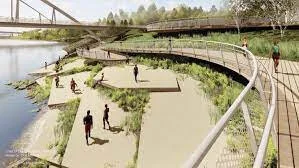
The river valley is a place people have been drawn to and gathered at since time immemorial. The City of Edmonton is exploring ways to improve access to the central river valley with the Touch the Water Promenade project. The project will include opportunities to celebrate heritage, encourage recreation and connect people with nature.

The Touch the Water Promenade project in the Rossdale Area will be moving forward with the next phase of design work. If you live, visit, move through or simply enjoy this area of the river valley, the city wants to hear from you.

Help shape the preliminary design for the Rossdale Area from July 19 to August 3, by engaging in the information and participating in an online survey at
https://www.edmonton.ca/projects_plans/parks_recreation/north-shore-promenade?utm_source=virtualaddress&utm_campaign=touchthewater

tent.jpg

New camp in river valley to serve Edmonton’s homeless
For the third time, non-profit organization Peace Camp YEG has launched a camp to serve Edmonton’s homeless population.

Officially launched on July 10, Peace Camp 3 is intended to be a safe space for those experiencing homelessness and offers shelter, food, and access to harm reduction supplies.

The camp is located at the city’s Indigenous Art Park along Queen Elizabeth Park Road. Volunteers say the camp has returned since Edmonton is still experiencing a shortage of housing programs. Learn more at https://edmonton.ctvnews.ca/peace-camp-yeg-launches-new-camp-in-river-valley-to-serve-edmonton-s-homeless-1.5513631

beaver.jpg

Beavers making a comeback as climate champions
Beavers used to be a prevalent species worldwide, ranging from Scotland to Spain, Syria to Russia, and Canada to Mexico. The fur trade of the 1500s to 1800s saw the creatures hunted to almost extinction, but a recent resurgence of research and lobbying by conservationists has seen their numbers climb again. One study estimates global numbers to be around 10 million, still a far cry from times when they numbered 100 million in North America alone.

The animals are best known for their skill at building dams in rivers, which create wetlands and standing ponds. These changes in the watershed contribute to several improvements in the environment, including better stream quality leading to healthier fish populations, carbon capture via the shallow ponds which hold back silt and sequester the gas, increasing resistance against wildfires, and providing a habitat for other animals.

All this contributes to their status as a keystone species, essentially defined as an animal that multiple other species rely on within an ecosystem. As the world heats up and extreme weather becomes more frequent, scientists have been rushing to reintegrate beavers into struggling ecosystems and dry landscapes. Learn more at https://www.bbc.com/future/article/20210713-the-beavers-returning-to-the-desert

feedback.jpg

Should Edmonton build on its flood plain
Marie writes “TransAlta will release water from Bighorn Dam starting July 22. The river flow will increase over several days, will be higher than seasonal water flows, and like what is experienced during spring melt. Hopefully, there will be no major thunderstorms upstream from Edmonton during this time.

dogs allowed.jpg

This sign is on a riverside path adjacent to the Rossdale water treatment plant. We’re not sure if this is a sign of the past, present or future.

River valley concern or contribution
If you have a river valley concern or question, contact us at nsrivervalley@gmail.com
Your friends and neighbours can sign up for this newsletter on our web site.
If you have a photo, information, or event about Edmonton’s river valley and think it should be in this newsletter, email it to us.

Sincerely yours,
Harvey Voogd
North Saskatchewan River Valley Conservation Society
780.691.1712