NSRVCS News - October 28, 2021

Beaver abundant wherever aquatic habitats are found
Beavers are stocky rodents adapted for aquatic environments. They can make a home anywhere with enough trees and a permanent water supply, such as Edmonton’s North Saskatchewan river valley.

Beavers are primarily nocturnal, meaning most of their feeding and working happens at night. They are active 12 hours each night except on the coldest of winter nights. The phrase busy as a beaver is appropriate. Beavers do not have many predators and normally live up to ten years. It is against Alberta law to disturb or remove a den or lodge without a Damage Control Licence.

Their prominent tail is flattened dorsoventrally, scaled, and almost hairless. It is used as a prop while the beaver is sitting upright and as a rudder when swimming. Beavers also use their tail to warn others of danger by abruptly slapping the surface of the water.

The beaver’s large incisor teeth, bright orange on the front, grow continuously throughout its life. These incisors are beveled so that they are continuously sharpened as the beaver gnaws and chews while feeding, girdling, and cutting trees.

Beavers are not responsible for the stomach ailment, "beaver fever." Beaver fever is caused by the parasite Giardia lamblia and transmitted by drinking water that has been contaminated by an infected person or animal. The most common carriers of the parasite are people, pets, and livestock. Learn more at https://www.alberta.ca/beavers.aspx

Indigenous faces on the buildings in the legislative grounds
Over 9,000 years of complex history exist in the surroundings of what is now the Alberta Legislature. The territory was traditionally a gathering place for Indigenous Nations who came together to hunt and gather, trade, cement alliances, and perform important ceremonies. It was the site of Fort Edmonton and home of a bustling Métis community.

With this vibrant Indigenous history, it makes sense that symbols of Indigenous Peoples are included in buildings on the Legislature grounds. However, these representations had a much different meaning to the settlers of early twentieth century Edmonton.

Settlers believed that Indigenous Peoples could only be successful if they gave up their cultures and adopted the same methods as their white brethren. The so-called vanishing Indian was to be memorialized and encapsulated in the stones of the new Alberta Legislature.

The Indigenous men in the carvings are depicted as wearing headdresses and aging, or near death. These features symbolized the vanishing Indian made possible through Canadian assimilation. The inclusion of headdresses is particularly telling because until 1951, Indigenous Peoples required permission from an Indian Agent to wear headdresses and other regalia, while traditional ceremonies were prohibited. The headdresses represent a historical past.

With this history in mind, one can more fully understand the inclusion of Indigenous figures on the buildings. They serve as a stark reminder of Alberta’s oppressive colonial history and harmful stereotypes which faced, and still face, Indigenous Peoples. Inanimate carvings of Indigenous Peoples were permitted to display traditional and spiritually significant items while living people were restricted from practicing their cultures. Read more at https://citymuseumedmonton.ca/2021/09/21/tokens-of-remembrance-indigenous-faces-in-edmontons-beaux-arts-architecture-1907-1930/

Waskahegan trail spans over 300 kms
This giant trail spans Edmonton and surrounding municipalities, includes public and private land, is maintained by volunteers, and has perfect day hikes for everyone.

Planning for the trail began in 1967 as a Canadian Centennial project under the leadership of Edmonton’s Oil Capital Kiwanis Club. In 1969, the Waskahegan Trail Association was created as a volunteer organization dedicated to building and maintaining the Waskahegan trail around Edmonton and neighboring east and south areas.

Thanks to the volunteer work of members, the generosity of landowners and the assistance of government and non-government organizations, the trail continues to grow. Presently it is 309 kilometres long. The association has amazing weekend guided walking tours that are scheduled on their website https://waskahegantrail.ca/

Beaver in the river valley
Elisabeth writes in response to last week’s letter “I am a biologist who has been interested in beaver since working in Gatineau park north of Ottawa. Beavers are very active in our river in Edmonton and in the Whitemud creek valley. I think in the river they generally build holes in the bank, which provides a warm home in winter. I saw a beaver lodge on the south side of the river last Monday, downstream of the footbridge from Gold Bar park to Rundle park. Paddling the river, canoeists frequently see beavers.”

Comment or contribution
If you have a comment, concern, or question, contact us at nsrivervalley@gmail.com Please also email us river valley photos or event information. Your friends, neighbours and colleagues can sign up for this newsletter on our web site.

Sincerely yours,
Harvey Voogd
North Saskatchewan River Valley Conservation Society
780.691.1712

NSRVCS News - October 21, 2021

New city council and our river valley
Campaign platforms and surveys give some indication about what Edmonton’s new city council thinks about river valley concerns and issues. Edmonton River Valley Conservation Coalition had a lengthy 10 question survey, which can be found on their web site, that five of the elected Councillors answered.

In response to Taproot Edmonton’s question “Do you think city council should have approved Epcor's E.L. Smith Solar Farm”, Mayor Sohi and ten Councillors said “No, I support solar power but that's the wrong location.” Only Sarah Hamilton, who voted in favour of the project, said yes, and no response was received from Karen Principe.

Mayor Sohi promised to ensure Indigenous traditional knowledge informs the preservation and restoration of our natural spaces, including the area around Rossdale and any development that might occur in that area. He also committed to advocate for the full Big Island-Woodbend area in southwest Edmonton to be protected through provincial action in collaboration with the Enoch Cree Nation.

Sohi pledged to work with key partners, including Indigenous communities and regional municipalities, to engage the federal government in creating an urban national park in Edmonton. He said, “The designation of our river valley as a national park will allow us to access federal funds for its protection and elevate our valley’s deserved national reputation.” Read Mayor Sohi’s Embracing Our Natural Environment commitment at https://sohi.ca/policy-embracing-our-natural-environment/

Will wild pigs enter Edmonton’s river valley
Parks Canada has confirmed that wild pigs, which tear up landscapes and eat everything from roots to bird eggs to deer, are present in Elk Island National Park, the only fully fenced national park, located about 40 km east of Edmonton.

According to University of Saskatchewan researcher Ryan Brook, it is only a matter of time before we start seeing the animals, which are a hybrid of domestic pigs and European wild boar, move into cities and towns. A Government of Alberta January 2021 map shows confirmed boar sightings in municipalities and counties adjacent to Edmonton’s western, northern, and eastern boundaries.

There are no native pig species in Canada. Wild boar were imported to Canada in the 1980s and 1990s to be raised on farms but they escaped into the wild and have adapted for forest, wetland, and riverbank habitats

They are large, up to 300 kg, very furry, and make pigloos in the snow to stay warm during the winter season. Pigloos are made by the pigs mounding cattails and burrowing deep into the snow caught by the cattails, creating tunnels within it, and using the snow as insulation.

Wild pigs are reproducing quickly and expanding their range extensively. Their combination of wild and domestic traits, including their high tolerance for cold and ability to birth large litters, “may have bred super pigs,” says Ryan Brook. More at https://www.cbc.ca/news/canada/edmonton/alberta-wild-pigs-breached-park-boundary-1.6207379

Indigenous Peoples Experience at Fort Edmonton Park
The Indigenous Peoples Experience is a new exhibit that opened this summer at Fort Edmonton Park. It is part of a $165 million enhancement project at the river valley park that includes new streetcar tracks and new attractions added to the midway.

The exhibit is an immersive and comprehensive exhibit. It explores the rich and beautiful cultures of First Nations and Métis Peoples while encouraging visitors to seek out the truths as lived by Indigenous Peoples before and after Canada became a country.

Considering September 30 marked the first National Day for Truth and Reconciliation, now is the perfect time to take a walk through the different parts of this exhibit, which include an outdoor hike, a short film about residential schools, a museum detailing the history of Indigenous peoples in Alberta, and a shop with local Indigenous vendors.

The event is open every weekend from noon to 4 p.m. until December, and tickets cost $20 per adult. More at https://www.fortedmontonpark.ca/learn/blog/post/the-indigenous-peoples-experience

Porcupine can swim because of its hollow quills
Porcupines are creatures who slowly, quietly wander our river valley. When the lighting is right, a porcupine's yellow guard hairs give the illusion of a glow all around them. Their quills are hollow, reducing their weight, and making them buoyant swimmers!

This animal's quills are their only defense. It hunches its back with all the quills standing up and lash its tail as the threat approaches. When the predator gets hit by the porcupine’s tail, the barbed quills stick in the predator’s skin and come out of the porcupine.

Historically, First Nations people used porcupine quills to decorate clothing and other objects. Porcupines were also an important source of food. Because of their herbivorous habits, they're usually found in vegetated riparian habitats like mature forests along rivers.

Porcupines keep forests healthy by eating mistletoe, a parasite of trees, and thinning out dense stands of saplings. They climb trees to forage for food. In the summer they eat leaves of trees, shrubs, and plants. In the winter they eat inner tree bark, buds, twigs, and evergreen needles.

Sometimes porcupines chew on leather, bones, and antlers for salt, and to hone their incisors teeth, which can grow 1.5 mm weekly. They are not very social and spend most of their time alone. However, they may share a den in the winter and sometimes forage for food in groups. More at https://www.ealt.ca/species-spotlight-list/porcupine

Beaver in the river valley
Alice writes “I have a naturalist question that might be of interest to other readers: Walking along the trails close to the river edge in the Buena Vista Park area, I have seen a number of trees that seem to have been gnawed on by beavers, a couple were still standing with the distinctive tooth mark chiselling. Surely beaver aren’t trying to dam the North Saskatchewan. Are there in fact any beaver in our river valley? What would they be up to here?”

Comment or contribution
If you have a comment, concern, or question, contact us at nsrivervalley@gmail.com Please also email us river valley photos or event information. Your friends, neighbours and colleagues can sign up for this newsletter on our web site.

Sincerely yours,
Harvey Voogd
North Saskatchewan River Valley Conservation Society
780.691.1712

NSRVCS News - October 14, 2021

logo.jpg
solar.jpg

Where solar energy is a conservation loss
This title begins a 5-page article in the Summer 2021 edition of the Alberta Wilderness Association Journal. The photo of Epcor’s solar power plant construction in the river valley was taken by Eric Gormley on Thanksgiving weekend.

Our society’s position is green energy should not be produced at the expense of Edmonton’s ribbon of green. This project should not have been approved.

The AWA Journal article highlights the work of the Edmonton River Valley Conservation Coalition which filed for judicial review of City Council’s October 2020 decision. The judicial review of Council’s decision will occur November 19.

The grounds for the case arise from a June 2019 Council motion. The first part of that motion required additional engagement activities with the Enoch Cree First Nation. The second part of the motion is the focus of the judicial review application.

It asked for the “work and reporting necessary to allow Council to fully consider whether the location within the River Valley should be deemed essential by Council.” The Coalition thinks Council simply ignored the findings of the work and never did what the motion required, deeming that the project was essential in its river valley location. Read the article, beginning on page 18, at https://albertawilderness.ca/wp-content/uploads/2021/09/Advocate-Summer-2021-Web.pdf

flycatcher.jpg

Alder Flycatcher banded in river valley
The Alder Flycatcher is a rather indistinct olive-green bird with bold wingbars and a distinctive, raspy song of free-beer! They thrive in open settings such as bogs and beaver ponds, where they sit on high perches and forage for insects by flying out from tree perches to take them from leaf surfaces or midair.

Prey include wasps, beetles, flies, butterflies and caterpillars, and grasshoppers. Wintering birds may include fruit in their diet. Alder Flycatchers build an untidy and bulky cup nest of coarse grass. The nest usually has “streamers’ of moss, cattail, and grass hanging from the bottom or the rim of the nest.

The Alder Flycatcher breeds farther north than any other member of the tyrant flycatcher family. It nests as far north as the Kenai Peninsula in Alaska. Little is known about their wintering habitat, since it is difficult to differentiate Alder, Willow, and other Empidonax flycatchers without hearing their songs.

It ranks 12th in the number of bird species banded at Lady Flower Gardens in northeast Edmonton. Learn more at https://www.allaboutbirds.org/guide/Alder_Flycatcher/id

park.jpg

Edmonton park named after this artist
Paul Kane was a largely self-taught artist known for his paintings of Aboriginal peoples and landscapes, which were based on sketches he made during his travels. The photo is his painting of Fort Edmonton. A park in the Oliver neighbourhood is named after him.

Beginning in 1846, with the approval of the Hudson’s Bay Company, he travelled by canoe, York boat, horse, and on foot across the prairies, the subarctic, and mountains with fur-trade brigades or with hired local guides.

Kane’s mission to record the life of Aboriginal peoples was in line with the Victorian imperialist belief that they were all but certain to vanish in the face of relentless encroachment by Western civilization.

He was the first and only artist in Canada to embark on a pictorial and literary project featuring the Country’s Aboriginal peoples, using the medium of portraiture in a time before the dominance of photography. See more at https://www.aci-iac.ca/art-books/paul-kane/key-works/

trail.jpg

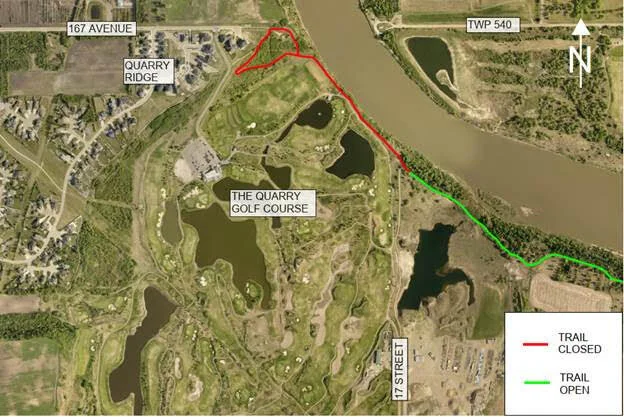
Trail south of 167 Avenue temporarily closed for geotechnical testing
The shared-use path south of 167 Avenue, along the west side of the North Saskatchewan River, will be closed for geotechnical testing from October 15 to October 22, between the hours of 7am to 9pm Monday through Saturday and 9am to 7pm on Sunday.

Boreholes will be drilled along the trail to gather information required for the construction of the Edmonton-Strathcona County Footbridge, which is anticipated to start in the summer of 2022. All holes will be restored after the testing is complete.

Borehole drilling will also occur in the Strathcona County Riverside Nature Trail site during this timeline. No trail closures are planned. All holes will be restored after the testing is complete. Up to date information at www.edmonton.ca/edmontonstrathconafootbridge

feedback.jpg

Saskatchewan Glacier and York boat articles
Mark writes “I much enjoy your weekly report, but you may have a couple of errors in last week's newsletter. First, the implication that the Saskatchewan Glacier is the only glacier that feeds our river. The Mistaya, Howse, and Brazeau rivers (Editor note - which feed into the North Saskatchewan River) all have glaciers in their headwaters.

Second, that the York boat brigades went east in the fall and returned the next spring. My understanding is that they went east or down river in the spring and returned in fall.

comment.jpg

Comment or contribution
If you have a comment, concern, or question, contact us at nsrivervalley@gmail.com Please also email us river valley photos or event information. Your friends, neighbours and colleagues can sign up for this newsletter on our web site.

Sincerely yours,
Harvey Voogd
North Saskatchewan River Valley Conservation Society
780.691.1712