River Valley News - Dec 29, 2022

Peter Erasmus a raconteur who helped shape the Canadian west
Born in 1833, Peter Erasmus was an adventuresome Métis from Red River who found himself in almost every expedition, treaty signing, and mission of importance from the 1850s to the 1870s, sometimes in a key role, at the very least in the background, in the stories that shaped the North-West.
 
Erasmus was a colourful and important character in the events that marked western Canada's transformation from the open buffalo plains of Rupert's Land into townsites and farmsteads. He was a remarkable and highly educated man, fluent in six Native languages as well as English, Latin and Greek, and respected by Indigenous peoples, settlers and explorers.
 
Trained by the church for missionary work, Erasmus instead became one of the "mixed-blood" guides and interpreters who helped shape the Canadian west. His long career as a celebrated buffalo hunter, mission worker, teacher, trader and interpreter made him a legend in his own time. His involvement in such events as the Palliser expedition, the smallpox epidemic of the 1870s, the signing of Treaty Six, and the last big buffalo hunt has ensured his place in history long after his death at the age of ninety-seven.

Erasmus’ book Buffalo Days and Nights is a lively and fascinating account of his experiences, first assembled with the help of Henry Thompson, an Edmonton reporter, in the 1920s. This classic in western Canadian history, available at Edmonton Public Library, offers an insider's view into the events that surrounded the start of a new era. Read one of his stories at http://www.yegtales.ca/erasmus.html
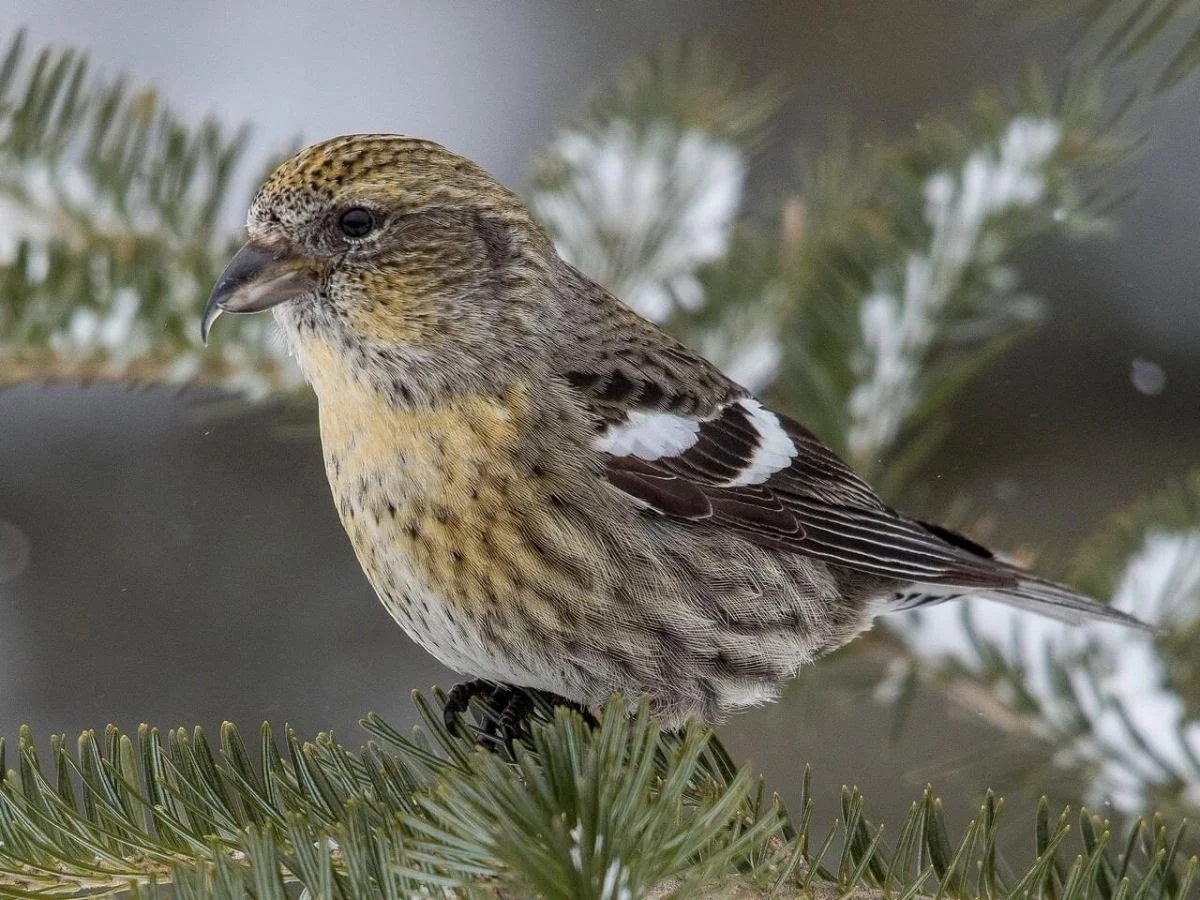
White-winged Crossbill eats up to 3,000 conifer seeds daily
White-winged Crossbills are an irruptive species, meaning that, when cone crops fail in their normal range, they can move far to the south. Their arrival in our area corresponds to the availability of food. The distinguishing characteristic of these birds is their crossed bill, an evolutionary adaptation allowing them to feed on cone crops.
 
White-winged Crossbills feed primarily on spruce seeds, eat up to 3,000 conifer seeds each day, and can be found in the boreal forest year-round. They feed in small flocks which work around treetops animatedly, hanging upside down like parrots, challenging others that come too close, then abruptly flying off to the next tree. They also descend to the ground to gather grit for digestion or to feed on fallen cones.
 
White-winged Crossbills are opportunistic breeders; they can start nesting at any point in the year when food is sufficient for the female to form eggs and raise young. The species has been recorded breeding in all 12 months. Learn more at https://edmonton.wbu.com/white-winged-crossbills-red-crossbills

Winter trails for dogs in the river valley
(Nick Croken photo)
Even in winter, our four-legged friends need fresh air and exercise. Though parts of the river valley are more suitable for snowshoes or cross-country skis in winter, with deep snow that isn’t as friendly for shorter dogs, there are several off-leash parks and trails in the river valley that make for the perfect getaway in the city to burn off your pup’s energy.
 
As with anywhere in the city, off-leash or not, be sure to be a considerate dog owner and scoop the poop, we all share the trails. If you are headed out to trek the trails with your pup in wintertime, make sure they are just as prepared for the elements as us humans are.
 
Here are some of our favourite spots in the river valley to take your dogs, Dawson Park, Hawrelak to Keillor Point, Mill Creek Ravine, Terwillegar Park, and West River’s Edge. These are either off-leash trails or are a trail adjacent to an off-leash park. In both cases, the trails are well-trodden enough by other walkers that you and your pup should not be knee-deep in snow at any point. Information on these trails at https://rivervalley.ab.ca/news/winter-activity-series-winter-pups/

Elk Island only completely fenced national park in Canada
Public interest in conserving rapidly dwindling elk populations lead to the establishment of an elk reserve in 1906. This evolved into Elk Island National Park. The “Island” in Elk Island’s name may have originated as a reference to the picturesque islands dotting Astotin Lake.
 
The park is situated in the Beaver Hills, an area, as the name suggests, abundant in beaver at the turn of the 19th century. What made the Beaver Hills unique was the aspen thickets which surrounded the prairie and provided forage and protection for the wintering herds of bison and year-round population of elk, moose, and deer.
 
Wildlife in the park includes coyote, rabbit, moose, elk, mule deer, hundreds of plain and wood bison, and at least 230 species of birds. Trumpeter swans have been re-introduced to the park. Elk Island has one of the highest concentrations of big game animals in the world.
 
Twenty-three bison were transported from Wood Buffalo National Park to Elk Island in 1965. When disease was detected in the herd, after infected cows produced calves, the cows were destroyed and the calves bottle fed. The wood bison in Elk Island today have descended from these bottle-fed babies. Learn about Elk Island National Park at https://parks.canada.ca/pn-np/ab/elkisland

Talus Dome by Ball Nogues Studio, City of Edmonton public art collection.
https://www.edmontonpublicart.ca/#!/details/61

Comment or contribution
Please note that articles may not reflect the position of NSRVCS. River Valley News is meant to be a clearinghouse for the wide variety of opinions and ideas about Edmonton’s River Valley. Email river valley photos, event information, comments, or questions to nsrivervalley@gmail.com
 
Sincerely yours,
Harvey Voogd
North Saskatchewan River Valley Conservation Society
780.691.1712

River Valley News - Dec 22, 2022

Natural Area Reserve funded, River Valley Trail Strategy not
Council added $3.5 million to the Natural Area Reserve Fund in its capital budget. This modest increase is welcome, but our society recommended $10 million be added as the current $6.5 million in the fund, is in the process of being spent and was part of the original $18 million put in the Fund in 2009.
 
The Natural Area Reserve Fund was created by Council in 2009 with $18 million dollars to fund the purchase of tableland natural areas that cannot be acquired through either environmental reserve or municipal reserve dedication. The City has leveraged the money to acquire six sites containing 70 hectares of natural areas. The two properties in process of being purchased are in Riverview, in ward sipiwiyiniwak, and the other is in Decoteau, which is in ward Sspomitapi.
 
Unfortunately, the River Valley Trail Strategy was not funded in the operating budget. We had received significant community feedback regarding informal and unsanctioned trails in Edmonton’s Ribbon of Green. The lack of a trail master plan has become a contentious public issue, involving both river valley users and residents who live adjacent to our river valley and ravine system.
 
Increased human use of the river valley and ravine system during the pandemic highlighted deficiencies in the city’s trail planning capacity. The modest amount of money required to fund the River Valley Trail Strategy would have expedited a trail master plan to address the current contentious and unaddressed public concerns. Read our budget presentation at https://www.edmontonrivervalley.org/projects

River valley cross-country ski trails open
The word ski comes from the Old Norse word skíð which means stick of wood. Skiing started as a technique for traveling cross-country over snow on skis, starting almost five millennia ago with beginnings in Scandinavia. It may have been practised as early as 600 BCE in what is now China.
 
Early historical evidence includes a 550 CE description of Sami people as skrithiphinoi translated as "ski running samis". A 950 CE saga describes King Haakon the Good’s practice of sending his tax collectors out on skis. The 1274 Gulating law stated that "No moose shall be disturbed by skiers on private land.”
 
Early skiers used one long pole or spear in addition to the skis. The first depiction of a skier with two ski poles dates to 1741. Traditional skis, used for snow travel in Norway and elsewhere into the 1800s, often comprised one short ski with a natural fur traction surface, the andor, and one long for gliding, the langski, one being up to 100 cm longer than the other, allowing skiers to propel themselves with a scooter motion.
 
Edmonton’s river valley is home to cross-country ski trails that are open to everyone, regularly groomed and varied to accommodate all different levels of skiers. Check trail options and conditions at 
https://www.edmonton.ca/activities_parks_recreation/cross-country-skiing

Abraham Cristall bust honours historically prominent Edmontonian
(Girl Named Shirl Photography)
Located on the Heritage Trail along Victoria Promenade is a bronze bust of Abraham Cristall. He and his wife Rebecca, Edmonton’s first Jews, arrived in 1893. Abe became a successful businessperson and helped to bring more Jews over from his native Bessarabia in Eastern Europe. By 1901, there were 17 Jewish citizens in Edmonton.
 
In 1907, Cristall purchased land on the south side in the Forest Heights neighbourhood for a Jewish cemetery and the Chevra Kadisha, or burial society, was formed. In 1912, the foundations were laid for the community’s first synagogue, the Beth Israel, on the corner of 95th Street and Rowland Road (now St. Boniface Catholic Church). Abe served as the first president.
 
Cristall was a prominent businessperson, owner of the Grand Hotel and proprietor of The Cristall Palace, a men’s clothing store. He was a prominent booster of Edmonton’s economic potential, a popular entrepreneur, and a community leader. His outward vision maintained contact between the Jewish community and the community at large. Learn more at http://www.yegtales.ca/cristall.html

Toboggan existed before settlers came to Turtle Island
Harry writes “I was enjoying reading the article and was interested in the author's pronunciation of the indigenous word, which I had seen before with slightly different phonetics. However, then came the very mistaken concluding statements. Olympic sports are performed on European sleds which have runners and they never have had anything to do with North American flat toboggans.”
 
Resonant Progression
Melanie emailed “Great newsletter. I’ve never really looked at Terwillegar’s art from that angle. I know now why growing up in Europe I had never heard of a toboggan. I’m looking forward to possibly doing some bush beating on Sunday. And I hope to learn which of those 250 endangered wild species would do well in my food forest and soon to be designed wild backyard! 

12 days of Noels in the Mill Creek Ravine Park
Schoen Duo is celebrating 12 old French Noels, at 12 spots in Mill Creek Ravine, over 12 days from December 25 to January 5. If you can’t get to the park, you can link to a new video with music each day from their web page. Information at https://www.schoen-duo.ca/soundscape-projects-2/12-days-of-noels-project/
 
Comment or contribution
Please note that articles may not reflect the position of NSRVCS. River Valley News is meant to be a clearinghouse for the wide variety of opinions and ideas about Edmonton’s River Valley. Email river valley photos, event information, comments, or questions to nsrivervalley@gmail.com
 
Sincerely yours,
Harvey Voogd
North Saskatchewan River Valley Conservation Society
780.691.1712

River Valley News - Dec 15, 2022

Outdoor skating, iceway skating trails and ice rinks open

Skaters have choices for public outdoor ice-skating surfaces in Edmonton. The City maintains both ground and pond ice rinks in major parks, as well as two Iceway Skating Trails. Residents can lace up their skates and experience Edmonton's river valley ice rinks now that Victoria Oval and Iceway, Hawrelak Park, and Rundle Park Iceway have opened for the season.

The Victoria Park IceWay is a skating trail wrapping through the majestic forests of Victoria Park offering visitors a magical and enchanted winter experience in the heart of downtown Edmonton. Rundle Park IceWay features a shinny pond, a large tableland ice skating surface and a smaller family rink.

Rundle Park IceWay is connected to picnic shelters and warming huts for an enjoyable, family-friendly skating experience in the River Valley. Information about City outdoor skating surfaces, pavilion hours and ice conditions at https://www.edmonton.ca/activities_parks_recreation/outdoor-ice-rinks

Lucien Dubuc the first judge in Alberta to hear a case in French

(Girl Named Shirl Photography)

Located on the Heritage Trail along the Victoria Promenade, a bronze bust of Lucien Dubuc looks out towards the river. Originally from Saint-Boniface, Manitoba, Lucien came to Edmonton in the 1890s to practice law.

By 1920, Dubuc had been appointed to the Alberta District Court Bench, beginning a career that culminated in his appointment as Chief Justice of Northern Alberta. Lucien is most famous for being the first judge in Alberta to hear a case in French.

Lucien Dubuc lived in Oliver and loved gardening. On the steep hillside above Victoria Park and golf course, he laid out, for the enjoyment of the public, his dream. According to historians, he planted over a hundred elm and evergreen trees, perennials, and berry bushes. He decorated the garden with building stones, iron arches, and rustic furniture. Little remains today except the elm and evergreen trees. More at https://www.edmontoncommonwealthwalkway.com/storyline/history/60

Conservation gardens can provide refuge for Canada’s plummeting biodiversity

Tending a garden can be a radical act. For a growing number, gardening is a grassroots effort to restore damaged ecosystems and reconcile our relationship with the land. The photo is of the Natural Spaces winner in Edmonton’s 2022 Front Yards in Bloom

The planet is experiencing unprecedented biodiversity loss. A 2022 report from WWF Canada cites dwindling access to healthy, intact habitats as a major factor limiting species recovery. Put simply, wildlife is running out of places to live. Cities are now the fastest growing ecosystem in the world, projected to cover 1.9 million square kilometres by 2030 and 3.6 million square kilometres by 2050.

Plants form the foundations of ecosystems. They take in sunlight and carbon dioxide, and in return provide oxygen, food and habitat for everything else. But these foundations are crumbling under human-caused pressures such as industrial activity, invasive species, urbanization, agriculture, a warming climate.

Of the more than 500 species at risk in Canada, 250 are wild plants. When these plants are gone, everything that relies on them eventually goes too. Read more at https://canadiangeographic.ca/articles/how-does-your-garden-grow/

Toboggan existed before settlers came to Turtle Island

Long before settlers arrived, Indigenous people used handcrafted toboggans to transport people and goods across the snowy tundra. Toboggans were long, but narrow, pulled by a man or woman wearing a chest harness or, if available, sled dogs. The significance of the width was that a narrow sleigh could fit easily inside a snowshoe trail.
The word toboggan likely originates from the word for sled by the Mi’kmaq - tobâkun or Abenaki - udãbãgan. French Canadians adopted the word in the early 1800s but spelled it tabaganne. Settlers were quick to adopt the use of toboggans for transport, hunting and fur trading ventures, but soon realized it could be used for recreation as well. It became a popular sport in the late 1800s. Clubs, such as the Montreal Tobogganing Club, founded in 1881, sponsored meets and competitions.

This recreational past-time has also evolved into serious competitive sports. Three modern Olympic sports were born out of downhill tobogganing: bobsledding, luging and skeleton racing. Hill conditions and safety tips on City toboggan hills in the river valley at https://www.edmonton.ca/activities_parks_recreation/toboggan-hills

Participate in YEG’s Christmas bird count on December 18

Liz writes “Thanks as always for a great newsletter. I will be bush beating this year, again.  Wonderful to be part of a program that has been going for more than 65 years in our community.”

Resonant Progression by Royden Mills, City of Edmonton public art collection. Photo by R. Mills. https://www.edmontonpublicart.ca/#!/details/223

Comment or contribution

Please note that articles may not reflect the position of NSRVCS. River Valley News is meant to be a clearinghouse for the wide variety of opinions and ideas about Edmonton’s River Valley. Email river valley photos, event information, comments, or questions to nsrivervalley@gmail.com

Sincerely yours,

Harvey Voogd

North Saskatchewan River Valley Conservation Society

780.691.1712