River Valley News - Feb 9, 2023

United Nations features Sherilee Harper from University of Alberta

February 11 is International Day of Women and Girls in Science. Did you know women are typically given smaller research grants than their male colleagues and, while they represent 33.3% of all researchers, only 12% of members of national science academies are women. In cutting edge fields such as artificial intelligence, only one in five professionals (22%) is a woman.

A significant gender gap has persisted throughout the years at all levels of science, technology, engineering and mathematics (STEM) disciplines all over the world. Even though women have made tremendous progress towards increasing their participation in higher education, they are still under-represented in these fields.

One of the women featured by the United Nations is Sherilee Harper, Associate Professor in the School of Public Health at the University of Alberta. Her research investigates associations between weather and Indigenous health in the context of climate change. She collaborates with Indigenous partners to prioritize climate-related health actions, planning, interventions, and research.

Harper co-leads the Indigenous Health Adaptation to Climate Change (IHACC) program, an international research initiative that works closely with Indigenous peoples and their organizations in the Canadian Arctic, Ugandan Impenetrable Forest, and the Peruvian Amazon. The program aims to utilize science and Indigenous knowledge to strengthen health systems in a rapidly changing climate, within three areas: food security; malaria; and foodborne and waterborne disease. Learn more https://www.un.org/en/observances/women-and-girls-in-science-day?mc_cid=ac785272d1&mc_eid=b02c6f60ed

Are Hawrelak Park trees the canary in the coal mine

Bob Priebe, former Director of Parks Planning at the City of Edmonton, asks in a recent post if the proposed Hawrelak Park tree cutting may be the proverbial ‘canary in the coal mine’. He says “The loss of trees at Hawrelak represents a symptom, the expansion of neoliberal policy applied to community projects, that prioritize efficiency of the construction process, and minimizing the cost of government.

The real and human cost of relocating festivals borne by our park co-production partners, festival goers and park visitors is hard to quantify, but nevertheless real. It appears there was no single voice for parks, it was passed between silos.

I have confidence in this group of councillors who have demonstrated a broad people orientated approach to sustainable city building. Has that message been adopted by the Administration?” Read complete piece at https://robertpriebe.substack.com/p/william-hawrelak-park-closure-are 

Three easy to grow wildflowers plus one challenging plant

Wild Bergamot, Slender Blue Beardtongue and Golden Aster are easy to grow perennial native plants. They can be grown from seed but will be small plants the first year because they like to establish a strong root system before they put energy into top growth. In their second year they put on a nice growth spurt and flower.

Wild bergamot is a member of the mint family but will not spread like mint. This is a bushy, medium-tall plant that adds more flowering stems each year. Slender Blue Beardtongue is a short, spring-blooming plant and the blooms come in an array of shades of blue, purple and even pink. Golden Aster is a small plant with sunshine yellow flowers and soft grey-green leaves.

Purple Prairie Clover are medium height and have fine textured foliage and narrow spikes of vivid pink flowers. If you would like to take on the challenge of growing this vibrant flower you will need a south-facing sunny slope, and sandy soil. Add some gravel and a good amount of compost to the planting hole. Plant information https://cdn.sanity.io/files/d59screl/production/a09af6fe35d8efb0ec2e662c3f03009f8349a5ac.pdf

ABMI hiring up to 40 summer field techs

Are you interested in being part of a world-class biodiversity monitoring program? Do you want to spend your summer travelling through Alberta’s landscapes, contributing to understanding of Alberta’s natural world, potentially helping discover new species, and getting paid for all of it? Then apply by February 27 to the Alberta Biodiversity Monitoring Institute (ABMI)

Summer field technologists are the backbone of the ABMI. Every spring the ABMI’s Monitoring Centre hires field technologists to collect information on the state of biodiversity across the province of Alberta. This information is used by various stakeholders, including government and industry, to facilitate responsible management of Alberta’s living resources.

Summer field technologists conduct surveys at confidential ABMI site locations. Successful applicants may work in the Ecosystem Health Program, or Oil Sands Monitoring program. Sites are located across a wide range of terrain, from boreal forests in the north, to the Rocky Mountains in the west, to prairie and grasslands in the south. Information https://abmi.ca/home/careers/field-monitoring-positions.html?mc_cid=ac785272d1&mc_eid=b02c6f60ed

Let’s rethink Hawrelak Park plan

Sandra writes “Cutting down trees that help the environment is unacceptable. Thank you for posting.”
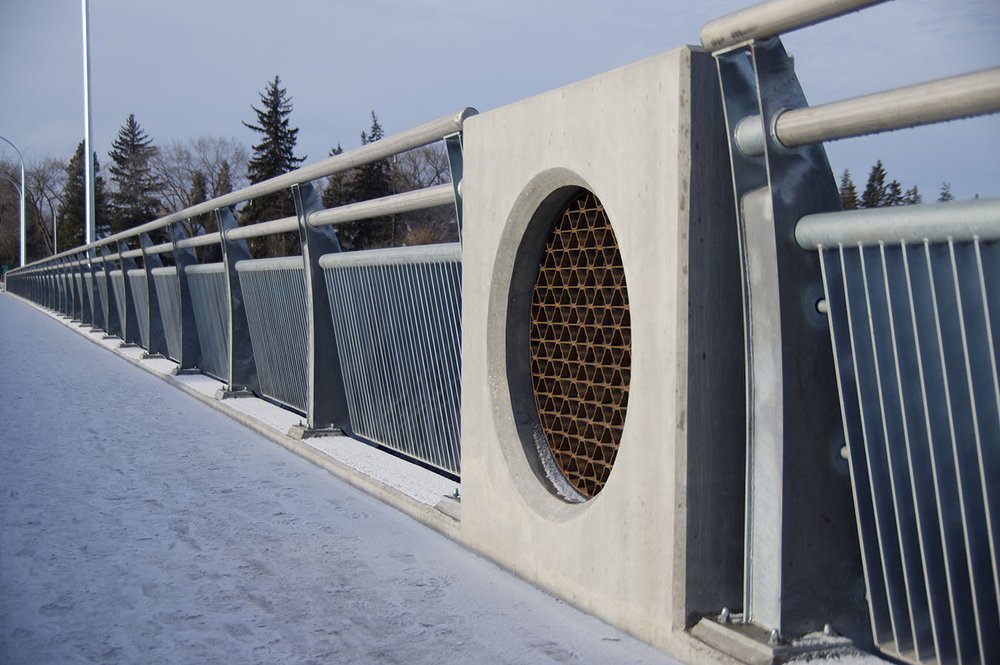
now & then by Faye HeavyShield, 102 Avenue Bridge. Doyle C. Marko photo. https://www.edmontonpublicart.ca/#!/details/213

Comment or contribution

Please note that articles may not reflect the position of NSRVCS. River Valley News is meant to be a clearinghouse for the wide variety of opinions and ideas about Edmonton’s River Valley. Email river valley photos, event information, comments, or questions to nsrivervalley@gmail.com

Sincerely yours,

Harvey Voogd

North Saskatchewan River Valley Conservation Society

780.691.1712

River Valley News - Feb 2, 2023

Let’s rethink Hawrelak Park plan

At its Jan 31 meeting, Council passed a motion “That Administration provide a report to committee with lessons learned on changes to the scope of the environmental impact on mature trees and share the plan for tree management for the William Hawrelak Park Rehabilitation project.”

That same day, an opinion piece in the Edmonton Journal argued the public should have the opportunity to respond to recent news that the Hawrelak Park rehabilitation project proposes to cut down 220 trees. The authors stated if a park project requires the cutting of 220 trees, then there’s a problem with that project and it should not proceed.

According to Kristine Kowalchuk and Lloyd Cardinal, the tree-cutting plan was not included in the project’s environmental impact assessment (EIA) that city council approved in spring 2022. The park is scheduled for closure on March 13, and the tree cutting would begin shortly thereafter.

There is also concern that the city’s Indigenous Relations Office “confirmed that targeted engagement with Indigenous communities would not be required given that the park is a developed, manicured park with limited natural areas.”

In other words, since Hawrelak Park is not “wild,” no Indigenous engagement was required. How is this acceptable when the entire river valley is an important cultural area? The EIA itself notes that the area has a “high potential to contain a historic resource.” Opinion piece at https://edmontonjournal.com/opinion/columnists/opinion-lets-reconsider-hawrelak-park-construction-project

Elegant railway station heralded YEG’s connection to the world

In 1905, the Canadian Northern Railway (CNoR) reached Edmonton just as Alberta became a province. The rail line crossed the North Saskatchewan River at Fort Saskatchewan, coming into the city from the northeast, following the present-day LRT track to the new railway station on the northwest corner of First St and Mackenzie Ave, today’s 101 St & 104 Ave.

Edmontonians had been anticipating their own railway station since the first train steamed into Strathcona in 1891. Strathcona arose when the first railway north from Calgary terminated at the south riverbank, much to the chagrin of the town of Edmonton on the north side, and to the delight of southsiders who quickly formed a burgeoning rival community.

The CNoR station, completed at a cost of $35,000, was one of the largest stations west of Winnipeg. The red-brick and Tyndall stone structure became a picturesque Edmonton landmark. Under a veranda with projecting eaves, typical of the Prairie style of architecture, passengers found waiting rooms, ticket offices, baggage room, and stores. The second floor accommodated offices and the living quarters for the station agent.

Demand for rail service in Edmonton grew and in 1928 a new station was built. The 1905 station was then used for office space and a bunkhouse for trainmen, before it was demolished to make way for a modern freight terminal building in 1952. More photos https://www.edmontonsarchitecturalheritage.ca/index.cfm/structures/canadian-northern-railway-station-1905/

Scattering cremated remains permitted in YEG open waterways

(Mack Male Photo)

In 2019, the Province of Alberta announced it was no longer prohibiting the scattering of cremated remains in waterways. The City of Edmonton decided to align with the Province's decision and allow the scattering of cremated remains in open waterways. This includes the North Saskatchewan River as well as any creek and ravine.

This practice is open to everyone at no cost during park hours and is an opportunity for Edmontonians of all cultural heritages to honour their loved ones. Family members can be true to their cultural and spiritual heritage and honour their deceased family members without worrying about breaking the law.

For ceremonies with attendees of 50 or more, a permit must be obtained. Scatterings are only allowed from May to October due to safety around the North Saskatchewan River and ravines.

The North Saskatchewan River, ravines and creeks are the only open waterways within Edmonton boundaries, and the only place the public can scatter cremated remains in the city. Scattering in closed waterways like ponds and lakes in parks and stormwater ponds is not permitted. Information at https://www.edmonton.ca/activities_parks_recreation/parks_rivervalley/scattering-cremated-remains-in-waterways

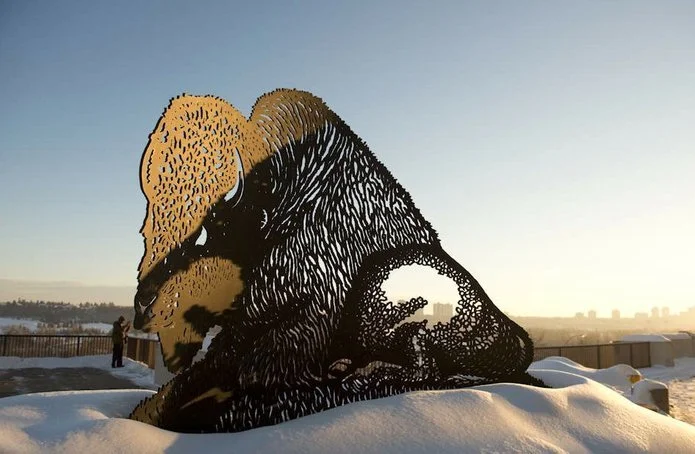
Paskwamostos by Joe Fafard, Lookout deck on the south side of the Edmonton Convention Centre

https://www.edmontonpublicart.ca/#!/details/81

Comment or contribution

Please note that articles may not reflect the position of NSRVCS. River Valley News is meant to be a clearinghouse for the wide variety of opinions and ideas about Edmonton’s River Valley. Email river valley photos, event information, comments, or questions to nsrivervalley@gmail.com

Sincerely yours,

Harvey Voogd

North Saskatchewan River Valley Conservation Society

780.691.1712

River Valley News - Jan 26, 2023

A Little Bit Ritchie podcast celebrates community’s 100th Anniversary

In September 2022, the Ritchie Community League celebrated its centennial. A unique part of the year long celebration was the podcast A Little Bit Ritchie, which shared stories of the past 100 years of the league and neighbourhood. The seven episodes range from Mill Creek Ravine and Gainers Meatpacking Plant to playgrounds.

The site of the 96th street condos, which overlook Mill Creek Ravine, was once home to the gigantic Gainers slaughterhouse, a keystone of Ritchie’s economic and social landscape. This episode discusses Gainers’ success within the greater context of meatpacking and in relation to the Ritchie community. It also delves into the infamous 1986 Gainers strike.

Did you know that in the early days of the twentieth century, city dwellers across Canada and the United States learned of a new phenomenon that pledged to reduce crime, increase morality, and improve public health, the playground. This episode uncovers how and why playgrounds and park spaces became essential to the health of our neighbourhoods, children, and society. Listen to A Little Bit Ritchie https://www.ritchie-league.com/a-little-bit-ritchie

Protect nature and sustainable ecosystems as an EALT board member

The Edmonton and Area Land Trust (EALT) is accepting applications to join its Board of Directors. The application deadline is February 12. EALT works to protect natural areas to benefit wildlife and people, and to conserve biodiversity by engaging volunteers and communities. It currently stewards 15 lands in the Edmonton region, with most of these lands open to the public to visit.

EALT is looking for individuals active and engaged in their field or community and have a genuine interest in its vision and mission. You embrace its core values of collaboration, integrity, accountability, and innovation. You have knowledge or experience with boards and non-profits, and are committed to good governance.

The EALT board strives for a governance team that is diverse and has the right mix of characteristics, skills, and experience. Current priorities for board recruitment include emerging leaders and individuals from Edmonton’s diverse Indigenous and cultural communities, the charitable sector, energy and resource sectors, land use planning, environmental planning, communications, and fundraising. Board information https://static1.squarespace.com/static/569ec99b841abaccb7c7e74c/t/63b86d4311889069e10c043d/1673030979202/Join+EALT%27s+Board+of+Directors.pdf

YEG’s first bridge, the Low Level, was built to provide rail service

The prime motivation for building the Low Level Bridge was the need to provide a rail connection between Strathcona and Edmonton. Designed and built in 1900 for rail traffic by the Federal Government, it carried only pedestrians and horses and wagons for its first two years.

The first train, from the Edmonton, Yukon and Pacific Railway (EYPR), crossed the bridge arriving in downtown Edmonton on October 20, 1902. A second 5.1 km track from the bridge to the Canadian Northern Railway, in what is now known as the Edmonton Brewery District, was made in 1905. The railway tracks were removed from the Low Level Bridge in 1954.

One of Edmonton’s most famous pictures is of a train acting as ballast on the Low Level Bridge to prevent it from being washed away during the 1915 flood. More photos https://csce.ca/en/historic-site/edmonton-pacific-and-yukon-railway-and-low-level-bridge/

Silver Skate Festival returns Feb 10-20 to Hawrelak Park

Edmonton’s longest running winter festival celebrates prairie winter life and creates winter experiences for Edmontonians of all ages. The Silver Skate Festival is a free 10-day family-oriented festival that combines culture, art, education, sport, and recreation.

Feel the breeze on your face as you glide along the city's largest skating pond while listening to a tuneful compilation of Edmonton-based music. Marvel at the artistic talent on display in the snow sculpture garden. Be dazzled by roving performers and experience renewal by writing out a fear or a wish to be added to the nightly fire sculpture burn.

Visit the Indigenous pavilion in the heritage village which includes installations, stories, and a Winter Walking Ceremony. Push yourself, or a team comprised of family and friends, to frosty victory in the Duathlon or Winter Triathlon. All types of skate blades and skill levels are welcome. Event information https://silverskate.ca/

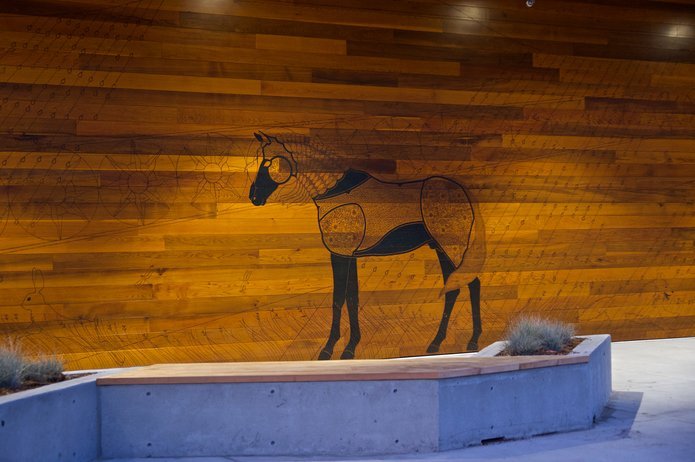
Heart of the Valley by Black Artifex, Whitemud Equine Learning Centre https://edmontonpublicart.ca/#!/details/217

Comment or contribution

Please note that articles may not reflect the position of NSRVCS. River Valley News is meant to be a clearinghouse for the wide variety of opinions and ideas about Edmonton’s River Valley. Email river valley photos, event information, comments, or questions to nsrivervalley@gmail.com

Sincerely yours,

Harvey Voogd

North Saskatchewan River Valley Conservation Society

780.691.1712