River Valley News - March 23, 2023

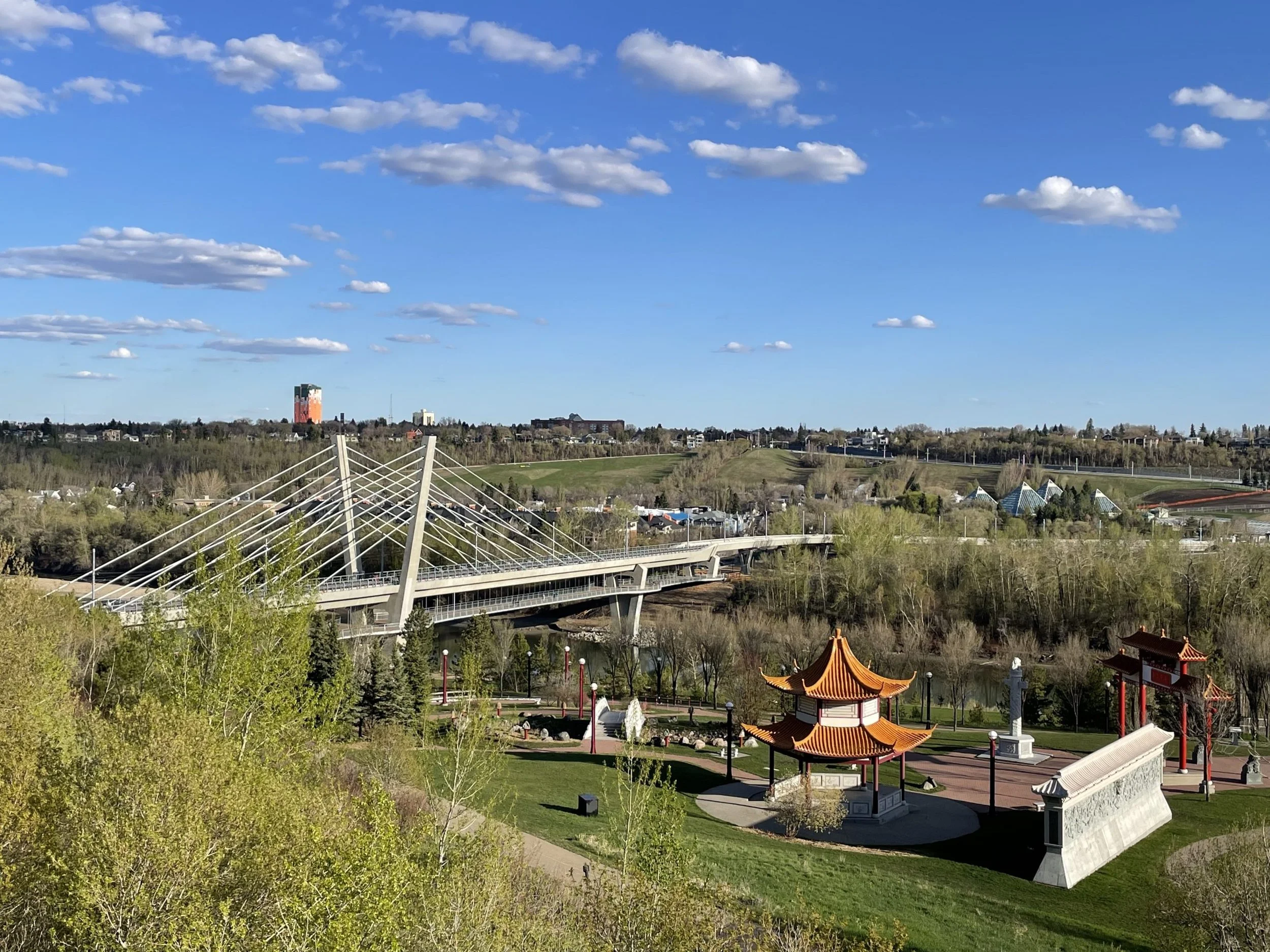
Nature-based solutions for successful river valley zoning

Our recent AGM featured a presentation by former City of Edmonton Director Grant Pearsell on how including Nature-based Solutions for the River Valley in the City’s Zoning Bylaw Modernization Project would enable ecological conservation & restoration, increase climate resilience, and save money.

He recommended the city create a Natural Area Conservation and Restoration Zone whose purpose is natural area conservation, restoration, and ecological connectivity. It would allow minimal and compatible uses and include intact natural areas and areas identified to be restored.

A Riparian Setback Regulation applicable to all river valley zones is important as conserving riparian areas is necessary for ecological functioning rivers. Development setbacks are commonly used in zoning bylaws to manage development and these regulations can be applied to any zone.

Climate change means a Flood Disaster Reduction Zone or Restrictive Overlay is needed to limit development in the floodplain and restore natural landscape. This could be achieved by amending the existing Floodplain Protection Overlay.

Additions to general regulations for the river valley should include wildlife friendly fencing, native plantings and landscaping, and inclusive and transparent Environmental Impact Assessment regulations. The 37-minute presentation can be viewed at https://www.youtube.com/watch?v=MaAlsQDc5dk
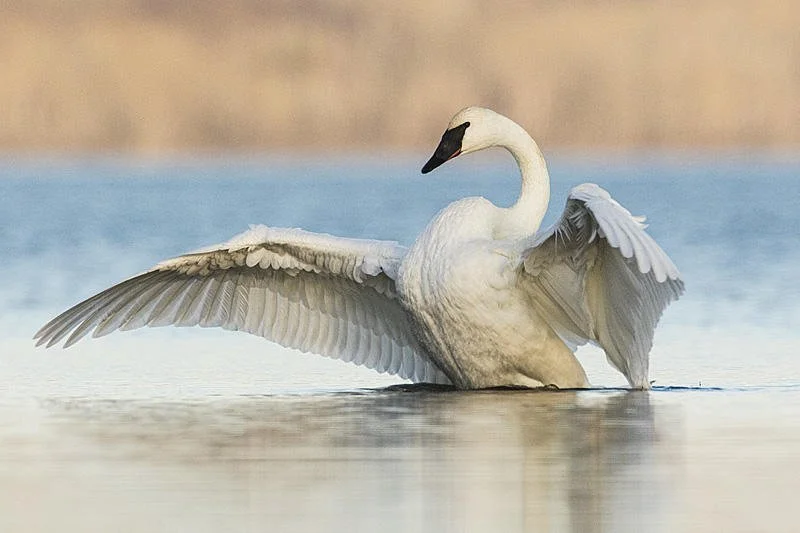
Tundra and Trumpeter swans are Canada’s swan sweethearts

Gerald Romanchuk photo

Tundra and trumpeter swans are migratory birds whose reputation for being lovebirds is well earned. Both birds often form a pair bond for life. These pairs are forged when the swans are young adults, usually between the ages of 3 and 6. Swans can live until they’re up to 30 years old, so finding the right one for them is no trivial endeavour.

To win the affection of their chosen partner, Trumpeter swans court by swimming alongside each other, usually with the male bumping the female with his breast on her flank, with both bobbing their heads. They then face each other, sometimes even making the iconic heart shape between their two graceful necks. Trumpeter Swans are our biggest native waterfowl, stretching to 6 feet in length and weighing more than 25 pounds, almost twice as massive as a Tundra Swan.

Tundra swans usually face each other, vocalizing one after the other in quick succession, all while half-flapping their wings, which eventually results in a larger wing-flare once the ritual is complete. Tundra swans don’t nest directly after finding a mate, instead staying together during the first breeding season without producing a nest. They do, however, protect a territory in this time, and actively drive away any interlopers. More at https://www.ealt.ca/blog/fun-facts-love-is-in-the-air
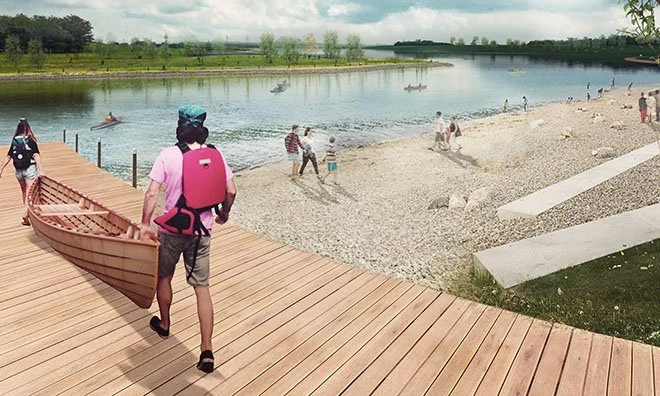
Master plan for Strathcona County Regional Park finalized

Located north of Township Road 540, where the new River Valley Alliance pedestrian bridge will connect to 167 Ave in Edmonton, this Regional Park is being promoted as a regenerative riverside park, which balances outdoor recreation nature appreciation and historical recognition, while fostering a healthy connected river valley system. It will reach across two quarter sections, or 290 acres, of land.

Previously used as a gravel quarry, North River Park, will be the key wildlife biodiversity zone, where forest and riparian restoration will take place. Construction includes topographic diversity, with hills created from earthmoving operations around wetlands. Within this portion, a north flood park will be developed, which will be designed to handle a one-in-one-hundred-year flood.

In South Wetland Park, existing ponds will be modified for wetland restoration. “The wetlands are one of the most unique aspects of this property, so developing boardwalks and pathways on the edges of them and through them will create really wonderful experiences and educational opportunities for school groups and visitors to the region,” according to the lead architect, Matt Williams.

The Central Gathering Place will have a visitor pavilion with outdoor seating, an adjacent plaza for community and school gatherings and a natural playground that uses the terrain for different play experiences. Connecting all three spaces will be the trail networks, which will focus on usage in all four seasons, so cross-country ski trails will be added.

“As the ecosystems start to regenerate we’ll have these wonderful loops of natural trails within forests, shrub-land, and grasslands, which all have the opportunities to have interpretative signage and diversity of experience to really enjoy and connect people with nature,”  said Williams. Learn more at https://sherwoodparknews.com/news/local-news/a-profound-opportunity-regional-park-master-plan-released-with-76-7m-price-tag
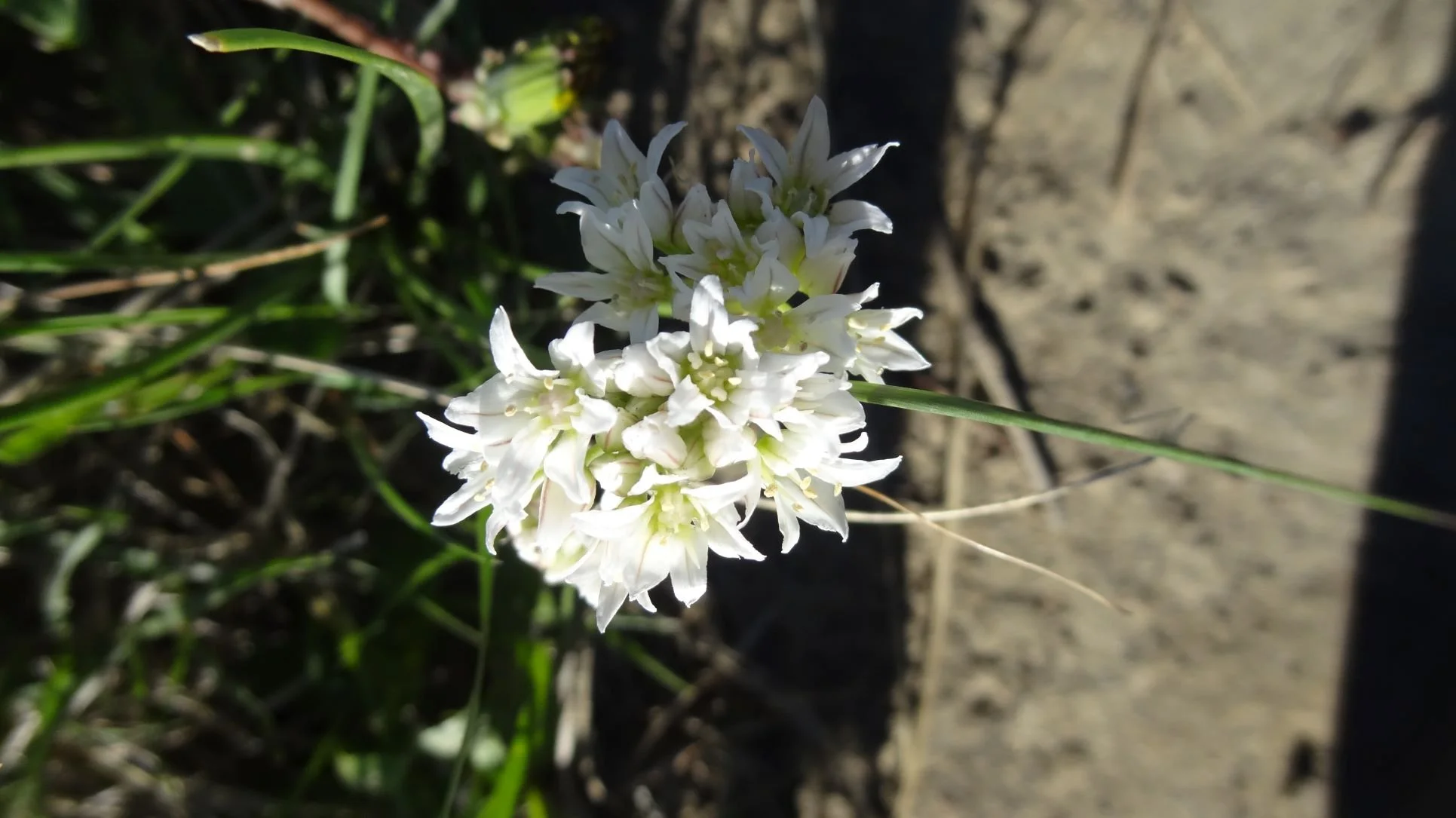
All parts of this native wild onion are edible, including its flowers

Allium textile, or textile onion, is a native wild onion. Chive like stems give rise to beautiful upright clusters of white flowers in late spring and early summer. Prairie onion is a member of the garlic family and is tolerant of hot, dry conditions making it ideal for xeriscaping or full sun beds. Hummingbirds are attracted to the flowers as are bees, and songbirds will happily eat the seeds that fall to the ground.

All parts of the plant are edible but care should be taken as mild toxicity has been reported if too much is eaten. The bulb can be eaten fresh, raw or cooked, or can be stored for later use. The leaves are good raw or cooked and the flowers can be used as a garnish on salads. Allium species usually grow well with roses, carrots, beet and chamomile.

Allium textile is a healthy addition to the diet. They contain sulphur compounds, which give them their onion flavour, and added to the diet on a regular basis help reduce blood cholesterol levels, act as a tonic to the digestive system and tonify the circulatory system. More at https://temperate.theferns.info/plant/Allium+textile

River Valley Trivia

Ron writes “I always enjoy your river valley news. Thanks for doing it. Here's a bit of river valley trivia. I remember, in the 1950s or 60s, the City of Edmonton created a rock garden beside Grierson Hill Road. In those days, that road was a source of constant frustration, as it kept sliding downhill. It finally was stabilized, I don't know how, and I don't know whether the rock garden had anything to do with it. Whether it ever had flowers planted between the rocks, I don't recall. But it soon was forgotten, abandoned, and untended. However, it's still there. On the uphill side of Grierson Hill Road, just south of the Convention Centre, you still can see the array of rocks, with all kinds of weeds and small trees growing up among them.”
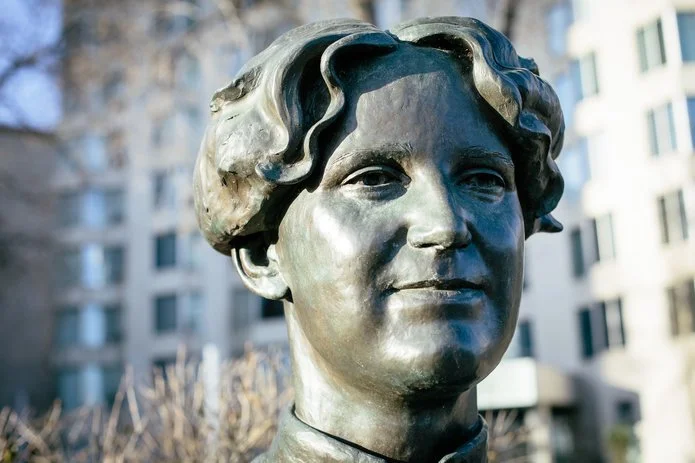
Bronze Bust of Nellie McClung by Danek Mozdzenski, Victoria Promenade. Girl named Shirl Photography https://www.edmontonpublicart.ca/#!/details/246

Comment or contribution

Please note that articles may not reflect the position of NSRVCS. River Valley News is meant to be a clearinghouse for the wide variety of opinions and ideas about Edmonton’s River Valley. Email river valley photos, event information, comments, or questions to nsrivervalley@gmail.com

Sincerely yours,

Harvey Voogd

North Saskatchewan River Valley Conservation Society

780.691.1712

River Valley News - March 16, 2023

Hares now found in most YEG neighbourhoods

Hares belong to the Lagomorph family, a family that also includes the mountain-dwelling pika. One of the interesting characteristics of this family is that individuals produce two types of fecal pellets: dry and moist. The dry ones are expelled and left behind. The moist pellets, called cecotropes, are expelled but immediately re-ingested so remaining nutrients can be absorbed.

Alberta has two types of hares, snowshoe hares and white-tailed jackrabbits. Despite their name, white-tailed jackrabbits are our largest hares. Hares tend to peak every 10 years. Baby hares, called leverets, are born with fur, can see, and are mobile within an hour of birth. Hares do not keep a customary den, but will find or dig out shallow depressions, called forms, for resting and birthing their young.

Hares change from brown in the summer to white in the winter and will readily dine on bark and twigs. They will hide among and under rocks, outbuildings, hollow logs, and other covered spaces. When faced with danger, hares usually try to run away and outmanoeuvre their pursuers.

Hares tend to pair up only to mate and are widely distributed across the prairie and parkland regions of the province. They have found cities so much to their liking that university campuses, parks, and most urban neighbourhoods in Edmonton now support large populations. More at https://naturealberta.ca/rabbits-and-hares/

Beaver Hills designated as a UNESCO biosphere in 2016

A biosphere is the natural shape of an ecosystem. Within the distinct contours of the Beaver Hills rests about 1600 sq km of terrain. It stretches over 21 Alberta townships, extends into parts of 5 different counties and is home to more than 13,000 people. As an oasis of boreal mixed wood forest and wetlands within the Beaver Hills sub watershed, it’s also a critically important home to a vital ecosystem sustaining over 300 species of wildlife.

A United Nations Educational, Scientific and Cultural Organization (UNESCO) designation is international recognition of a community striving to preserve balance with nature. It acknowledges a collective commitment to protecting significant habitats through conservation and sustainable economic development.

Federal and provincial legislation protects a green core consisting of Elk Island National Park and Miquelon Lake Provincial Park. These parks are supported by a buffer of recreation areas, a game bird sanctuary and an abundance of parcels set aside by municipal governments and private land trusts. Together the core and buffer areas keep nearly 1/3 of the Beaver Hills safe from development pressure.

Biospheres are also containers of historical and cultural significance. The Beaver Hills are full of old stories and were of central importance to Indigenous peoples who relied on this diverse ecosystem for shelter, hunting and natural resources. These hills are part of Treaty 6 territory. Watch A Biosphere in Our Own Backyard https://www.beaverhills.ca/explore/videos

Sedum lanceolatum a succulent plant that thrives in dry exposed sites

Sedum lanceolatum is a species of flowering plant in the family Crassulaceae known by the common names spearleaf stonecrop and lanceleaf stonecrop. It is native to western North America, including Alberta. It is a succulent plant.

Succulents are drought resistant plants with parts that are thickened, fleshy, and engorged, usually to retain water.  Succulents are characterized by their ability to thrive on limited water sources, such as mist and dew, which makes them equipped to survive in an ecosystem that contains scarce water sources.

This flowering plant is the host plant of the butterfly species Parnassius smintheus or Rocky Mountain apollo, a high-altitude butterfly found in the Rocky Mountains. The butterfly primarily feeds on the leaves of the plant as larvae and on its nectar as adults. The plant produces a deterrent so that herbivores do not feed on it. The butterfly's larvae sequester sarmentosin from the plant for their own defense.

This hardy succulent produces bright yellow star-like flowers and the green waxy foliage turns reddish in the fall. Use in rock gardens, dry exposed sites or with low spreading evergreens. A great choice for isolated flowerbeds that get little or no attention. Learn more https://en.wikipedia.org/wiki/Sedum_lanceolatum

What happened to Baden Powell Park

Mark writes “Another good weekly newsletter.  As an old scout & scouter, and one who once met Lady Baden Powel, I much appreciated the notes on Baden Powell Park...something we should revive/restore.”

Sound Columns by Darren Copeland and Andreas Kahre, Queen Elizabeth Pool. An installation that invites people to immerse themselves in the audio streams located at the entrance to the Pool. https://www.edmontonpublicart.ca/#!/details/29

Comment or contribution

Please note that articles may not reflect the position of NSRVCS. River Valley News is meant to be a clearinghouse for the wide variety of opinions and ideas about Edmonton’s River Valley. Email river valley photos, event information, comments, or questions to nsrivervalley@gmail.com

Sincerely yours,

Harvey Voogd

North Saskatchewan River Valley Conservation Society

780.691.1712

River Valley News - March 9, 2023

Have your say on the future of Elk Island National Park

The Elk Island National Park draft management plan has been released for public review. You have an opportunity, until March 17, to shape the future of this National Park. It is the sixth oldest and one of the smallest of Canada’s forty-seven national parks. Initially created as a wildlife sanctuary for elk in 1906, Elk Island became a national park in 1913.

The park protects a representative portion of the Southern Boreal Plains and Plateaux natural region and is located on the Beaver Hills plateau, known as Amiskwaciy to Cree peoples. This plateau rises twenty metres above the surrounding plains and supports wetlands, aspen forest, grasslands and agricultural lands.

The size of park belies its ecological importance. In a transition area between the grasslands to the south and the boreal forest to the north, the aspen parkland of the Beaver Hills has a unique ecology and supports high levels of biodiversity. Aspen parkland is one of the most endangered ecosystems in the world. Globally, less than 10 percent of the original extent remains intact.

In addition to forests and modified grassland habitats, Elk Island contains a rich and highly concentrated system of unique wetlands. Wetlands characteristic of the “knob and kettle” terrain of the Beaver Hills support biodiversity, sequester carbon, filter water, and maintain surface water flow within the North Saskatchewan River watershed. Draft and survey https://parks.canada.ca/pn-np/ab/elkisland/info/plan/ebauche-draft

Where Western Wood-Pewee goes in winter is a mystery

Western Wood-Pewees and their Eastern cousins both migrate to northern South America, but because they look so similar and they don't call much on the wintering ground it's hard to say for certain where each species spends its winter.

This flycatcher eats flying ants, bees, crane flies, mayflies, dragonflies, wasps, beetles, and moths. Western Wood-Pewees are sit-and-wait predators. They sit on prominent perches often at the end of a dead branch for long periods waiting for an insect to fly by. They eat most smaller insects in midair but bring back larger insects to their perch before eating them.

Western Wood-Pewee are common, but their numbers declined by over 1% per year between 1966 and 2015, resulting in a cumulative decline of 48%, according to the North American Breeding Bird Survey. Partners in Flight estimates the global breeding population at 9.2 million, with 59% breeding in the United States, 29% in Canada, and 12% in Mexico. Learn more https://www.allaboutbirds.org/guide/Western_Wood-Pewee/overview

What happened to Baden Powell Park

A few weeks ago, we ran a story on Roman Fodchuk, the landscape architect who completed the Capital City Recreation Park. The article included a photo with the caption #13 Planting of trees and shrubs at Baden Powell Park. This led to an email from someone active in scouting who wanted to know where the park was, as the founder and first Chief Scout of the world-wide scout movement was Robert Baden-Powell.

A May 1979 article titled Edmonton Restores Its River Valley: A Capital Case for Reclamation by Nancy Ellwand and Roman Fodchuk includes Baden Powell Park in a list of Edmonton parks where various developments had been constructed.

According to the City of Edmonton Archives “It's a bit of a mystery. When processing the Roman Fodchuck fonds, I came across Baden Powell Park but could find no information on the park. The park was under the James MacDonald Bridge, east of 100 St. NW and south of Rossdale Rd NW, but google lists it as Rossdale Park.”

Do any readers know what happened to Baden Powell Park? Was the name officially changed? If so, why?

Learn about Baden-Powell https://en.wikipedia.org/wiki/Robert_Baden-Powell,_1st_Baron_Baden-Powell

Smooth Fleabane is a native wildflower easy to grow from seed

The name fleabane is an old English word which means to banish fleas. It was a belief at the time that the dried plants repelled fleas. Smooth fleabane, or Erigeron glabellus, is a short, neat and compact perennial with dark green leaves, about 30 to 45cm tall. It usually starts blooming the first week of July and the pretty daisy-like flowers come in various shades of purple or pink.

There are several species of fleabane native to the Edmonton area, but smooth fleabane is the easiest to grow from seed. The seeds do not need to be stratified. They can be planted in spring without any pre-treatment and germination is usually good. Your plants will bloom the second year, but sometimes they will surprise you and bloom the first year in late summer.

Smooth fleabanes will thrive in most locations, except a hot and dry site, and are happy in sun or semi-shade https://cdn.sanity.io/files/d59screl/production/dc44e11c20c2ada20734f0f396c9cef6dc3a093d.pdf

Poems for a Small Park by E. D. Blodgett, Louise McKinney Riverfront Park. 40 poems in many languages highlight peoples' enjoyment of the River Valley https://www.edmontonpublicart.ca/#!/details/192

Comment or contribution

Please note that articles may not reflect the position of NSRVCS. River Valley News is meant to be a clearinghouse for the wide variety of opinions and ideas about Edmonton’s River Valley. Email river valley photos, event information, comments, or questions to nsrivervalley@gmail.com

Sincerely yours,

Harvey Voogd

North Saskatchewan River Valley Conservation Society

780.691.1712