River Valley News - May 4, 2023

YEG funicular a tale of vandalism, costs and closures

Besides being a choice target for vandals, including a “massive increase” in graffiti over the last two years, there have been numerous lengthy shutdowns for planned and unplanned maintenance work, while crews have been kept chronically busy responding to various alarms, emergency stops and trapped passengers.

For the funicular’s first full year of service, in 2018, records show the city spent $682,000 on operations, before costs settled at around $530,000 in each of the next three years. This includes funding for various kinds of maintenance, utilities, security and custodial services, but not snow clearing, which is covered through a different budget.

Counting all this up, city records show that between January 2018 and July 2022, about 55 months, there were 162 days when the funicular was not in service or experienced a disruption of at least three hours. Of these days with stoppages, 99 involved planned maintenance while 63 featured unexpected issues, including a 10-day closure amid very cold weather in February 2021.

Why was it built? In his column, Keith Gerein says the real motivation was the fact that almost all the $24 million construction bill was covered by other orders of government and the River Valley Alliance. There was no choice in the matter. The city either built the funicular, or it lost the funding. https://edmontonjournal.com/opinion/columnists/keith-gerein-edmontons-funicular-after-five-years-a-tale-of-vandalism-costs-and-closures

Climate change impacting bird migration patterns

Myrna Pearman photo

In Canada, almost three-quarters of our birds are migratory. "Only the hardiest birds like magpies and even though they're tiny, chickadees, have ways to cope with the cold," said Geoff Holroyd, chair of the Beaverhill Bird Observatory east of Tofield. "There's several hundred species that migrate."

But as our climate changes, those migration patterns are being interrupted. "Some birds are arriving earlier because of our earlier spring temperatures … our mountain bluebirds are now arriving 19 days earlier than they did 60 years ago," said Holroyd, who has been studying Alberta's birds for about four decades.

And in the fall, Holroyd said he has noticed later trends with birds leaving. "Saw-whet owls that we catch at our Beaverhill Bird Observatory are migrating late … one and a half days per decade later," he said. The risks with these changes come with our variable weather, according to Holroyd. 

"If the bluebirds arrive early and get hit with a late snowstorm, then they could be in trouble. It can kill them," he said. "With the owls, if they get caught with an early snowstorm in the fall and they've been tricked into thinking they can stay and migrate later, that can also get them in trouble." https://www.cbc.ca/news/canada/edmonton/climate-change-is-impacting-bird-migration-patterns-here-s-what-we-know-1.6796477

Upright prairie coneflower has a deep taproot making it drought tolerant

Ratibida columnifera commonly known as upright prairie coneflower, Mexican hat, and longhead prairie coneflower is a native erect perennial prairie plant that grows from one to three feet high with occasional branching, on stems that are green and smooth to slightly rough with hair.

The floral array is a solitary 2 to 3 inch high flower on a tall stalk, held well above the leaves. The flower is a composite. There are 4 to 12 yellow ray florets with rays that are ovate to elliptic in shape and hang downward. The rays can also have a reddish-brown color. When the rays have this alternate color, it is sometimes called Mexican Hat Plant.

Coneflower has a deep taproot making it drought tolerant and it is well adapted to poorer drier soils, mesic to dry moisture conditions. On grazeland Upright Prairie Coneflower is palatable and nutritious to domestic grazing animals as well a source of seeds for birds and other wildlife. It will self-seed. https://www.gardenia.net/plant/ratibida-columnifera
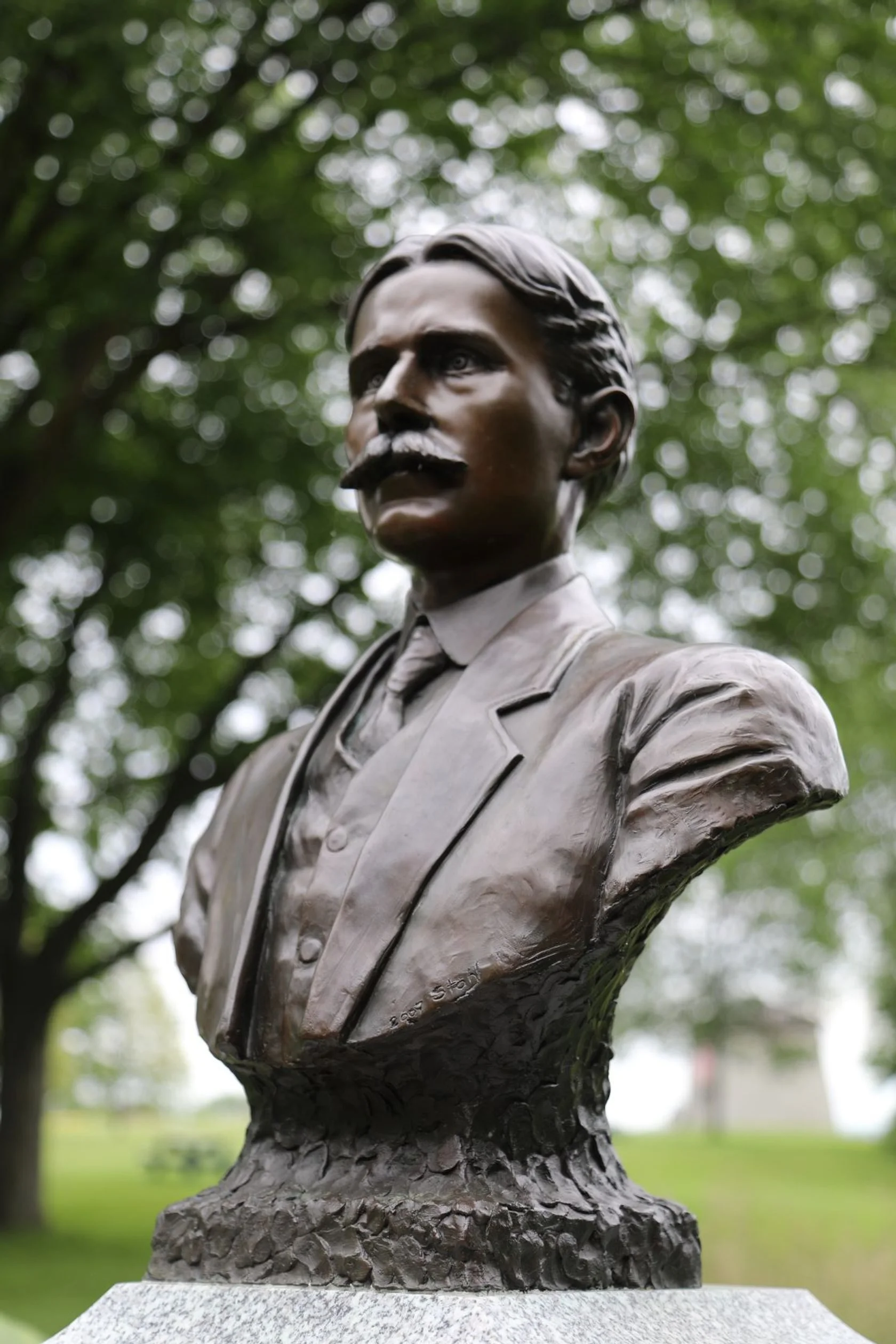
Frederick Todd envisioned YEG with a ribbon of green as its heart

Edmonton’s river valley, the largest urban park in Canada, is an asset that may never have existed without the efforts of Frederick G. Todd. As was common in most Canadian settlements, Edmonton’s river valley was used for industry and manufacturing leading up to the flood in 1915.

In the winter of 1906 through 1907, the City of Edmonton asked Todd to generate a report on how to provide park space to meet the future needs of citizens. In that report, Todd found Edmonton to have the potential to grow into a bustling metropolis owing to its situation in the centre of a developing province, attractiveness for business and residential development, and its picturesque setting.

With the potential for swift growth, Todd noted that park space becomes the limiting factor, and that financial prudency demands purchasing park land before people move in since land costs rise over time. In addition to recommending playgrounds, boulevards along streets, and large parks, Todd emphasized that ravines and hillsides are easily turned into natural areas for the public good as their incline makes other uses more difficult.

Frederick Gage Todd’s report was adopted in principle by the Government of Alberta following the floods in 1915 and that same year Edmonton spoke of the river valley park system in its municipal development plan. It began the preservation of the river valley that has grown stronger over time through zoning bylaws, land use plans, community activists, and government investment. https://www.edmonton.ca/public-files/assets/document?path=Naming_Committee_Biography_Frederick_Gage_Todd_Lookout.pdf

EPCOR YEG river valley solar power plant

Alice writes “Thanks, as always, for the latest issue of the newsletter. The photo by Kyle Schole of Epcor’s solar plant is a whole story and editorial commentary on that project, supposedly a ‘green’ renewable source of energy, but in fact a huge grey bite out of the green valley.”

Wendell emailed “The photo of the solar panels is real? The one with the caption: EPCOR YEG river valley solar power plant. Too bad, eh!”

More than 700 trees at risk in Hawrelak Park reconstruction

Sandra writes “This is an absolute horror situation. Edmonton deserves better. Adding insult to injury with the total climbing! Global warming is real. Cutting down trees accelerates it. Is there any way the public can have a say? I will attend any meetings. I feel it must be reviewed, ASAP. Please let us know. As citizens we deserve to have our voices heard. Thank you for posting.”

Preparing to Cross the Sacred River by Marianne Nicolson, INIW River Lot 11, 10380 Queen Elizabeth Park Road. Conor McNally still. https://www.edmontonpublicart.ca/#!/details/189

Comment or contribution

Please note that articles may not reflect the position of NSRVCS. River Valley News is meant to be a clearinghouse for the wide variety of opinions and ideas about Edmonton’s River Valley. Email river valley photos, event information, comments, or questions to nsrivervalley@gmail.com

Sincerely yours,

Harvey Voogd

North Saskatchewan River Valley Conservation Society

780.691.1712

River Valley News - April 27, 2023

More than 700 trees at risk in Hawrelak Park reconstruction

More than 700 trees are at risk of being damaged or cut down during construction at Edmonton’s William Hawrelak Park, a new report shows. The arborist’s report shows 741 trees at risk, hundreds higher than the approximately 220 trees thought to be impacted in some manner during construction.

Members of the Edmonton River Valley Conservation Coalition have been outspoken about the city’s plans to remove or damage potentially hundreds of trees for fear of environmental damage. The city, Raquel Feroe said, is looking at the park through the lens of renovating infrastructure rather than an opportunity to protect nature and to make progress on climate change goals.

“We could be helping to design a park that is more financially sustainable which could be used to enhance biodiversity, to lower our carbon budget, instead we’re doing the opposite. More cement, less permeable surfaces, just overall the direction is the wrong way.”

Jesse Banford, director of facility infrastructure delivery, said trees will be cut down for three reasons; to access and repair utilities, refurbish surfaces such as paving rough pathways, and fix facilities. https://edmontonjournal.com/news/local-news/more-than-700-trees-at-risk-in-edmontons-hawrelak-park-renewal-report

Possible cougar sighting at Terwillegar Park

A dog owner, who wishes to remain anonymous says she was walking through the trails by the river valley with her mom and dog, when they spotted the large cat.

“I was like ‘oh no, oh no, that’s a cougar, we need to get out of here’,” she says. “We’re about halfway through the trail, kind of where it gets quiet by the river, and we stopped at a bench there, by a hill. We were just sitting there talking, and I just noticed it about 50 feet away from us, down the hill in the bush.”

While cougar sightings in Edmonton are rare, they are not unheard of. A professor of biological sciences at the University of Alberta, Colleen Cassady St. Clair says the river makes a good corridor for wildlife to travel through.

“The river valley is a wonderful corridor, we are very lucky to have it, but it does bring potential predators, like cougars, into closer proximity to people than would otherwise occur, and Terwilliger is quite well connected to the edge of the city,” she says. “This is a time of year where cougars are quite stressed in terms of food access, and they might be moving around a little bit more than usual.” https://edmonton.citynews.ca/2023/04/21/possible-cougar-sighting-edmonton-park/

Métis Nation of Alberta traditional plant walks

The Métis Nation of Alberta’s Environment and Climate Change Department is pleased to again offer its Traditional Plant Walks. Embark on a guided walk with Métis cultural educator Natalie Pepin to learn about traditionally utilized plants. Gain a deeper understanding of the plants around us, their cultural significance, and how they can help us.

Each event is a 2.5-hour leisurely nature walk introduction to the plants around us. While on this walk, Knowledge Holder Natalie shares stories and discusses the cultural and ecological significance of the plants and how they can be used.

Space is limited and offered on a first come, first-serve basis. The Traditional Plant Walks are a family-friendly event, and any children attending under 12 years old do not require registration or tickets to join https://www.eventbrite.ca/e/environment-and-climate-change-traditional-plant-walks-with-natalie-pepin-tickets-615821567887

Another fantastic newsletter

Andrew writes "Always a gem in the inbox. Thank you from a Highlands resident!”

Tree planting as climate action is no solution without animals

Raquel emailed “Great edition. The article on trophic landscapes and carbon is a keeper. The article on Leilani Muir L Muir was also a well written eye opener.”

EPCOR YEG river valley solar power plant

Kyle Schole photo taken July 12, 2022

Comment or contribution

Please note that articles may not reflect the position of NSRVCS. River Valley News is meant to be a clearinghouse for the wide variety of opinions and ideas about Edmonton’s River Valley. Email river valley photos, event information, comments, or questions to nsrivervalley@gmail.com

Sincerely yours,

Harvey Voogd

North Saskatchewan River Valley Conservation Society

780.691.1712

River Valley News - April 20, 2023

Fort Saskatchewan naturalists raise concern over vandalism to trails

Susan Gronau with the Fort Saskatchewan Naturalist Society says that unauthorized trails in Ross Creek and Turner Park have been meddling with the fragile ecosystem that exists in the area. "The creek is littered and plugged with chain sawed live trees and dead logs from the ground, small trees were cut down, bundled, and tossed to the side," said Gronau.

The damage that some of those trails can inflict on the environment can be more wide-reaching than you think. One of these trails goes right through a patch of Yellow Lady's Slipper, a rare plant in the area. Forest ecosystems are especially fragile once the snow melts, with many animals breeding and plants beginning to bloom.

Gronau mentioned that most of the unpaved trails in Fort Saskatchewan were created without permission of the city council, and she hopes that there will be more restrictions on the trails in the future. "For both Turner Park and Ross Creek, if there has to be a trail there, shut down all of them but one," said Gronau.

https://fortsaskonline.com/articles/fort-saskatchewan-naturalists-raise-concern-over-vandalism-to-trails?

What do wildlife do to stay cool in summer heat

Animals use various methods of evaporative cooling to regulate their body temperatures. Rabbits and foxes have thin skin paired with blood vessels near the surface in their large ears to help shed excess body heat. Bees carry water droplets back to their hives and fan them with their wings, effectively creating their own air conditioning.

Storks and vultures perform guttural fluttering, which is similar to panting, and defecate on their legs to stay cool. Like hibernation in cold weather, some snails, worms and small mammals will go into estivation in hot weather, hiding from the heat and saving their energy.

Ground squirrels and prairie dogs, take refuge underground on hot days. They will even build special tunnels for optimal airflow that aids in keeping their dens cool. Bushy-tailed animals, like tree squirrels, use their tails like an umbrella to create their own shade.

Unlike mammals, reptiles and amphibians are poikilotherms and use their environment to manipulate their body temperature. They will bask in the sun to warm up and will seek water, mud, or crevices when they need to cool down. https://www.ealt.ca/blog/fun-facts-keeping-cool-in-the-animal-kingdom

Eugenics and the Leilani Muir footbridge

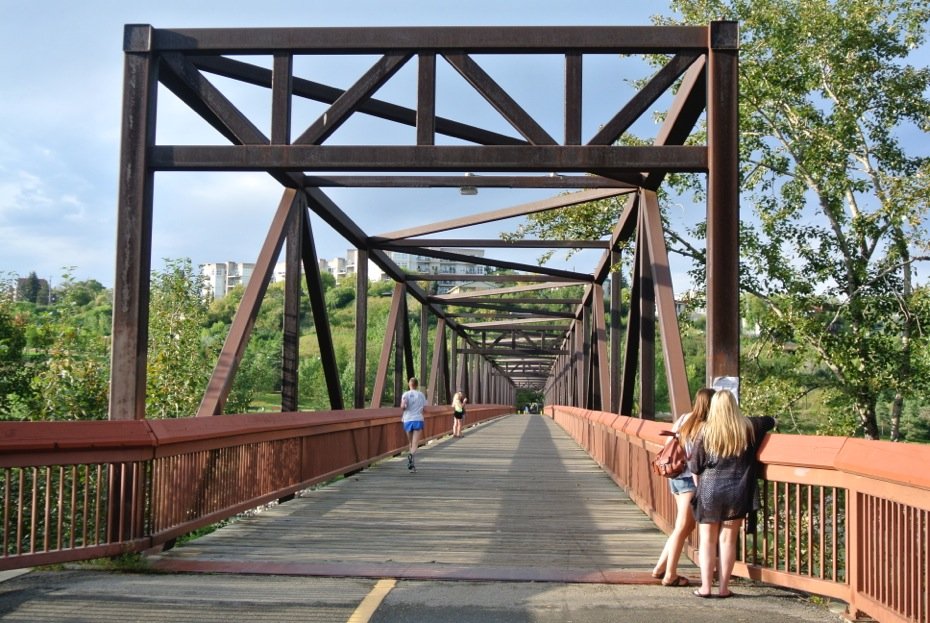
The footbridge in the photo has been replaced by the Tawatinâ LRT Bridge. In 2011, the footbridge was informally named the Leilani Muir Foot Bridge in a Works Festival project. Small plaques were affixed to the railings and remained there until 2016.

Muir was born July 15, 1944 in Calgary. In 1955, Leilani’s mother admitted her to the Provincial Training School for Mental Defectives in Red Deer, later known as the Michener Center. A precondition was consent permitting sterilization, which Leilani’s mother gave.

In 1959, Leilani underwent a bilateral salpingectomy, cutting of the fallopian tubes. Leilani was told only that she was having her appendix removed. Leilani’s sterilization occurred under the premise of Alberta’s Sexual Sterilization Act. Leilani left the training school in 1965 to begin an independent life.

After learning about her sterilization through a medical test, Muir spent years trying to have the damage reversed. She hired two Edmonton lawyers, and in 1996 she became the first person to successfully sue the Alberta government for wrongful sterilization. She was awarded $740,780, plus $230,000 for legal costs.

In her decision, Justice Joanne B. Veit stated, “The circumstances of Ms. Muir’s sterilization were so high-handed and so contemptuous of the statutory authority…and…so little respected Ms. Muir’s human dignity that the community’s, and the court’s sense of decency is offended.”

Leilani’s case opened the door for similar class action lawsuits. By 1999, the province had paid $142 million in settlement costs to over 700 victims. Leilani Muir O’Malley died on March 14, 2016. The Sexual Sterilization Act was repealed in 1972 by Peter Lougheed’s provincial government. https://citymuseumedmonton.ca/2023/03/14/leilani-muir-and-eugenics-in-alberta/

Tree planting as climate action is no solution without animals

Wayne Lynch photo

Tree-planting, the main so-called nature-based solution intended to help draw down carbon dioxide from the atmosphere, has become a synonym for climate action. A recent paper published in Nature’s climate change journal says trees might not be able to do their carbon-uptake job efficiently without the right animals in their ecosystem.

That is because, in the words of the paper, animals “animate the carbon cycle” through their behavior and roles in the ecosystem. That goes far beyond forests. Take wildebeests. They turn the Serengeti into a carbon sink by grazing, which reduces wildfire risk. Their waste, which contains carbon from the vegetation, is then buried in the soil by insects.

In Canada’s tundra, herds of muskox compact the snow, which keeps the soil frozen, therefore reducing methane emissions and increasing albedo, or the ability to reflect sunlight, which cools the local environment.

It is frustrating that efforts to protect biodiversity and halt climate change are treated separately. The paper’s co-author says people should start thinking holistically. By expanding the dimensions of the problem, we can arrive at solutions that are beneficial for both biodiversity and climate. https://www.bloomberg.com/opinion/articles/2023-04-11/rewilding-nature-is-no-solution-if-all-you-ve-got-are-trees?leadSource=uverify%20wall

Kirsten writes “We enjoy the River Valley News. Always new stuff to learn and it helps us see the wonders right outside our door.”

Vaulted Willow by Marc Fornes & THEVERYMANY. Borden Park. Doyle C. Marko/DCM Photography. https://www.edmontonpublicart.ca/#!/details/141

Comment or contribution

Please note that articles may not reflect the position of NSRVCS. River Valley News is meant to be a clearinghouse for the wide variety of opinions and ideas about Edmonton’s River Valley. Email river valley photos, event information, comments, or questions to nsrivervalley@gmail.com

Sincerely yours,

Harvey Voogd

North Saskatchewan River Valley Conservation Society

780.691.1712