River Valley News - October 12, 2023

Guided fall foliage tours at Bunchberry Meadows Conservation Area

Join the Nature Conservancy of Canada for a guided tour to witness the dramatic fall colours of Bunchberry Meadow's tamarack stands and to learn about the diverse features of this conservation area. Home to sand dunes, wetlands, and old-growth forest, Bunchberry Meadows provides a valuable habitat for many species such as moose and jack pine.

Dates still available are October 13, 14, 21, 28, and 29. Bunchberry Meadows’ 640 acres is located 30 kms from downtown Edmonton on Range Road 261 in Spruce Grove. Don’t forget to check out the Edmonton Native Plant Society’s demonstration plots down by the parking lot, and on either side of the road as you first drive into the conservation area.

Bring a water bottle, snacks and dress for the weather with appropriate footwear. Parking available onsite, carpooling encouraged, moderate fitness level required, no dogs allowed, and there are toilets on site. Price: $10. Register at https://www.eventbrite.ca/e/fall-foliage-tours-sept-22-oct-29-2023-tickets-719514205357

High chloride concentration in Whitemud Creek an impact of road salts

The North Saskatchewan River WaterSHED monitoring network is a collaborative project between the Government of Alberta, EPCOR, the North Saskatchewan Watershed Alliance (NSWA), and the City of Edmonton. It has developed an extensive 20-station tributary monitoring network throughout the region, allowing scientists to track water quality and quantity over time.

WaterSHED data demonstrates drastic changes in water quality from the mountains down through the forest and foothills areas, and then into the agricultural and urbanized plains. You can see clearly, changes in nutrients and salts and some metals. Particularly around the Drayton Valley area, when you start getting more clearing of former grasslands and forests into agriculture and residential areas.

One notable parameter was found to change remarkably in concentration downstream from the watershed’s pristine headwaters: chloride. Whitemud Creek in Edmonton had particularly high concentrations, and an expert says that “it gives you an idea of the impact of road salts, not only just on the concentration of these small creeks, but that it’s the most important contributor of chloride from any of our tributaries.”

He highlights this as interesting because Whitemud Creek is smaller than most of the watershed’s other monitored tributaries, and notes that, “But because it’s so urbanized, it really gets that chloride input.” As for pointing to a culprit for some of these pollutants, the aquatic scientist says, “We aren’t there yet, we can see where contaminants are coming from but more data are needed to know how much.” https://www.nswa.ab.ca/2023/09/27/inside-the-north-saskatchewan-river-watershed-monitoring-network/
River Valley Alliance looking for new board members

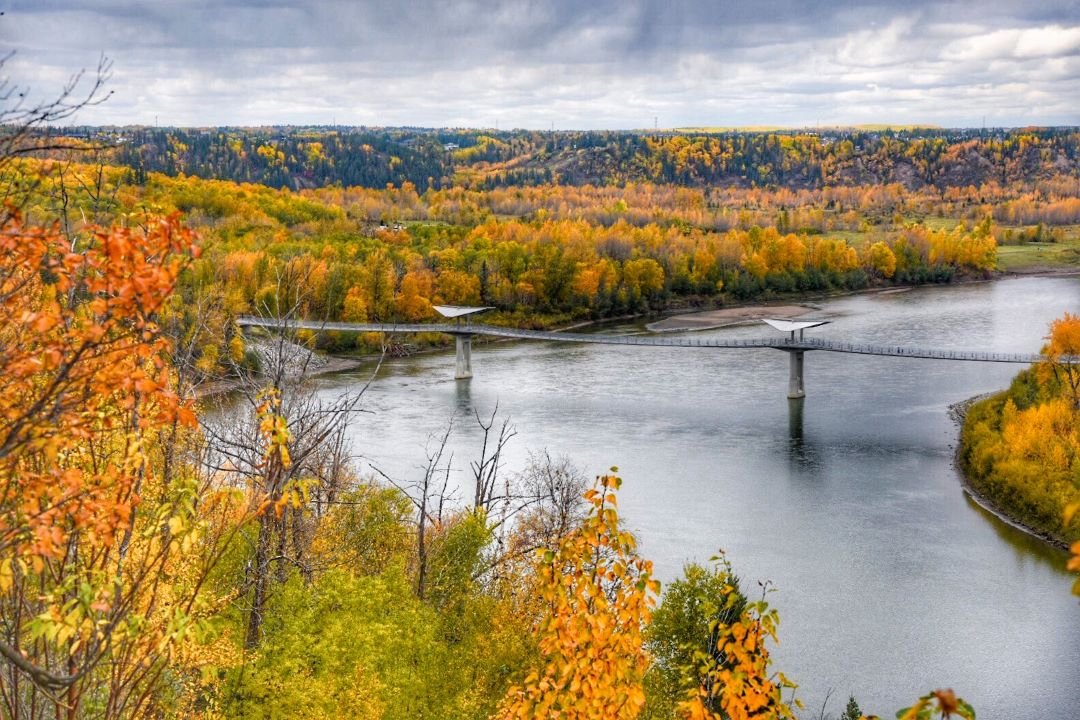
The RVA Board comprises seven elected Councillors from its municipal shareholders and eight Directors-at-Large. It has 3 openings for Directors-at-Large and invites interested candidates to submit their applications up to November 5.

The RVA Board is dedicated to a balanced approach of preserving, protecting, enhancing and connecting the river valley with the potential of becoming a world-class pedestrian trail, linking over 100 km through 8,000 hectares of parkland, the longest river valley trail and park system in North America, recently named Amisk Wacîw Mêskanaw or Beaver Hill Road.

It is accepting applications from residents of Parkland County, Town of Devon, City of Edmonton, Fort Saskatchewan, Sturgeon County and applicants of Indigenous Heritage that reside within Treaty 6 Territory or Métis Nation of Alberta Region 4. More information on the role description and application process

https://rivervalley.ab.ca/get-involved/board-of-directors/

Kids in Riverdale fish out 6 e-scooters in the North Saskatchewan River

George writes “Congratulations that your previous issue motivated those kids to get the e-scooters out of the river. Well done!

Liz emailed “Good for the Riverdale kids. They see a need and go do something about it! Thanks for highlighting the scooters in the river.”

Garden Frame by Will Truchon, Muttart Conservatory grounds adjacent to the picturesque garden gazebo. 

https://www.edmontonarts.ca/public-art/garden-frame

Comment or contribution

Please note that articles may not reflect the position of NSRVCS. River Valley News is meant to be a clearinghouse for the wide variety of opinions and ideas about Edmonton’s River Valley. Email river valley photos, event information, comments, or questions to nsrivervalley@gmail.com

River Valley News - October 5, 2023

Kihciy Maskikiy/Aakaakmotaani garden opened at Alberta legislature

Kihciy Maskikiy/Aakaakmotaani is a name that combines Cree and Blackfoot words and translates to “sacred medicine/save many people.” The garden is centred around a linden tree that was planted by Indigenous and government leaders in 2021 as a symbol of reconciliation.

It includes a medicine wheel, a sacred symbol of the four directions and the interconnectedness of all things. The four quadrants of the wheel contain sweetgrass, sage, tobacco and cedar. A series of small footprints are pressed into its main path, representing the many children who did not return home from residential schools.

One highlight of the garden is Alberta’s official residential school monument. The stone sculpture Mother Earth Circling: Healing from the residential school experience was created by Saddle Lake Cree Nation artist Stewart Steinhauer. It fulfils the Truth and Reconciliation Commission’s 82nd Call to Action, which asks all provinces to commission monuments in their capital cities to honour the victims and survivors of residential schools. 

The sculpture includes many Indigenous petroglyphs and symbols that create a narrative about the history of Turtle Island and the impact of residential schools. The central theme of the monument is the need for healing from that trauma. https://www.alberta.ca/reconciliation-garden-and-residential-school-monument

National urban park one step further to becoming a reality

Recently, by a 10-3 vote of support, the proposed national urban park moved to the planning process. This is not a full approval, it means council will do more fact-finding and administration will further engage the public and the federal government about the feasibility of a park, from maintenance costs to boundaries. Councillors Tim Cartmell, Jennifer Rice and Karen Principe voted against continuing this process.

Common Sense Edmonton gathered 2,153 signatures in support of its call for the city to abandon the national park plan. It believes that Edmontonians should decide by referendum whether to partner with the federal government on an urban national park.

Spokesperson Kerry Diotte, a former MP, and city councillor who also lost a mayoral bid, says they don’t see a need for the federal government to get involved in the river valley. Diotte is skeptical of the City’s assertions that the feds would not control the national-park project. “I don’t think you can have a national park without the feds having ownership,” said Diotte. “It doesn’t make sense.”

Coun. Andrew Knack asserted Common Sense Edmonton is spreading misinformation and “should have known better” when it came to making so much noise about a potential park. He repeatedly asked administration if the feds would have any control over the park, and was repeatedly told, “no.” He wanted to make sure all of council, and members of the public who tuned in, heard it, numerous times.

Coun. Keren Tang said its simply too early for the City to walk away from the process. “It would be almost irresponsible if we walked away and left resources on the table.” https://urbanaffairs.ca/edmonton-ish/the-park-has-become-a-political-football/

New Smith Crossing Pedestrian Bridge opens

The Smith Crossing Pedestrian Bridge, located along 23 Avenue, forms a key link in Edmonton’s river valley trail network as it provides a safe crossing over Whitemud Creek and access to the MacTaggart and Larch Sanctuaries. The new bridge is in the same location as the old bridge which reduces its impact on nature and strengthens ties to the existing trail network.

Built in 1914, the original Smith Crossing Bridge was named after the Smith family, who were pioneers in the area. It was a vehicle bridge until 1961 when it was changed to a pedestrian bridge. A piece of the old bridge has been used in a new interpretive plaque near the bridge. 

The new structure is a tied arch bridge with a slender, open design that helps it fit within the natural area. It is installed higher from the ground to improve the bridge’s resilience to floods while also allowing larger animals such as moose or deer to walk under the bridge. https://www.edmonton.ca/projects_plans/roads/smith-crossing-pedestrian-bridge-replacement?utm_source=virtualaddress&utm_campaign=smithcrossing

Edmonton a beacon for wildlife because of geography and city planning

Dennis Kovtun photo

A new study states Edmonton will be more hospitable to wildlife than southern cities thanks to its geography and wildlife friendly city planning. Colleen St Clair, professor of biological sciences at the University of Alberta and one of the study's co-authors, says that’s because of the river valley and ravine system, which is the largest contiguous protected natural habitat in any city in North America.

Edmonton's early managers “set aside the river valley for future generations. That was a tremendous thing to do," St Clair said. "We have this enormous natural area in Edmonton because of that forethought. Our geographic location also contributes to a wildlife friendly climate: cool winters, not overly warm summers and enough precipitation to allow plants, which drive the rest of the ecosystem, to flourish.”

Despite this good news, Edmonton will not be exempt from the effects of climate change, said Catherine Shier, a conservation coordinator with the City of Edmonton, who also participated in the research. The city could become between three and five degrees hotter by the 2050s, meaning the city may move on to having a more prairie-like climate. 

Edmonton is in a zone called central parkland, Shier said, which lies at the intersection of prairies from the south and boreal forests from the north. It's one of the most endangered ecological subregions in Alberta. "If we do move towards more of the prairie ecosystem, then the species composition of our vegetation may change and it may drive out some of our larger mammals." Shier https://www.cbc.ca/news/canada/edmonton/how-geography-and-city-planning-have-made-edmonton-a-beacon-for-urban-wildlife-1.6981645

Reader Feedback on E-Bike Scooters in North Saskatchewan River

Stephanie Brown Yoshisaka photo.

After last week’s photo and story, kids in Riverdale fished out 6 e-scooters in the North Saskatchewan River by Dawson bridge. They spent all day doing it!

From the Model by Susan Owen Kagan, Belgravia Art Park

https://www.edmontonarts.ca/public-art/from-the-model

Comment or contribution

Please note that articles may not reflect the position of NSRVCS. River Valley News is meant to be a clearinghouse for the wide variety of opinions and ideas about Edmonton’s River Valley. Email river valley photos, event information, comments, or questions to nsrivervalley@gmail.com

River Valley News - September 28, 2023

Canada’s first urban Indigenous ceremonial site opens in YEG

kihcihkaw askî, meaning “sacred land” in Cree, provides a natural setting for the Indigenous community to host ceremonies, sweatlodges, facilitate intergenerational learning, and build and maintain good relations. It officially opened September 22 and is in Whitemud Park at 14141 Fox Drive NW.

“It is an honour to have the first urban Indigenous ceremony site in Canada located in Treaty No. 6,” said Grand Chief Leonard Standingontheroad. “I hope all Indigenous Peoples use the site to connect to their homelands and own traditions.”

"We are proud to have played a role in building the first permanent urban Indigenous cultural and ceremony grounds of its kind in Canada," said Mayor Amarjeet Sohi. "Through this partnership with the Indigenous Knowledge & Wisdom Centre, kihcihkaw askî will be a safe place for Indigenous and non-Indigenous people to access and share knowledge within Edmonton."

The location is historically and culturally significant and has served as a ceremonial and gathering site in the past. Long before becoming farmland, the area around kihcihkaw askî was used for many centuries by Indigenous people harvesting medicines for healing purposes. Ochre, a rare mineral also found close to the site, was and continues to be used in spiritual and traditional ceremonies. https://www.facebook.com/IKWC.org/

Playing in the sand: restoration work at Bunchberry Meadows

Cherry Dodd photo

The latest Wildflower News has an article by Cherry Dodd, in the form of a diary, of work done by herself and other volunteers this past year at Bunchberry Meadows Conservation Area, which is west of Edmonton in the Devon Sand Dune system. Her diary serves as a series of snapshots of the challenges, tribulations, surprises and satisfactions of creating and maintaining native plant gardens in the middle of a nature reserve.

Cherry writes, There are now four restoration plots that are looked after by different people. Two plots are next to the parking lot and the two I look after are on each side of the driveway as you first enter.

There is a small pond on the south side of the driveway that was the cattle dugout when this land was a ranch. The wetland plot is the space between the pond and the driveway. The soil here is peaty and very rich thanks to years of cattle going down to the water to drink.

Across the driveway to the north is a flat, sandy area backed by a steep slope. Here the topsoil was removed to make a place to park the construction machinery. So, the ecosystem on this side is compacted sandy subsoil. Wow, two completely different ecosystems with different soil conditions, separated by the driveway. Read diary at file:///C:/Users/user/Downloads/WF_News_Sept2023%20(1).pdf

Flow of the North Saskatchewan River has shaped Edmonton

Are You On the North or Southside by Anita Nawrocki

Ebb and flow describe the rhythm of life - the flow of the seasons, the flow of time. The flow of the North Saskatchewan River has shaped the city that Edmonton has become. Flow with whatever may happen and let your mind be free. – Zhuangzi

The FLOW exhibit is currently showcased at ten different Edmonton Public Library locations. This captivating exhibition boasts a collection of 81 remarkable pieces created by 47 talented artists.

Jasper Place spotlights exquisite paintings by William Roy and the mesmerizing sculptures of Anthony Antoine. Clareview showcases an array of ceramic artworks crafted by Anita Narocki, Jessica Laurie, and Athena Photinopoulos. Lois Hole presents the impressive works of Melissa Baron and Sara Larsen.

Highlands proudly features participants from the Art Mentorship Society programs as well as artists from the Mustard Seed Art Program. At Castledowns, you'll find the captivating creations of Juwayriya Abdullahi. https://www.epl.ca/capital-city-art/

North America’s largest land mammal is the bison

Lise writes “I love getting this newsletter and always learn something new. The article on the bison was so informative. I wish I’d known all that when I taught Grade 4 social studies. What a fascinating animal!”

Electric Bike & Electric Scooters in North Saskatchewan River

Ethan Doward photo. View from the northside of Dawson bridge of at least 4 e-scooters and one e-bike still in the water, 3 weeks after the City of Edmonton notified. Hey Lime “Do what’s right for our river.”

Comment or contribution

Please note that articles may not reflect the position of NSRVCS. River Valley News is meant to be a clearinghouse for the wide variety of opinions and ideas about Edmonton’s River Valley. Email river valley photos, event information, comments, or questions to nsrivervalley@gmail.com