NSRVCS Newsletter - August 26, 2021

logo.jpg
green.jpg

Green energy vs Indigenous heritage in Edmonton
Epcor’s solar farm, a 51 acre, 45,000 panel operation is being built next to the North Saskatchewan River on what was a flourishing meadow rich in cultural sites. Epcor itself wrote “This site can be described as a multicomponent pre-contact period campsite which consists of a series of undisturbed cultural occupations from below the plough zone, approximately 30 cm below surface, to approximately four metres below ground surface.”

There appears to be multiple layers of occupation present, which speaks to ongoing and recurrent habitation. The geotechnical report for test pit TP17-08 notes cultural artifacts discovered at 1m, then again at 2.5 m. Indigenous people, before contact, would return to sacred places and spaces as a matter of practice. This evidence supports oral histories that speak to those practice.

Supporters of the project made much about the site being previously disturbed, farmed over and part of Epcor’s private holdings. These are the usual refrains used to depreciate the land and sell the idea of “no greater damage” so common when it comes to bulldozing Indigenous heritage sites. But we know that archaeological resources exist below the depth of a plow, and that the land was not always part of Epcor’s holdings.

Must Indigenous history, heritage, culture, and sacred sites remain off-limits for years more in order for a utility company to save money? Should archaeologists, experts and engineers be able to applaud themselves for getting a project approved that may destroy a place in the River Valley that has been proven to be occupied for a minimum of 9,000 years?

Read Robert Houle’s complete blog at https://yellowheadinstitute.org/2020/10/29/green-energy-vs-indigenous-heritage-in-edmonton/

lost lake.jpg

Edmonton’s lost lake, creeks, and wetlands
Early Edmontonians had strong cultural connections to their water bodies. That was especially true of McKernan Lake, once covering about 30 acres and now covered up by the McKernan neighbourhood. The lake was a community gathering place in all seasons and included boating, swimming, picnicking, skating, and curling.

Many creeks were lost to road and bridge construction during the city’s building booms. Goat Creek was culverted, filled, and buried to construct Groat Road. Upper sections of MacKinnon Creek were culverted and paved to build residential neighbourhoods.

In the 1960s, MacKinnon Ravine was earmarked for a highway through central Edmonton. To this end, MacKinnon Creek and Ramsay Creek were culverted, filled, and packed down to create a roadbed. This roadway is now a walking and cycling trail.

Fulton Creek in east Edmonton illustrated gradual creek loss. Lower sections of the creek were culverted and filled to build Gretzky Drive and Capilano bridge. Current expansion of industrial areas encroaches on city’s remaining marshy areas. Text and information for this piece from Living in the Shed by Billie Milholland https://www.linkedin.com/in/billie-milholland-474a1639/?originalSubdomain=ca

ward.jpg

City ward name calls for an equal future for LGBTQ2S+ community
The name tastawiyiniwak, is the nêhiyawak (Cree) term referring to the LGBTQ2S+ community. Its rough English translation is “in-between people.” The Cree heritage does not have a binary view of gender, or of traditional gender roles. In fact, the Cree worldview recognized eight genders, and each had their own role to play in the betterment of their community.

The Cree believe all people are unified by a single ahcahk (spirit). Each individual could choose where they belonged, what responsibilities they bore to their community, and were free to move between roles as they wished. This is the origin of the term tastawiyiniwak, or "in-between people."

The City of Edmonton ward tastawiyiniwak name calls for a more equal future for the LGBTQ2S+ community. Learn more by watching the video at https://www.youtube.com/watch?v=2nc6cDzY2PA

solomon seal.jpg

Star-Flowered Solomon’s Seal great for a shade garden
This perennial is a member of the Lily family and grows from spreading rootstalks to form thick groundcover. Although it is slower to establish than the sun loving prairie wildflowers, this plant has staying power. It simply gets thicker each year and lives for many years.

This is an elegant wildflower with tall, arching stems. The narrow, grey-green leaves have long, noticeable veins. Leaf size and shape can vary, depending on where the plant is located. In bright light, the leaves are stiff; in shade, they are limp but tend to grow larger.

The white flowers have six petals and form a loose group at the end of each leafy stem. The species name, stellata, means “star-like” and describes the lovely white flowers. Berries are greenish with dark stripes, before turning red, and then nearly black, in early fall.

This plant prefers woodlands, open meadows, shores of sandy marshes and grows across Canada, including in Edmonton’s river valley. More at https://www.naturewatch.ca/plantwatch/star-flowered-solomons-seal/

feedback.jpg

Anirniq ward honours those who never made it home
Liz writes “I went to St Andrew’s school for 9 years. Across the street was the entrance of the Camsell hospital. We never knew what was happening. We were told the eskimos there were being cared for while they recovered from a very infectious TB. We could not visit them or ever see them. Thanks for this history lesson.”

Hermitage Park Disc Golf Course
Cass says “There is a new disc golf course being installed at Hermitage Park. The course design was released by the Edmonton Disc Golf Association https://edga.ca/courses/hermitage-park/ and it looks like 3 of the fairways-flight paths go through forests and even a ravine. How this made it past the city is beyond me. I worry players will lose discs in the ravine trying to throw across it, then scramble down. This is through our natural areas along the river. What about erosion and wildlife? This was such a scenic and quiet park for bird watching.”

woodpecker.jpg

Comment or contribution
If you have a comment, concern, or question, contact us at nsrivervalley@gmail.com Please also email us river valley photos or event information. Your friends, neighbours and colleagues can sign up for this newsletter on our web site.

Sincerely yours,
Harvey Voogd
North Saskatchewan River Valley Conservation Society
780.691.1712

NSRVCS Newsletter - August 19, 2021

logo.jpg
trees.jpg

Bylaw to preserve and protect trees in public spaces
On August 24, City Council’s Urban Planning Committee will discuss a proposed bylaw to preserve and protect trees in public spaces owned by the City of Edmonton. There is currently no proactive tree protection or preservation bylaw.

The city’s urban forest of 380,000 boulevard and open space trees and 3,000 hectares of natural stands provides environmental and ecological benefits by contributing to urban biodiversity, retaining water, providing wildlife habitat, and sequestering carbon. Trees enhance the livability and quality of life in the city’s neighbourhoods by cooling the streetscape, purifying the air we breathe, providing shade and creating a sense of well being in the urban environment.

City trees are damaged or lost by soil compaction from vehicles, heavy equipment, and storage of construction materials over tree roots that can reduce pore space in soil which leads to limited water and air flow to the roots causing decline in the overall health and resilience of the trees. It is critical that tree assets, especially existing mature trees, are responsibly managed, preserved and protected for current and future generations.

Mature trees provide the largest ecosystem benefits, but their inventory is relatively small. City-owned mature trees make up 15 percent of the total inventory for boulevard and open space trees, excluding natural stands. They are estimated to have a monetary value of over $900 million and annual ecosystem benefits of over $10 million. When mature trees are damaged or lost, their many benefits are degraded or lost for decades.

To present to the Committee on this issue, register with the City Clerk at 780.496.8178 or city.clerk@edmonton.ca Read the reports at Agenda Item 6.2 https://pub-edmonton.escribemeetings.com/Meeting.aspx?Id=e2a9adbb-058b-4ed5-b5d9-2f199fb024be&Agenda=Agenda&lang=English&Item=23&Tab=attachments

coal.jpg

Proposed coal mining upstream of Edmonton a risk to our drinking water
City Council’s Utility Committee at its August 27 meeting will discuss the potential impact on Edmonton’s drinking water from four provincially approved coal mining projects. Activity that happens in the headwaters of the North Saskatchewan River is a matter of vital interest to the City of Edmonton and every Edmontonian.

Five percent of the North Saskatchewan watershed upstream of the City of Edmonton is currently held by coal leases, and poses a risk to source water, aquatic ecosystem health, and industrial and agricultural users if development occurs.

The North Saskatchewan River is currently Edmonton’s sole source of drinking water and provides Edmontonians with recreational opportunities including fishing, swimming, and boating in addition to being an important ecological system for wildlife. A basin wide, comprehensive risk assessment and integrated land use and water management plan does not currently exist.

EPCOR conducted a risk assessment of upstream coal mining in the North Saskatchewan River Watershed that suggests risks to drinking water and assimilative capacity of the river under normal operating conditions is low, and risks to water quality for aquatic ecosystem health within Edmonton is medium-low. However, in the event of a rare catastrophic mine failure, such as a tailings dam failure, there would be an extreme impact on downstream water quality.

To present to the Committee on this issue, register with the City Clerk at 780.496.8178 or city.clerk@edmonton.ca Read the City and EPCOR reports at Agenda Item 6.1 https://pub-edmonton.escribemeetings.com/Meeting.aspx?Id=0cfd3d5e-d0e0-46af-8916-336acf259964&Agenda=Agenda&lang=English&Item=21&Tab=attachments

rhubarb.jpg

Rhubarb originally valued for medicinal purposes
Although rhubarb is a perennial vegetable, it is often put to the same culinary uses as fruits.The stalks are the only edible part of the rhubarb plant. They have a rich, tart flavor when cooked. The leaves of the rhubarb plant are toxic, they contain an irritant called oxalic acid, so be sure not to eat them.

The Chinese call rhubarb "the great yellow" and have used rhubarb root for medicinal purposes for thousands of years. During Islamic times, it was imported along the Silk Road reaching Europe in the 14th century. The cost of transportation across Asia made rhubarb expensive in medieval Europe. It was several times the price of other valuable herbs and spices such as cinnamon, opium and saffron.

The high price, as well as the increasing demand from apothecaries, stimulated efforts to cultivate different species of rhubarb on European soil. Certain species came to be grown in England. The local availability of the plants grown for medicinal purposes, together with the increasing abundance and decreasing price of sugar in the 18th century, galvanised its culinary adoption. Rhubarb came to North America with European settlers. Learn more at https://en.wikipedia.org/wiki/Rhubarb

feedbaack.jpg

Photo of EPCOR solar power plant construction
Garry writes “Another good weekly newsletter. Just a quick comment about the caption describing it as reindustrialization. A solar farm possesses none of the problems we commonly associate with industrial sites. Once operating solar farms produce no audible noise, traffic, odours, dust, nor stray light. Hardly the characteristics of an industrial site.”

Melanie says “I’m so gutted to see the solar panels going up. Will you share an update on what the heck happened with the court injunction or whatever legalese was trying to hold this up that absolutely failed? Want to make noise about this around elections and such.”

Harry states, “I appreciate your informative newsletter. I see that EPCOR is aggressively moving forward with it’s industrial-scale solar farm in the river valley. I think there will be a lot of very disappointed users of the river valley in this area, when they see the finished result. There will be a significant loss of aesthetics, not to mention ecological impacts.”

Apology re Mountain Bike Concerns headline
Feedback has been received from many Edmonton Mountain Bike Alliance members concerned this headline unfairly blamed their sport for unsanctioned trails in the river valley. We accept this criticism and apologize for the headline. Illegal trails can be made by runners, hikers, dog walkers, homeless encampments, etc. A better headline would have been Unsanctioned Trails Concerns.

Readers should note that unless we explicitly state it, articles and reader feedback in this newsletter do not necessarily reflect the position of NSRVCS.

Photo by Louisa Bruinsma of a bald eagle at Rundle Park.

Photo by Louisa Bruinsma of a bald eagle at Rundle Park.

Comment or contribution
If you have a comment, concern, or question, contact us at nsrivervalley@gmail.com Please also email us river valley photos or event information. Your friends, neighbours and colleagues can sign up for this newsletter on our web site.

Sincerely yours,
Harvey Voogd
North Saskatchewan River Valley Conservation Society
780.691.1712

NSRVCS Newsletter - August 12, 2021

logo.jpg
parks.jpg

Ottawa invests $130 million to create a network of national urban parks
Parks Canada has launched a new program to support the creation of a network of national urban parks. It will collaborate with municipalities, provinces, Indigenous partners, and conservation organizations, to identify opportunities for creating or expanding national urban parks in urban and near-urban settings across

The North Saskatchewan River Valley Conservation Society, Sierra Club Canada Foundation Prairie Chapter, and Canadian Parks and Wilderness Society-Northern Alberta have been working together with Parks Canada to encourage this initiative in the Edmonton metropolitan region.

Discussions are in the early stages, but we envision a national urban park that includes our region’s ribbon of green, the North Saskatchewan River Valley, and could even branch outside of the river valley to connect to other important wildlife, cultural and historical areas. Learn more at https://edmonton.taproot.news/news/2021/08/11/parks-canada-to-consider-edmonton-area-river-valley-fornational-urban-park-network

plants.jpg

Top 5 native plants for birds in our yards
With so many choices for native plants that benefit birds it is hard to pick just five. But since most city yards are small, you must make the most of what you have. Why do birds need native plants?

Nature plants thrive despite our cold winters and sometimes searing hot summers and attract insects that birds want to eat. By attracting beneficial insects, your whole garden will get better pollination. This will give you more flowers, which means more seeds and berries for birds.

These five plants are easy to grow from seed and readily available for purchase in Edmonton. In addition to deciding what to plant, it is important to consider where to plant to maximize the benefit for birds.

Birds and pollinators enjoy mass plantings. You do not want to scatter your plants around the yard and make it a scavenger hunt for them! You are bringing birds to your garden so you can enjoy them, so plant where you can watch them! Discover the names of the top 5 native plants and learn more at http://cloud2.snappages.com/be296ab53ae397c57bac9e522bed2bb32a5a17f8/Wildflower%20News%20-%20August%202021%20R.pdf

Canada needs your help identifying critical habitat for bank swallows
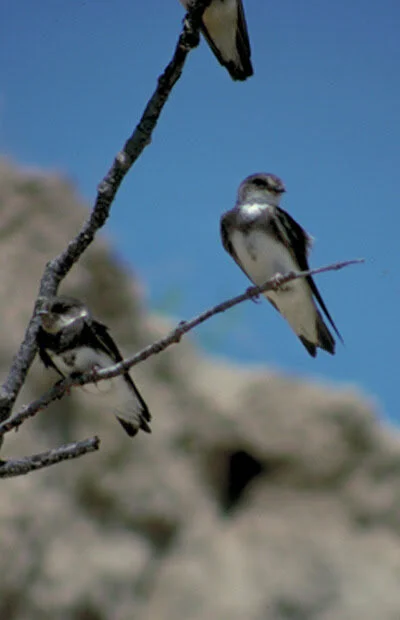
The bank swallow, a cliff nesting species found throughout Alberta usually near water, has experienced a 98% population decline in Canada over the last 40 years and was classified as threatened by Canada’s Species at Risk Act (SARA) in November 2017.

Under SARA, the federal minister is responsible for preparing recovery strategies for any species listed as threatened. A crucial part of any recovery strategy is identifying critical habitat, the habitat necessary for the survival and recovery of a species. The proposed bank swallow recovery strategy has identified 15 critical habitat units across Alberta.

However, the document states that the critical habitat identified in the strategy is insufficient to meet the population objectives, meaning that more critical habitat needs to be identified to give these birds a chance at recovery.

The Alberta Wilderness Association is asking Albertans to submit information on riparian areas across the province where bank swallows or nesting colonies are observed frequently or have been in the past. This would be an important step in ensuring that more critical habitat is protected as part of these recovery activities.

Environment and Climate Change Canada’s proposed recovery strategy for bank swallow populations in Canada is open for public consultation until September 14 at https://www.canada.ca/en/environment-climate-change/services/species-risk-public-registry/recovery-strategies/bank-swallow-proposed-2021.html

women.jpg

What if women were never elected to Edmonton City Council
What if the 31 women who served on Edmonton City Council over the past century were never elected. How different would our city look and feel? Would Edmonton be Edmonton?

While Edmonton’s women councillors did all the bread-and-butter work during their terms, budgets, committee meetings etc., many also brought forward initiatives that made our city more livable, more beautiful, more Edmonton.

Two former City of Edmonton historian laureates, Shirley Lowe and Marlena Wyman, take us on a podcast tour and talk about the incredible, often visionary, and sometimes hidden legacies of many of our former female councillors.

From the controversial Talus Dome to our tranquil river valley system to City Hall, join them for a special journey that will change the way you forever look at Edmonton. Listen to the podcast at https://www.ywcaofedmonton.org/izena/podcast/podcast-part-7/

feedback.jpg

Anirniq ward honours those who never made it home
Sandra says “The river and Edmonton has so much history. Thank you for including it all. As devastating as it was, it is time to look at it. Your balanced view is much appreciated.”

Mountain Bike Concerns
Elisabeth writes, “With other friends, we are concerned about the escalating damage from new trails by mountain bikes in the river valley. The section we visit is the forested trail from 76th avenue in Belgravia, north towards Hawrelak. It would be interesting to document with GPS and photos the amazing number of new trails descending steep areas from the bike trail along Saskatchewan Drive. I hope someone can do this!”

Photo by Eric Gormley of EPCOR’s current reindustrialization of Edmonton’s river valley to build a solar power plant.

Photo by Eric Gormley of EPCOR’s current reindustrialization of Edmonton’s river valley to build a solar power plant.

River valley concern or contribution
If you have a river valley concern or question, contact us at nsrivervalley@gmail.com
Your friends and neighbours can sign up for this newsletter on our web site.
If you have a photo, information, or event about Edmonton’s river valley and think it should be in this newsletter, email it to us.

Sincerely yours,
Harvey Voogd
North Saskatchewan River Valley Conservation Society
780.691.1712