NSRVCS News - August 13, 2020

logo.jpg
lichen.jpg

Learn to speak Lichen
Join Diane Haughland for a river valley walk on August 22, 9:30-11:00am, to learn about your lichen neighbours and how to translate what they are telling us about our urban environment. Not sure what a lichen is? Come and find out! You will be introduced to common and uncommon lichens and learn why listening to urban lichens is important.
 
Diane is an ecologist and lichen taxonomist who has studied Alberta’s lichens for over a decade. She teaches a course on lichen identification and ecology at the University of Alberta. Participation is limited to 10 individuals or up to 10 cohorts.
 
Registered participants will be emailed with the exact event location closer to the event. All participants are required to wear a mask and use hand sanitizer upon arrival. Registration and more information about the event sponsor, the Tomorrow Foundation, is at https://tomorrowfoundation.ca/

harvey.jpg

Paddle Edmonton's original main street
Canoe down Edmonton’s original main street, the North Saskatchewan River, and see the scenic river valley just as First Nations and fur traders did for hundreds of years. Keep an eye out for wildlife along the riverbank and learn the true meaning of going with the flow. A popular day trip is the 5-6 hour canoe trip from Devon to Edmonton.
 
My friend Ted Garver and I recently canoed 319km on the North Saskatchewan River from Rocky Mountain House to Edmonton. The deepness of the river valley in Edmonton means consistent urban sound and sights, except for the south Anthony Henday freeway bridge, do not register until quite far within the city’s boundaries, in our case Terwilliger Park.
 
Mark Lund’s connection to water ranges from teaching swimming lessons at 14, paddling as a member of Red Deer College’s canoe team and writing “Mark’s Guide for Alberta Paddlers”. Read his tips for safe paddling at https://rivervalley.ab.ca/news/tips-for-safe-paddling-on-the-north-saskatchewan-river/
plantain.jpg

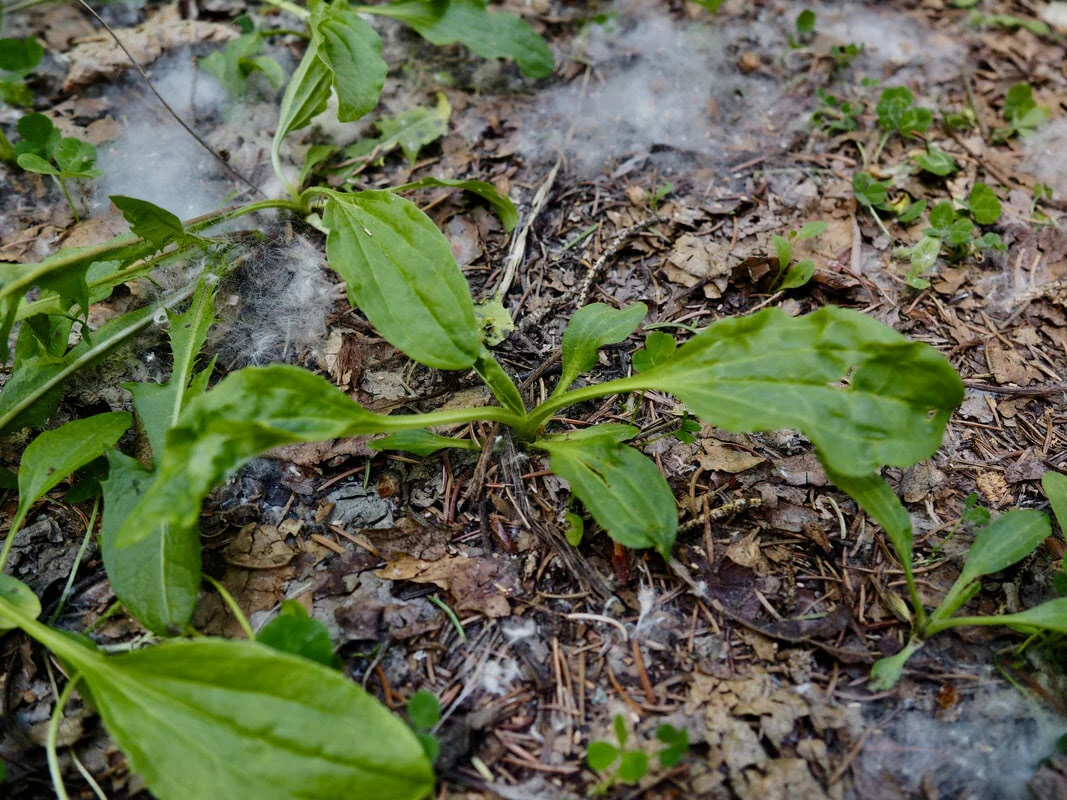
Plantain - plant that grows where humans walk
Plantain is an invasive plant that was introduced to the Americas with colonization. It was brought over by Europeans as an important medicinal plant. It has been referred to as “White man’s footprint” by a variety of Indigenous Peoples since it seemed to follow the footsteps of Settlers. This can be attributed to the fact that it thrives in disturbed soils, such as the soil that surrounded European settlements.

For millennia, poultices (soft, moist mass placed over skin) of plantain leaves have been applied to wounds, sores, and stings to promote healing. A tea of plantain leaves can be ingested to treat diarrhea and various gastrointestinal inflammation issues such as gastritis, peptic ulceration, colitis, and IBS. Plantain is also useful as a tea for UTI’s or episodes of kidney stones due to its anti-inflammatory, anti-hemorrhagic and anti-septic actions. 
 
The leaves are edible but become tough and fibrous quickly. In the fall, the seeds turn brown and may be used in place of Metamucil. The leaves of the plantain are rich in vitamins A, C, and K, making them a great healthy snack. Recipe for plantain chips at https://www.ealt.ca/natures-nourishment-1/plantain-chips Share river valley event, job posting, or news
If you have a river valley event, job posting, or news that you would like to see published in this newsletter, please send the info to nsrivervalley@gmail.com
 
Sincerely yours,
Harvey Voogd
North Saskatchewan River Valley Conservation Society
780.691.1712
nsrivervalley@gmail.com
https://www.facebook.com/NSRVCS/
http://www.edmontonrivervalley.org/

NSRVCS News - July 30, 2020

logo.jpg
saskatoons.jpg

Saskatoons - berries of nostalgia
The Edmonton river valley was as familiar as my backyard when I was young. My memories are full of weekends tromping after my dad through the foot-worn trails that meandered through the “bush,” as we called it back then. He helped me and my brothers bravely scale the beams of an old rail bridge that has long since disappeared. One summer we sailed fearlessly over a ravine on a homemade rope swing hidden deep in the woods. When snow arrived, we brought along our sleds or cross-country skis. When the ice froze exactly right, we skated on Whitemud Creek.
 
There was that time of year in the middle of summer when the Saskatoon bushes were heavy with berries and my parents would take plastic ice cream pails on our adventures. Picking Saskatoon berries was a chore we didn’t mind because we could eat as much as we put in the pails. And the payoff was pie all fall and winter and, if it was a good year for berries, into the spring.
 
Read more of Edmonton writer and podcaster Annette Wierstra’s reflections on picking Saskatoon berries in the river valley with her family and baking pies at https://www.avenueedmonton.com/yeg/berries-of-nostalgia/

teepee.jpg

River valley camp out advocates for homeless
A community group advocating for more action to support homeless Edmontonians says it will be camping out on public land near Remax Field until its demands are met. The camp was publicized on social media by Black Lives Matter Edmonton, but it wasn’t organized solely by the group.
 
Outreach worker and organizer Deanna Cachagee said several racialized community groups have joined together with housing and outreach workers to create a donation drive and resource site for homeless residents. City spokesman Geoff Grimble said peace officers are aware of the camp and protest and are monitoring the situation closely with police. There is currently no plan to remove the camp.
 
On homeless encampments, Grimble said the city continues to offer supports along with community partners to those in need. The city stopped removing camps during the pandemic, but started again in early June, prioritized by level of risk. More at https://edmontonjournal.com/news/local-news/river-valley-campout-by-housing-outreach-workers-to-support-homeless

weasel.jpg

Ermine a royal weasel
The winter pelt of the ermine or short-tailed weasel has long been associated with royalty. It is the most common weasel in Alberta. They are about a foot long and weigh little. They may be small, but they are mighty! Weasels are some of the most carnivorous creatures in Alberta. They eat almost any small mammal, invertebrate, and sometimes even amphibians.
 
Weasels are cute, but hard to spot. They live in thick vegetation and are active during the nighttime. Short-tailed weasels also change colour in summer and winter to blend in with their surroundings. In summer, they are brown with white bellies, but when winter comes around, they are all white, with a tip of black on their tail.
 
Watch this short video of an inquisitive short-tailed weasel at Kinsmen Park https://www.reddit.com/r/Edmonton/comments/1gxvpg/an_inquisitive_shorttailed_weasel_at_the_kinsmen/

bridge.jpg

Dawson bridge to McNally lookout trail
This 4km round trip trail has a moderately flat dirt path with some single track for the first half. Second half changes to a steep, uphill, wide paved path, and then flattens out. The trail is rated moderate to difficult due to the uphill climb and single-track. Bikes and dogs on-leash are allowed.
 
If you love dirt trails, great views and a perspective refresh, this route is for you. Beginning at the Riverside Golf Course parking lot, this trail weaves along the riverfront on a quiet dirt trail with great views of the water and Dawson Park across the river before connecting with a paved uphill trail that takes you to the McNally lookout, one of the most underrated viewpoints in Edmonton.
 
With plenty of benches along the way that gaze upon amazing river valley vistas, pack a picnic and rest a while and with that uphill climb, do not forget to bring water. This is a busy area for cyclists and mountain bikers, so stay alert and share the trail. Directions and information at
https://rivervalley.ab.ca/trail-treks/trailtrek-how-to-dawson-bridge-to-mcnally-lookout/ Share river valley event, job posting, or news
If you have a river valley event, job posting, or news that you would like to see published in this newsletter, please send the info to nsrivervalley@gmail.com
 
Sincerely yours,
Harvey Voogd
North Saskatchewan River Valley Conservation Society
780.691.1712
nsrivervalley@gmail.com
https://www.facebook.com/NSRVCS/
http://www.edmontonrivervalley.org/

NSRVCS News - July 16, 2020

logo.jpg
bottle.jpg

Living near Edmonton natural areas good for bottled fed babies
Living close to natural green space can mitigate some of the changes in infant gut bacteria associated with formula feeding. Formula-fed babies who live near natural green spaces are more likely to have gut bacteria like that in breastfed babies, according to a new study
 
“Not every infant can be breastfed,” said Anita Kozyrskyj, pediatrics professor at the University of Alberta. “This is one of the first pieces of evidence for a nature-related intervention that could possibly help promote healthy gut microbial composition in infants who are not breastfed.”
 
The babies’ postal codes were cross-referenced with the City of Edmonton’s urban Primary Land and Vegetation Inventory, which maps natural green spaces in the city, including natural forest, grasslands, wetlands, lakes, rivers, and ravines.
 
“We found that the infants who lived within 500 metres of a natural environment were less likely to have higher diversity in their gut bacteria,” she said. “It may seem counterintuitive, but a young breastfed infant has lower gut microbial diversity than a formula-fed infant because formula feeding increases the number of different gut bacteria.” Read more at https://www.folio.ca/living-close-to-natural-green-space-benefits-gut-bacteria-of-urban-formula-fed-infants-study-shows/

pigeon.jpg

Edmonton pigeons both licenced and natural
Pets licenced by the City include 56 pigeon licences with each permit good for up to 75 birds. These are birds of the racing or fancy variety. Fancy pigeons are more ornamental than athletic, revered for their strong bloodlines and strange features.
 
All pigeons are descendants of the standard rock pigeon, the plump, short-legged, small headed birds that are commonly seen in urban areas. Although not native to North America, the rock pigeon was introduced so long ago, in the early 17th century, they have attained the status of ‘naturalized’.
 
Although its natural habitat includes cliffs and open scrub vegetation, rock pigeon preferred habitat is urban areas and farmyards. It nests and roosts on tall buildings, bridges, barns, and granaries.
 
According to the Alberta Biodiversity Monitoring Institute this pigeon is very much an urban bird. Its numbers are highest at sites dominated by urban-industry and cultivated human footprint types in the prairie region. Learn more at https://www.abmi.ca/home/data-analytics/biobrowser-home/species-profile?tsn=99003061

bee.jpg

94% of wild bee and native plant species networks losts
Climate change and an increase in disturbed bee habitats from expanding agriculture and development in northeastern North America over the last 30 years are likely responsible for a 94 per cent loss of plant-pollinator networks, York University researchers found.
 
The researchers looked at plant-pollinator networks from 125 years ago through present day. The networks are comprised of wild bees and the native plants they historically rely on, although most of those have now been disrupted. About 30 per cent of plant-pollinator networks were completely lost, which translates to a disappearance of either the bees, the plants or both.
 
In another 64 per cent of the network loss, the wild bees, such as sweat or miner bees, or native plants, such as sumac and willow, are still present in the eco-system, but the bees no longer visit those plants. The association is gone.
 
The remaining six per cent of the plant-pollinator networks are stable or even thriving with pollinators such as small carpenter bees, which like broken stems for nest making. Read more and watch the video at https://www.eurekalert.org/pub_releases/2020-07/yu-a9p071420.php
 

ladyflower.jpg

Lady Flower Garden Forest BioBlitz
Lady Flower Gardens in northeast Edmonton is hosting a Forest BioBlitz this Saturday, July 18 from 10am to 2 pm. The BioBlitz will be conducted in the adjacent 75-acre New Jubilee forest which lies along the North Saskatchewan River.
 
New Jubilee is one of the largest old growth forests within Edmonton city limits. This mixed wood and coniferous forest features a variety of vascular plants, shrubs, and trees that supports a wide diversity of wildlife such as deer, moose, coyotes and over 90 species of birds!
 
BioBlitz participants will be paired into groups of two with one surveyor and one recorder. Volunteers are needed as either the surveyor of plants or the recorder of the data. It will be helpful if the surveyor (plant identifier) has a good working knowledge of local plants. Learn more and register at https://www.ladyflowergardens.com/bioblitz.html
  Share river valley event, job posting, or news
If you have a river valley event, job posting, or news that you would like to see published in this newsletter, please send the info to nsrivervalley@gmail.com
 
Sincerely yours,
Harvey Voogd
North Saskatchewan River Valley Conservation Society
780.691.1712
nsrivervalley@gmail.com
https://www.facebook.com/NSRVCS/
http://www.edmontonrivervalley.org/