River Valley News - July 7, 2022

Big Island Provincial Park online survey open until August 21
The Government of Alberta has launched public, stakeholder and Indigenous engagement on a proposal to establish Big Island Provincial Park along the North Saskatchewan River Valley in the southwest corner of the City of Edmonton.

Our society has had a catalytic and ongoing role in this initiative. We raised the idea with Mayor Don Iveson in early 2016 and in September 2017 City Council approved a recommendation that the Mayor write to the relevant provincial ministers indicating the City’s interest in the development of an Urban Regional Provincial Park.

The proposed provincial park will be managed cooperatively by the Alberta government, Enoch Cree Nation, and the City of Edmonton. This tri-party partnership approach is a unique model for park development that brings a diversity of voices to the table to help shape the proposed park vision. This approach allows the three governments to co-create a space that is welcoming and inclusive for both Indigenous and non-Indigenous visitors.

The proposed designation of the Big Island site as a provincial park will provide protection for the sensitive river valley ecosystem, including its wildlife corridor and habitat; help to manage and develop recreation and tourism opportunities; provide cultural exchange and storytelling opportunities; and enhance community connections to the river valley. More information, including a map, fact sheets, and online survey at https://www.alberta.ca/big-island-provincial-park-engagement.aspx

Sedges important to the ecology of Edmonton’s wetlands
Sedge is a plant that tends to go unnoticed by those visiting Edmonton’s natural areas. This is partly because sedge does not have eye-catching flowers, and because it is most prevalent in wet areas that are not always easily accessible.

While sedges appear similar to grasses, they are in a different plant family. There is one characteristic of the sedge family that can be used to differentiate it from grasses, and it is best remembered with the phrase “sedges have edges.” If you feel the stem of a sedge plant you will notice it is triangular and has sharp edges, while grasses have a round stem.

Sedges are important to the ecology of Edmonton’s wetlands. Their spreading roots provide erosion control by stabilizing streambanks and provide an environment for the growth of micro-organisms that clean the water of pollutants. The underwater portion of the leaves and stems of sedges provide a habitat for invertebrates, which in turn feed larger organisms, including fish.

Photos (run your cursor over the photos to learn the names of the various sedges) and more at
https://natureedmonton.wordpress.com/2013/08/03/sedges-have-edges/

Singer and writer come together to tell a story of Edmonton artistically
The third artist pair to take up residence at the Yorath House Artist Studio Placement are Jody Shenkarek and Thea Bowering. During their joint residency at Yorath House, they will begin a long talked-about collaboration that blends Jody’s music with Thea’s storytelling.

Jody Shenkarek is a singer and songwriter, currently leading the band Jody Shenkarek and Hot Kindlin’, and has shared the stage with many local and touring artists over her 30 years in music. She is a member of the Edmonton Potters Guild, a pinhole photography enthusiast and artist, and an accomplished vegetarian chef and former owner of Café Mosaics.

Primarily a fiction writer, Thea Bowering also works in several forms of creative nonfiction. Much of her work is an experimental hybrid of both fiction and nonfiction. She explores the relationship between walking and writing, and themes of memory and trauma, technologization of culture, environment, and intergenerational conflict. Her collection of short fiction Love at Last Sight (NeWest Press, 2013) won the Alberta Book Publishing Award, Trade Fiction Book of the Year in 2014 and was longlisted for the Alberta Readers’ Choice Award.

Jody and Thea have come together to tell a story of the city artistically. On long walks and talks "they will record the sounds of the trails and river, as well as their unfolding ideas about place and nature within the city, their shared history in Edmonton, memory and loss, aging, and finding hope and purpose in this current difficult moment. The long-term goal is to develop and record the material towards an album accompanied by a book of stories and photos." More at
https://yegarts.tumblr.com/post/687229217658863616/yorath-house-studio-residency-meet-the-artists

How the City takes a bite out of mosquitoes
Raquel writes “Bti (bacillus thuringiensis israelensis) as used by the city of Edmonton takes out the base of the food chain. The loss of the base of the food chain kills insect eating birds, dragonflies, beetles, spiders, bats, amphibians, and fish. Researchers Carsten Bruhle and Brigitte Poulin found a 50% drop in dragonflies in areas treated with Bti, a 57% drop in spiders, and a 64% loss in beetles.

Germany does not allow use of Bti and other biocides in natural areas. As we are in the middle of a biodiversity and climate crisis, we need to be respectful and realistic about our relationships with mosquitos. Dress properly and protect you own body on mosquito heavy days. Rejoice when you encounter them and celebrate healthy wetlands and biodiversity!”

Eco-Indigenous gardening guide available for free
Judith emailed “I must take issue with the Eco-Indigenous gardening guide. This is a poorly prepared document in terms of the plants suggested and the encouragement of wild foraging in our River Valley! Harvesting and foraging in Edmonton Parkland including the River Valley and Ravine Systems is Illegal - City of Edmonton Bylaw 2202.

The lack of botanical nomenclature leads to much confusion and misleading information. Advocating picking any mushrooms at all can be extremely dangerous and a disclaimer of “Some mushrooms can be toxic...” is not enough information or warning. Mushroom picking should be left to those who know what they’re doing, not the likes of you or me who have no idea which are safe to eat.

I should also like to point out that many people now feel that our natural areas are their untapped grocery stores or pharmacies. They fail or refuse to even think about their negative impacts on the overall eco-system or to individual plant, animal, bird, and insect species that all rely on every aspect of a healthy habitat. Wild harvesting to collect for things like decorative arrangements, medicinal value, or berries for jam or freezing, can have serious impacts on both the target plant species and the surrounding habitat.”
Comment or contribution
Please note that articles may not reflect the position of NSRVCS. River Valley News is meant to be a clearinghouse for the wide variety of opinions and ideas about Edmonton’s River Valley.

If you have a comment, concern, or question, contact us at nsrivervalley@gmail.com Please email us river valley photos or event information. Your friends, neighbours and colleagues can sign up for this newsletter on our web site https://www.edmontonrivervalley.org/

Sincerely yours,
Harvey Voogd
North Saskatchewan River Valley Conservation Society
780.691.1712

River Valley News - June 30, 2022

How the City takes a bite out of mosquitoes
What do ponds, eavestroughs, bird baths and patio furniture have in common? According to Mike Jenkins, Pest Management Coordinator with the City of Edmonton, they’re all ground zero for one of summer’s biggest nuisances, the mosquito. The city and mosquito have a storied history.

Developed by researchers at the University of Alberta in 1974, the Mosquito Control Program was one of the first integrated programs in Canada. “Instead of targeting adult mosquitoes with clouds of DDT, researchers targeted the mosquito’s more vulnerable larval stage,” explains Jenkins.

In addition to biological controls, the pest management team is always looking for innovative ways to reduce pests. “You may have noticed an absence of mosquitoes wherever you see dragonflies or bats. This isn’t a coincidence. For example, the dragonfly is a mosquito-eating machine and can eat hundreds each day,” Jenkins explains.

The City’s plan to improve the populations of dragonflies and other mosquito predators includes preserving wetlands and increasing naturalization around Stormwater Management Facilities. Naturalization includes planting native trees and shrubs, and stopping mowing to allow native plants, birds, and other wildlife populations to re-establish themselves. More at https://transforming.edmonton.ca/how-the-city-takes-a-bite-out-of-mosquitoes-an-interview-with-pest-management-coordinator-mike-jenkins/

Eco-Indigenous gardening guide available for free
The Edmonton Federation of Community Leagues has published a gardening guide which provides information needed to plant traditional Indigenous medicines and foods in your home garden at home. It also informs how you can benefit from planting, harvesting, and incorporating these foods and medicines into your diet.

Many traditional Indigenous plant foods are similar to those available in the average supermarket today. These include root vegetables, green vegetables, fruits, wild berries, seeds, nuts, grains, and mushrooms. Indigenous people have also known about nutrients available in algae, lichens, flowers, and bark or inner bark of trees.

Ojibwe people believe that health and wellbeing of the body and mind are vital aspects of wellness and that the Earth, Nimaamaa Aki, provides all the foods and medicines required to be and stay well. Access the gardening guide at https://efcl.org/wp-content/uploads/2020/05/Sustainable-Indigenous-Gardening-Guide.pdf

Lessons from Canadian cities that cherish and protect greenspace
Canadian cities are losing greenspace, a Statistics Canada report shows. A study on urban greenness measured the amount of vegetation in Canada’s 31 most-populated areas. Researchers used satellite images to find how much green vegetation exists in cities.

Areas that appeared green in colour indicating vegetation concentration were classified “green.” The rest were classified “grey,” usually indicating urban development. Research shows an average of 6.6 per cent of the area of Canada’s 31 most-populated cities changed from green to grey from 2001 to 2021.

Winnipeg, Edmonton, Kelowna, Abbotsford, and Vancouver lost the largest proportion of greenspace over the years covered by the study. Edmonton had a 30.6% decrease in proportion of greenery. More at https://www.nationalobserver.com/2022/06/17/news/lessons-canadian-cities-cherish-and-protect-green-space

Best stairs in YEG’s river valley
Whether you like to run stairs, walk up them, or used them for great views, Edmonton’s river valley has a wide variety of stairs. Many of us have our favourite set of stairs, but the consensus is the following three stairs are a step above the rest.

Just off Fox Drive, Grandview Heights Stairs has the most steps, with 254 from top to bottom. While they are long, their grade is comparably gentle, making them good for beginners and endurance enthusiasts alike.

Wolf Willow Stairs, across from Fort Edmonton Park, will have you climbing roughly 200 steps. They are considered the steepest and most challenging stairs in the valley. Due to its downtown location, the 202 steps of the stairs near Royal Glenora Club may be most heavily used in the river valley.

The most frequently used steps of me and my dog are Highland Stairs. More at https://dailyhive.com/edmonton/best-places-to-run-stairs-edmonton

Lady Flower Gardens land conserved in perpetuity
Alan writes “Thanks for putting in the article about Lady Flower Gardens and the Jubilee and Evelyn's Conservation Lands. A number of us worked pretty hard to see that happen, with the creation of the Edmonton and Area Land Trust and all the lobbying and fundraising it took to convince the land trust to take it on. Not an easy ride, to say the least. But it's there now and that's a pretty special place.

Photo by Suzanne Cody

Comment or contribution
Please note that articles may not reflect the position of NSRVCS. River Valley News is meant to be a clearinghouse for the wide variety of opinions and ideas about Edmonton’s River Valley.

If you have a comment, concern, or question, contact us at nsrivervalley@gmail.com Please email us river valley photos or event information. Your friends, neighbours and colleagues can sign up for this newsletter on our web site https://www.edmontonrivervalley.org/

Sincerely yours,
Harvey Voogd
North Saskatchewan River Valley Conservation Society
780.691.1712
River Valley News - June 16, 2022

Lady Flower Gardens land conserved in perpetuity
Lady Flower Gardens along the North Saskatchewan River in northeast Edmonton offers Edmontonians in need a chance to connect with nature, while sharing its harvest with the food bank and community at large.

It is part of the New Jubilee and Evelyn’s Acres conservation lands which span 233 acres of forests and farmland. These treasured lands have 80 acres of native habitat and 125 acres of agricultural lands

Honouring his parent’s wishes for the land to be protected, Doug Visser worked with the Edmonton and Area Land Trust to place conservation easements on title. The easements safeguard the conservation values of the forests and farmland in perpetuity.

Video and story at https://www.cbc.ca/news/canada/edmonton/lady-flower-gardens-doug-visser-edmonton-s-food-bank-urban-farming-1.6482182

Beaver Hills Biodiversity trail part of UNESCO designated biosphere
Stroll this historic Strathcona County trail, located in the Beaver Hills Biosphere and experience mixed-wood boreal forests, wildlife, and the immersive wetlands created by ecosystem engineers, beavers!

Located at 52535 Range Road 211, on the east side of the Strathcona Wilderness Centre, this 2 km trail features picnic areas, rest benches, lookouts and a boardwalk. The trail is designed to inspire and educate, encouraging visitors to experience biodiversity, culture, the story of the land and the vision of the Biosphere.

For part of the trail, you are also walking on a portion of the historic Edmonton to Beaver Hills trail. It is a trail that Indigenous people used for centuries, if not thousands of years. Much later, settlers came along and used it as well. It is always fun to think that your footsteps are going in the same steps of many people who walked these lands over the many, many years before us. More at https://www.travelalberta.com/ca/listings/beaver-hills-biodiversity-trail-20828/

Edmonton river valley is Vivek Shraya’s favourite place in Canada
According to the musician, writer and artist, growing up in Edmonton, one of the challenging things about living in a small city is that you sometimes feel overexposed. Some people like that small-town vibe, but for me, especially being queer and brown, sometimes I wanted spaces to be invisible in.

The North Saskatchewan River Valley was a space within the city to feel anonymous. I have such a tender spot for the River Valley because I associate it with finding my own way. It feels like a choice. I go there when I want to do something with the people I love who aren’t biological family.

This might speak to just how displaced I felt as a teenager, but there were a lot of times I was in the River Valley and I didn’t even know that I was in the River Valley. Sometimes when you’re in a space where you feel safe, it’s not that you arrive at the space and think “I feel safe now” or “I can be myself now.” Sometimes it’s about being in a space where I forget to worry about not feeling safe or acting a certain way. I can let my guard down. More at https://canadiangeographic.ca/articles/vivek-shrayas-favourite-place-in-canada/

If river valley parkland is not pristine, does it have no ecological value
Proponents of development in the river valley, such as Epcor’s solar power plant and the planned Alldritt 80-storey tower, have successfully argued at City Council that the land they need is disturbed, rather than undisturbed, river valley land. They argued if parkland is not pristine, it has no ecological value.

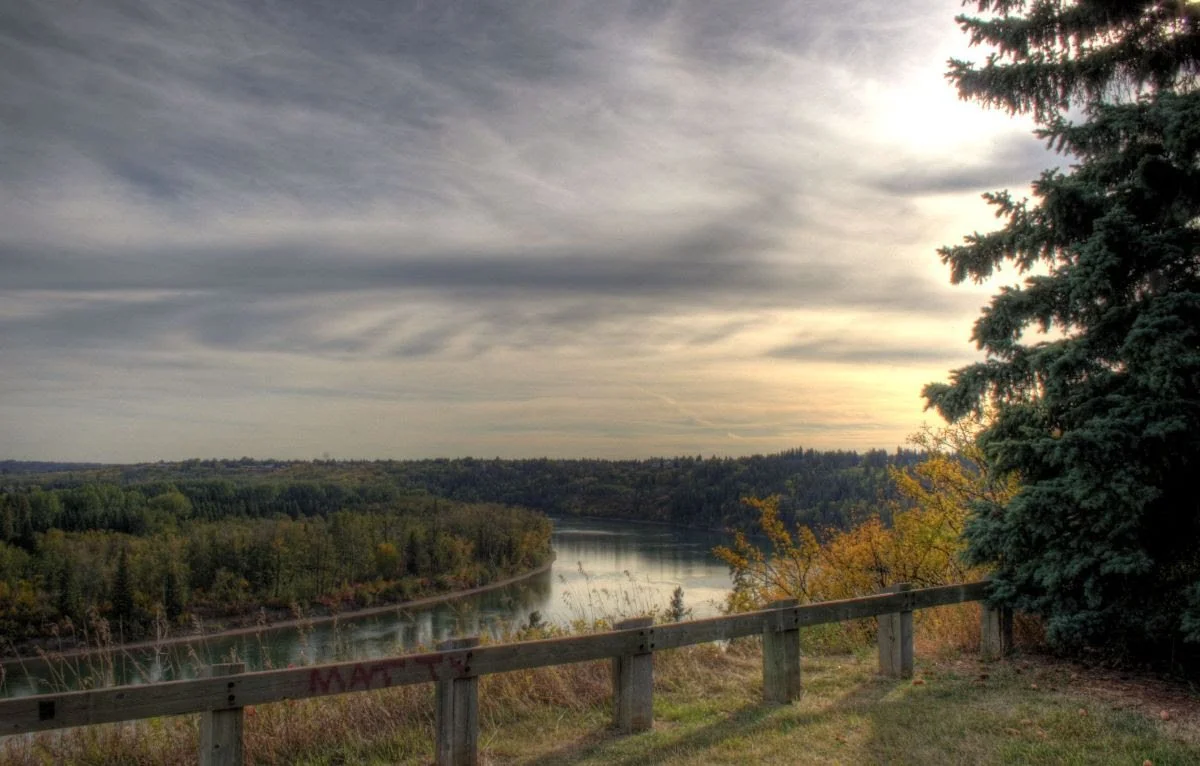
The irony of this argument is that it ignores the history of the river valley and the original reason the river valley was preserved as parkland. Our river valley history is not of pristine, undisturbed natural lands. This bend in the North Saskatchewan River has been a site of human activity for 15,000 years. Early settlers used much of the river valley for industry and as garbage dumps.

The recent history of our river valley park is citizens and councils having a vision of a ribbon of green. More than one hundred years ago the recommendation for a river valley park system was accepted and subsequent visionary councils have added land to Edmonton’s crown jewel. Now, we also understand its value as an ecological corridor for wildlife, birds, and other creatures.

The question our elected public stewards, city council, needs to address is, will they degrade or enhance Edmonton’s river valley vision? Learn why there’s no such thing as pristine nature at https://knowablemagazine.org/article/food-environment/2021/why-theres-no-such-thing-pristine-nature

Pollinators and Allergies
Joy writes “I live in a condo unit adjacent to a city park. Given the effort to increase pollinators in the urban community, please advise me as to how I can prevent bees from building a nest under my deck and wasps from building a nest in a crevice along my front walk. This is posing significant risk to those with allergies.”

Photo by Ria Busink

Comment or contribution
The newsletter will not publish next week. The next issue will be June 30.

Please note that articles may not reflect the position of NSRVCS. River Valley News is meant to be a clearinghouse for the wide variety of opinions and ideas about Edmonton’s River Valley.

If you have a comment, concern, or question, contact us at nsrivervalley@gmail.com Please email us river valley photos or event information. Your friends, neighbours and colleagues can sign up for this newsletter on our web site https://www.edmontonrivervalley.org/

Sincerely yours,
Harvey Voogd
North Saskatchewan River Valley Conservation Society
780.691.1712