River Valley News - Jan 12, 2023

New guide on Big Lake mammals, reptiles, and amphibians

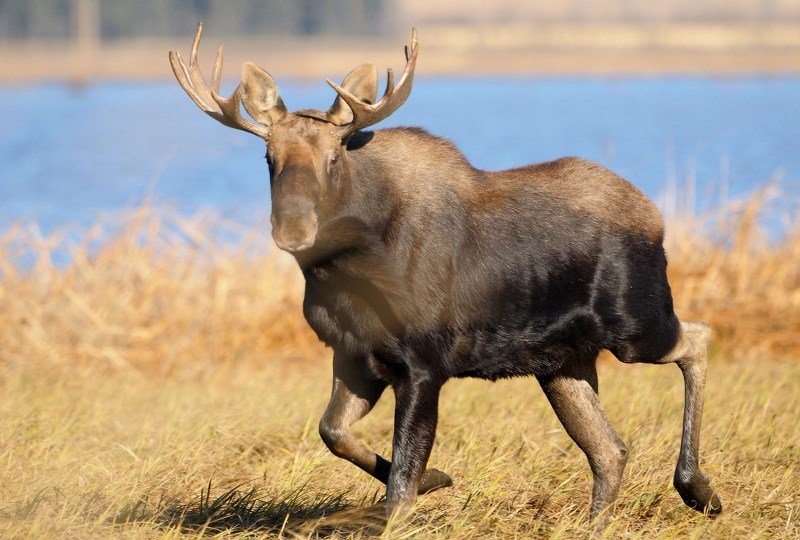
Nature fans can now learn all about the moose, mice, and wolverines of Big Lake through a just-released guide to the animals of Lois Hole Park. The Big Lake Environment Support Society’s Animal Guide to Lois Hole Centennial Provincial Park is available for purchase and in a free digital version.

The guide contains photos and information on 53 mammals, reptiles, and amphibians found in and around Lois Hole Park based on local knowledge and scientific research. The guide covers salamanders, toads, frogs, and snakes around Big Lake, said co-author Lyn Druett. These species tend to be elusive, and park visitors were more likely to hear than see them.

Guide co-author Linda Brain said researching the animals of Big Lake left her awestruck. The muskrat has two-to-three litters of six-to-eight young a year and serves as a food source for many predators. Big Lake was also likely home to thirteen-lined ground squirrels, which breathe once every five minutes during hibernation, and pygmy shrews, which eat three times their body weight every day.

Perhaps the most surprising entry in the guide is the wolverine, a ferocious, brown, stocky, dog-like creature that has been spotted just twice around Lois Hole Park in the last 10 years. Purchase and free digital version information at https://www.stalbertgazette.com/local-news/new-guide-for-big-lakes-animals-available-6344515

Three easy to grow flowers and one challenging flower

(Photo by Kristyn Mayner)

Wildflower News has an excellent article which is the first in a series to help people decide which native plants to add to their gardens this year. Three species will be featured each month with the article outlining the advantages and disadvantages of each and their distinctive features. A challenging species has been added for those of you who are looking for a challenge or something new.

Three easy to grow flowers are meadow blazingstar, giant hyssop, and gaillardia. All of these species have seeds that can be planted in spring without any special treatment. All three species attract and feed bees, butterflies, other pollinators and birds. These flowers are all perennials.

Who doesn’t love prairie crocus, the first flower of spring. It often pops up through the snow and their flowers are ready for harsh spring conditions. Each flower is a little solar energy collector that follows the sun. The petals, actually sepals, reflect the sunlight towards the centre, warming it by as much as 10 degrees above the surrounding temperature. However, this beautiful plant is challenging to grow.

Native plants in general bloom in the second year but could bloom in the first or third year in some instances. These plants do well in Edmonton garden soil without a lot added. Some may benefit from a small amount of compost added to soil. They do not need to be watered once they are established unless there is a drought. Learn more at https://cdn.sanity.io/files/d59screl/production/d4058cf2babdd6425c58826de8c81fb787cbfe87.pdf

Nocturnal animals that thrive in the dark

Meghan Jacklin, Conservation Coordinator for the Edmonton and Area Land Trust, recently spoke on CBC Radio about animals that thrive in the dark. Nocturnal animals in Edmonton includes foxes, owls, porcupines, skunks, bats in summer, and our most recent addition, the raccoon.

Being active at night means avoiding competition with animals active in the daytime and helps to avoid predators. Red squirrels are active in the day, while flying squirrels are active at night. Flying squirrels have large eyes to see in the dark and though called flying, actually glide. During the day, they roost in tree cavities.

A good spot to watch nocturnal animals is bird feeders. Flying squirrels will glide to feeders to eat and gather up the seeds and food left there. Porcupines will feast on fruit and seeds lying on the ground. Our river valley with its trees and natural habitat is also a good place to see nocturnal creatures. Remain quiet, lights out, and you may be surprised at the activity around you. Listen to interview at https://www.cbc.ca/listen/live-radio/1-17-edmonton-am/clip/15956255-its-dark-outside-animals

Balsam Poplar can live up to 70 years

Balsam poplar is a fast growing, fast suckering tree that prefers moist to wet sites, and can handle seasonal flooding. Indeed, it is well adapted to flooding: its deep, binding root system is excellent for holding together the banks of rivers, streams, lakes, and wetlands. Further, its infamous white fluff is timed perfectly with the June flood season, sprouting up on the exposed wet soils that are left as the waters recede.

The seeds of balsam poplar are eaten by birds, and the sticky fragrant leaf buds have medicinal properties, and can be used in salves and infused oils. Bees sometimes harvest the resin from balsam poplar and use it to disinfect their hives.

Balsam poplar is an excellent, commonly used pioneering species for Eco-Buffers, and is also used extensively in riparian buffers. It can provide a quick “nurse crop” for shade-tolerant species needing wind protection to get established, such as hemlock or white pine. It is often planted as a fast-growing windbreak in rural areas and does not root sucker as readily as other species.

The range of balsam poplar spans coast to coast and it is one of the hardiest deciduous trees in Canada. More at https://www.awes-ab.ca/species/balsam-poplar/

New Life. . .New Beginnings by Richard Tosczak, Hawrelak Park https://www.edmontonpublicart.ca/#!/details/78

Comment or contribution

Please note that articles may not reflect the position of NSRVCS. River Valley News is meant to be a clearinghouse for the wide variety of opinions and ideas about Edmonton’s River Valley. Email river valley photos, event information, comments, or questions to nsrivervalley@gmail.com

Sincerely yours,

Harvey Voogd

North Saskatchewan River Valley Conservation Society

780.691.1712

River Valley News - Jan 5, 2023

Al-Rashid the original little Mosque on the prairie

The Muslim community was established in Canada in the late 1800s when people began to immigrate from what is now Lebanon and Syria. As the community grew in Edmonton, some women made plans to open a mosque where the children could learn their religion and the community could host social functions.

Hilwi Hamdon, approached Edmonton’s Mayor, John Fry, in the hope that he would supply them with land on which to build the mosque. He responded by stating that the community did not have the money to build a mosque. Hamdon answered, “We’ll get the money.” The Mayor agreed to grant them the land if they supplied the money to cover the cost of construction, approximately $5,000

The community hired a Ukrainian-Canadian builder, Mike Drewoth. On the outside, two hexagonal minarets would be topped with an onion-shaped silver dome and a crescent moon. The mosque resembled a Russian Orthodox Church. The Al-Rashid Mosque was officially opened on December 12, 1938 on the corner of 101 St &108 Ave. It stood there until 1946 when the Public School Board asked the Muslim community to relocate so Victoria Composite High School could expand. In November of 1946, the Al-Rashid was relocated to 102 St & 111 Ave.

By 1975, the Al-Rashid was too small to accommodate them, and the community decided to build a new mosque. The Al-Rashid was left unused for 10 years. In 1988, the Royal Alexandra Hospital told the community the mosque needed to be moved within eight months or it would be demolished at the congregation’s expense.

The Canadian Council of Muslim Women formed to relocate the mosque to Fort Edmonton Park. They met with a great deal of opposition from Edmonton City Council, the city’s Parks and Recreation department, and Fort Edmonton Park. After a citywide debate, Fort Edmonton Park agreed to take the mosque under the condition that the Muslim community raise the funds to relocate and restore it. The Al-Rashid Mosque was formally opened at Fort Edmonton Park on May 28, 1992. Learn more at http://www.yegtales.ca/alrashid.html

Human gut microbiota invade urban wildlife

Different animals have different gut microbiota, depending on evolution, lifestyle, and their environment. Human urbanization is impacting ecosystems worldwide, so scientists want to understand how this might alter the microbiomes of affected wildlife.

Researchers investigated whether city-dwelling wildlife have different gut microbiomes than rural wildlife. They studied gut microbiomes in species that have both urban and rural populations, including white crowned sparrows, coyotes, and several anole lizard species, all of which are native to North America. To get a snapshot of their gut microbiomes, the team compiled DNA from fecal samples of each animal.

The coyote dataset included DNA from urban populations living in Edmonton, Canada, and rural populations in Leduc. The microbiomes of urban coyotes were somewhat similar to humans, but they still had more in common with their rural counterparts. This meant that the microbiomes of urban-dwelling populations of these animals were not identical to humans, but only shifted slightly towards more human-like microbes.

The authors wanted to know what factors could have changed the gut microbiomes of these animals. Their analysis showed the gut microbiomes of urban humans were less diverse than those of rural humans, but the gut microbiomes of urban coyotes were more diverse than rural populations. Scientists interpreted these results to mean that urban populations of animals had gained gut microbes rather than lost them. Read more at https://sciworthy.com/human-gut-microbiota-invade-urban-wildlife/

Pine Grosbeak a species of low conservation concern

(Photo by Joe Chowaniec)

Pine Grosbeaks are part of the finch family, dwarf every other finch and nearly every bird that lands on a bird feeder. They frequently visit feeders with black oil sunflower seeds or suet. Grosbeaks drink water or eat snow daily.

Most of their diet is made up of buds, seeds, and fruits from spruce, pine, juniper, birch, mountain ash, maple, box elder, crabapple, blackberry, ragweed, and burdock. It can be tough for their nestlings to eat and digest all that vegetation. Instead of feeding plants directly to their nestlings, they regurgitate a paste of insects and vegetable matter that they store in pouches at the lower part of their jaw on either side of their tongues.

In winter, they forage in groups from 5 to15 individuals. In areas where different call types exist, individuals with the same song type stick together. They do not forage with other groups with different flight calls. North American data suggest populations of Pine Grosbeaks held steady between 1966 and 2019. More at https://www.allaboutbirds.org/guide/Pine_Grosbeak/overview

Winter trails for dogs in the river valley

George writes “I just read your article about dogs off leash in the winter. I wish you would have added that the bylaw requires a dog off the property to be under the control of the owner at all times. I think a lot of people just assume that off leash means the dog can do whatever they want including running up to and jumping on other people. Readers can find the bylaw at https://www.edmonton.ca/public-files/assets/document?path=Bylaws/C13145.pdf “ 

Photo by Peter Woloshyn

Comment or contribution

Please note that articles may not reflect the position of NSRVCS. River Valley News is meant to be a clearinghouse for the wide variety of opinions and ideas about Edmonton’s River Valley. Email river valley photos, event information, comments, or questions to nsrivervalley@gmail.com

Sincerely yours,

Harvey Voogd

North Saskatchewan River Valley Conservation Society

780.691.1712

River Valley News - Dec 29, 2022

Peter Erasmus a raconteur who helped shape the Canadian west
Born in 1833, Peter Erasmus was an adventuresome Métis from Red River who found himself in almost every expedition, treaty signing, and mission of importance from the 1850s to the 1870s, sometimes in a key role, at the very least in the background, in the stories that shaped the North-West.
 
Erasmus was a colourful and important character in the events that marked western Canada's transformation from the open buffalo plains of Rupert's Land into townsites and farmsteads. He was a remarkable and highly educated man, fluent in six Native languages as well as English, Latin and Greek, and respected by Indigenous peoples, settlers and explorers.
 
Trained by the church for missionary work, Erasmus instead became one of the "mixed-blood" guides and interpreters who helped shape the Canadian west. His long career as a celebrated buffalo hunter, mission worker, teacher, trader and interpreter made him a legend in his own time. His involvement in such events as the Palliser expedition, the smallpox epidemic of the 1870s, the signing of Treaty Six, and the last big buffalo hunt has ensured his place in history long after his death at the age of ninety-seven.

Erasmus’ book Buffalo Days and Nights is a lively and fascinating account of his experiences, first assembled with the help of Henry Thompson, an Edmonton reporter, in the 1920s. This classic in western Canadian history, available at Edmonton Public Library, offers an insider's view into the events that surrounded the start of a new era. Read one of his stories at http://www.yegtales.ca/erasmus.html

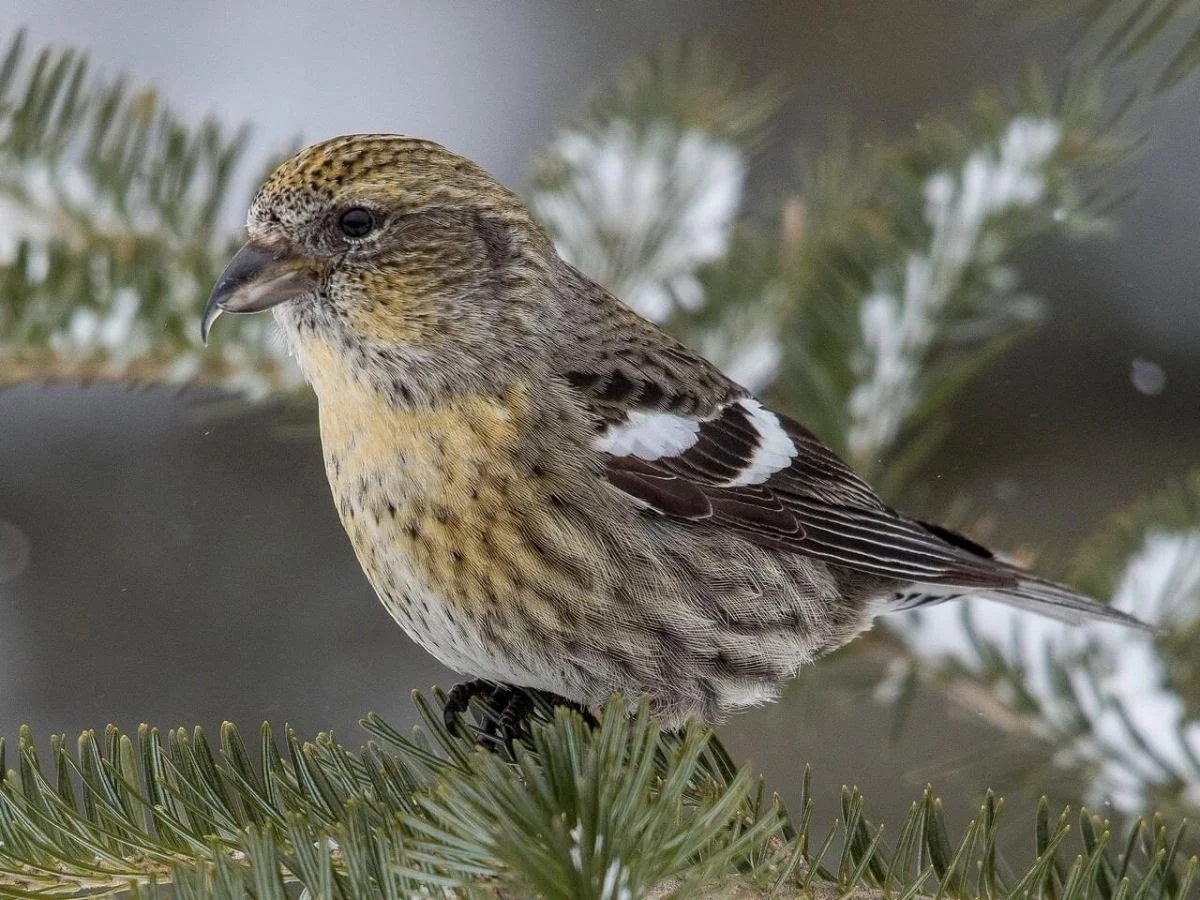
White-winged Crossbill eats up to 3,000 conifer seeds daily
White-winged Crossbills are an irruptive species, meaning that, when cone crops fail in their normal range, they can move far to the south. Their arrival in our area corresponds to the availability of food. The distinguishing characteristic of these birds is their crossed bill, an evolutionary adaptation allowing them to feed on cone crops.
 
White-winged Crossbills feed primarily on spruce seeds, eat up to 3,000 conifer seeds each day, and can be found in the boreal forest year-round. They feed in small flocks which work around treetops animatedly, hanging upside down like parrots, challenging others that come too close, then abruptly flying off to the next tree. They also descend to the ground to gather grit for digestion or to feed on fallen cones.
 
White-winged Crossbills are opportunistic breeders; they can start nesting at any point in the year when food is sufficient for the female to form eggs and raise young. The species has been recorded breeding in all 12 months. Learn more at https://edmonton.wbu.com/white-winged-crossbills-red-crossbills

Winter trails for dogs in the river valley
(Nick Croken photo)
Even in winter, our four-legged friends need fresh air and exercise. Though parts of the river valley are more suitable for snowshoes or cross-country skis in winter, with deep snow that isn’t as friendly for shorter dogs, there are several off-leash parks and trails in the river valley that make for the perfect getaway in the city to burn off your pup’s energy.
 
As with anywhere in the city, off-leash or not, be sure to be a considerate dog owner and scoop the poop, we all share the trails. If you are headed out to trek the trails with your pup in wintertime, make sure they are just as prepared for the elements as us humans are.
 
Here are some of our favourite spots in the river valley to take your dogs, Dawson Park, Hawrelak to Keillor Point, Mill Creek Ravine, Terwillegar Park, and West River’s Edge. These are either off-leash trails or are a trail adjacent to an off-leash park. In both cases, the trails are well-trodden enough by other walkers that you and your pup should not be knee-deep in snow at any point. Information on these trails at https://rivervalley.ab.ca/news/winter-activity-series-winter-pups/

Elk Island only completely fenced national park in Canada
Public interest in conserving rapidly dwindling elk populations lead to the establishment of an elk reserve in 1906. This evolved into Elk Island National Park. The “Island” in Elk Island’s name may have originated as a reference to the picturesque islands dotting Astotin Lake.
 
The park is situated in the Beaver Hills, an area, as the name suggests, abundant in beaver at the turn of the 19th century. What made the Beaver Hills unique was the aspen thickets which surrounded the prairie and provided forage and protection for the wintering herds of bison and year-round population of elk, moose, and deer.
 
Wildlife in the park includes coyote, rabbit, moose, elk, mule deer, hundreds of plain and wood bison, and at least 230 species of birds. Trumpeter swans have been re-introduced to the park. Elk Island has one of the highest concentrations of big game animals in the world.
 
Twenty-three bison were transported from Wood Buffalo National Park to Elk Island in 1965. When disease was detected in the herd, after infected cows produced calves, the cows were destroyed and the calves bottle fed. The wood bison in Elk Island today have descended from these bottle-fed babies. Learn about Elk Island National Park at https://parks.canada.ca/pn-np/ab/elkisland

Talus Dome by Ball Nogues Studio, City of Edmonton public art collection.
https://www.edmontonpublicart.ca/#!/details/61

Comment or contribution
Please note that articles may not reflect the position of NSRVCS. River Valley News is meant to be a clearinghouse for the wide variety of opinions and ideas about Edmonton’s River Valley. Email river valley photos, event information, comments, or questions to nsrivervalley@gmail.com
 
Sincerely yours,
Harvey Voogd
North Saskatchewan River Valley Conservation Society
780.691.1712