River Valley News - Feb 23, 2023

Nature-based solutions and Edmonton’s Zoning Bylaw

NSRVCS’ online Annual General Meeting will feature a presentation by Grant Pearsell titled “How Including Nature-based Solutions in the Zoning Bylaw can Increase Climate Resilience and Restore Ecological Functioning in Edmonton’s River Valley for Present and Future Generations.” The topic is timely as the Zoning Bylaw Renewal Initiative is underway and will result in City Council approving a new Zoning Bylaw by the end of 2023.

Grant will outline how NbS, or Nature-based Solutions, can help. The use of NbS is widely acknowledged as an essential part of mitigating and adapting to climate change as well as restoring biodiversity. Indeed, the importance of NbS was included in the Convention on Biological Diversity late last year at the COP15 where it was endorsed by more than190 nations.

The talk will provide an overview of NbS and explain how straightforward modifications to the Zoning Bylaw to include NbS can enhance ecological functioning, improve climate resilience, and user experiences for both present and future generations. The presentation is scheduled for 5:30pm, Monday, March 13. RSVP to nsrivervalley@gmail.com Your name and email is necessary to send the Zoom contact information to attend the event.

Grant Pearsell is an award winning urban ecological planner with over 40 years experience in the environmental sector. In 2020, he retired from the City of Edmonton, where he served as a Director in the Urban Planning Branch with portfolios that included urban nature and biodiversity, strategic parks planning, and data and analytics. Currently, Grant works part-time on Cities4Biodiversity with the Global Platform for Sustainable Cities https://www.thegpsc.org/

Private tree stand threatened by developer’s bylaw amendment proposal

In southwest Edmonton, where swaths of new single-family homes encroach on fields of wheat and canola, a century-old stand of trees is at risk. Cameron Developments has proposed bylaw amendments that would allow it to develop its own land, and plan for a stormwater pond to be built over most of the tree stand owned by Darryl Howery.

The stand of aspen, dogwoods and wild rose bushes makes up about three hectares of a 30-hectare property. It runs from 199 Street to the crest of the North Saskatchewan River Valley, where it spreads out and runs down the slope. A wildlife trail is visible along the stand’s southern edge. Cameron’s own consultant, Stantec, has found the tree stand to be an environmentally significant wildlife corridor, and to be of high ecological value. Stantec recommended that it be retained.

Howery’s daughter, Alicia, says the proposal runs counter to Edmonton’s City Plan and planning documents that emphasize preservation of trees and environmental connectivity. The City’s own estimate to reach its goal of 20 per cent tree-canopy coverage in 50 years, states it needs to encourage private landowners to increase their canopy by 70 per cent. “It’s hard to imagine how they’re going to get close to that if they’re not letting landowners who want to preserve and grow their trees to keep what they have,” she says.

The Howerys have no plans to develop their property, and, in fact, continue to rewild it. Just last summer, with the help of the Agroforestry & Woodlot Extension Society, they planted more than 1,000 trees. “We don’t need somebody to designate it in some way for us to value it,” says Darryl. “We already value it and will continue to value it.” Read more at https://urbanaffairs.ca/edmonton-ish/trouble-with-the-trees/

Wood frogs freeze to survive Canadian winter

Unable to travel large distances to escape Canada's winter, wood frogs have developed one of the most incredible survival strategies.  They freeze. As winter comes, they hunker down just under the leaf litter. They begin to produce a special anti-freeze in their blood, made out of glucose and glycogen. 

As the temperature continues to drop, this antifreeze is taken up into their cells. Inside each cell, the sugary syrup keeps the cells plump and strong, and prevents ice crystals from forming which would kill them. When in this frogcicle state, their hearts stop beating and they stop breathing. As much as 70 per cent of the frog's body is frozen solid.

The frogs can survive all winter in this suspended animation, undergoing several cycles of freezing and thawing as the temperature changes. When the weather warms, the frogs thaw and emerge to begin their chorus, signalling the start of Canadian spring. Watch video at https://www.cbc.ca/wildcanadianyear/m_blog/these-zombie-wood-frogs-literally-freeze-to-survive-the-northern-winter
Canadian Pacific Railway and the High Level Bridge

In the early 1900s, the Town of Strathcona became concerned that when the High Level Bridge into Edmonton was opened it would become a mere whistle-stop on the extended main line. In 1906, it worked out an agreement with the Canadian Pacific Railway making Strathcona the railway’s chief divisional point in northern Alberta.

In return for up to 70 acres of land, free from taxation for 15 years, Canadian Pacific completed a $50,000 extension to its yard in Strathcona, constructed a 12-stall roundhouse, built a 280-ton coaling plant and agreed that the town would be the terminal for the lines via Saskatchewan and Wetaskiwin.

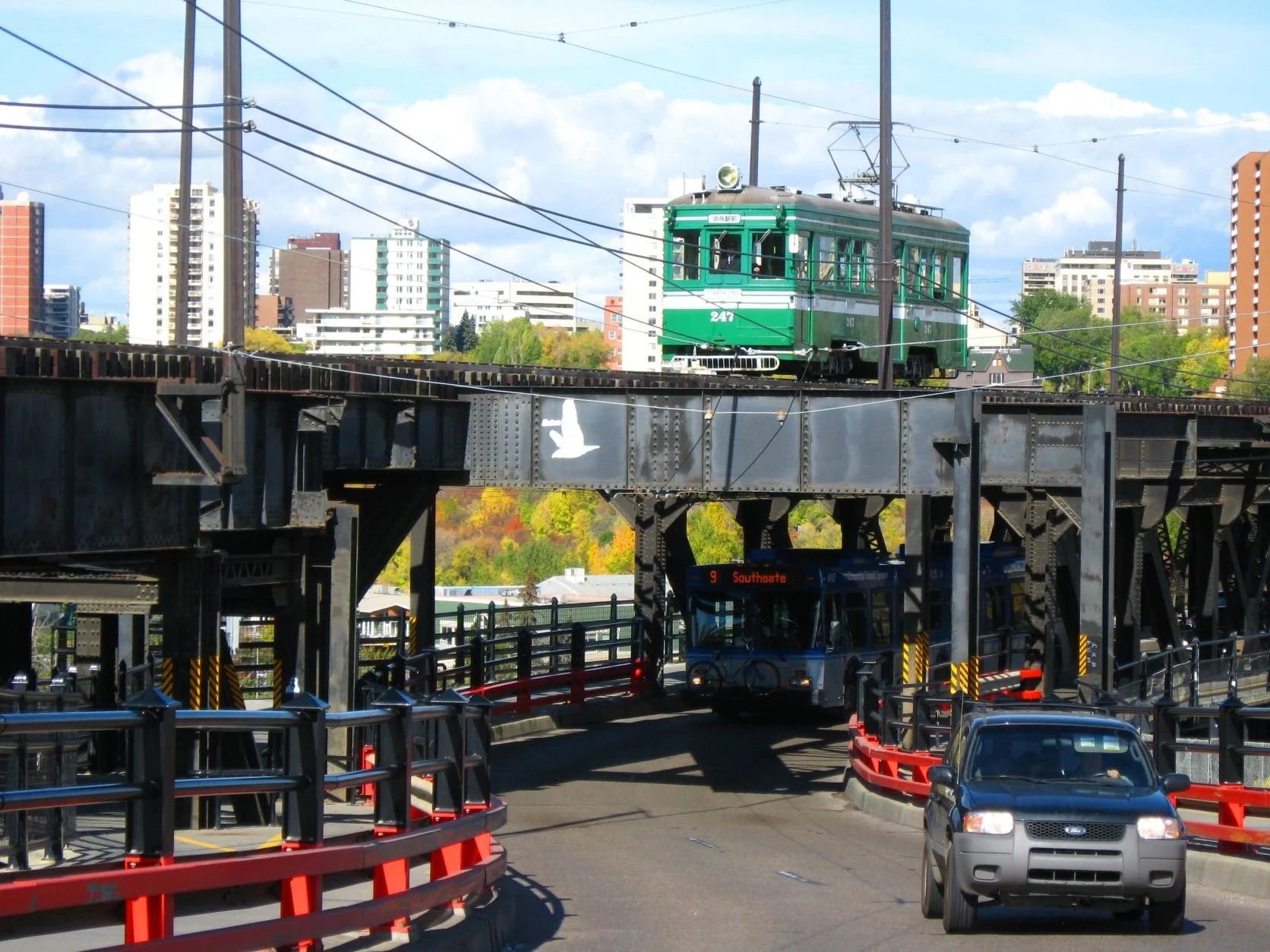
Construction of the High Level Bridge commenced in 1910 and the final steelwork was in place in mid 1913. It was opened for traffic on June 20, 1913. The bridge was unusual in that it was used by the CPR, the Edmonton Radial Railway and carried highway traffic on the lower deck. The streetcar service from downtown to south Edmonton, via the High Level Bridge, commenced on August 11, 1913 and ran on tracks on the upper deck, laid on either side of the railway track.

The last streetcar ran over the bridge on September 1, 1951. Rail passenger service across the bridge ceased on October 28, 1972 when CP Rail trains were cut back to the Strathcona Station. Learn more at https://railways.library.ualberta.ca/Chapters-7-3/

Hawrelak Park trees

Carol writes “I love the newsletter and am also concerned about the total lack of clarity around the three-year Hawrelak Park redevelopment. I am retired but if I can help please let me know.”

Masood emails “I’ve been following the public reaction to the Hawrelak tree removal plan from afar and with some sadness. I don’t want to be broadly naïve, some trees sometimes do need to be removed, but I have no idea which trees are soon to disappear, and that is unsettling. 

Has any citizen group asked the City to identify and mark the individual trees that are planned to be cut? If this is known, might advocates not go to the park and adorn these trees, perhaps in mourning colours, black, white, purple, and give everyone a chance to say goodbye to those trees? Might this not make a very strong visual counterpoint to the current plan?”

Kaskitewâw Asiskîy or Blackmud Creek rich in history

Melanie says “Fascinating read, thank you! Have you written about Whitemud Creek? I live on the side of it and would love to know more Indigenous connection about it!”
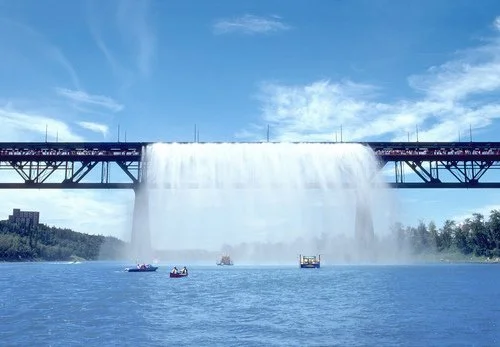
Great Divide by Peter Lewis, 200 pipes producing a cascade of water from the High Level Bridge. This artwork is not currently operating. https://www.edmontonpublicart.ca/#!/details/96

Comment or contribution

Please note that articles may not reflect the position of NSRVCS. River Valley News is meant to be a clearinghouse for the wide variety of opinions and ideas about Edmonton’s River Valley. Email river valley photos, event information, comments, or questions to nsrivervalley@gmail.com

Sincerely yours,

Harvey Voogd

North Saskatchewan River Valley Conservation Society

780.691.1712

River Valley News - Feb 16, 2023

How do freshwater turtles survive a Canadian winter

Turtles are ectotherms, cold-blooded, hence their body temperature is determined by the environment. They avoid sub-freezing temperatures by remaining on the bottom of wetlands, lakes and rivers. Ice covers the top of these waterbodies but on the bottom the water remains liquid, but very cold.

How can they survive so long without breathing? The only reason they can do this is because the temperature of the water and their bodies are so cold. A study in Ontario found that the body temperature of turtles remained around 1C all winter long. By having a very low body temperature, turtles reduce the amount of oxygen they need.

One would expect turtles sitting on the bottom of the pond with a body temperature of 1C to be completely inert and unresponsive, yet they seem to be aware of what is going on around them and can even move. A study on Wood Turtles in winter found they moved up to 10 metres.

Video of turtles hibernating https://blog.cwf-fcf.org/index.php/en/how-do-freshwater-turtles-survive-a-canadian winter/#:~:text=They%20would%20freeze%20to%20death,of%20wetlands%2C%20lakes%20and%20rivers

Kaskitewâw Asiskîy or Blackmud Creek rich in history

The headwaters of Kaskitewâw Asiskîythe Cree word for Blackmud Creek, are located near Nisku. It meanders north, crossing Highway 2 before entering Edmonton. Blackmud Creek offers ample opportunities to enjoy nature through interactions made available at numerous urban parks.

The creek and ravine are rich in history. Calvin Bruneau of Papaschase First Nation has been looking for the Kaskitewâw Asiskîy burial ground since the mid-1990s to find physical evidence to support the nation’s claims. He discovered oral histories suggesting the burial ground had been in use prior to their second forcible displacement and disputed surrender of the land in 1888.

In 2019, using ground-penetrating radar, the University of Alberta and Papaschase First Nation conducted an unmarked grave survey at the suspected site, which is on land owned by the City of Edmonton and Taylor Seminary. The remote sensing data did locate some graves where the Elders and community members believed the burials to be but future research will be needed.

Blackmud Creek joins Whitemud Creek in Mactaggart Sanctuary before traveling the final distance to the North Saskatchewan River. Blackmud Creek walking map https://www.edmonton.ca/sites/default/files/public-files/assets/PDF/201701_blackmud_heritage_map.pdf?cb=1624667971

Roman Fodchuk the landscape architect who completed the Capital City Recreation Park

For those interested in the history of our river valley, the City of Edmonton Archives is pleased to announce that the Roman Fodchuk fonds is now available to the public, with a description of the holdings available on its database. Fodchuk was the landscape architect hired by the City and Provincial Government to complete the Capital City Recreation Park, beginning in 1975.

This part of the River Valley stretched from Kinsmen Park and the Alberta Government Centre to Strathcona Science Park and Hermitage Park. He created hiking and biking trails, cross country ski mazes and downhill ski slopes, purchased land to create wildlife throughway when there was none, planted up areas to limit erosion and landslides, and developed the riverbank to limit flooding damage into the future. 

The initial collection came from Roman and the archives continues to receive further materials from the estate. The collection was appraised by the National Archival Appraisal Board as a significant collection of Canadian History. View the yeg_archives Instagram page to see images and blueprints of his projects. Roman Fodchuk fonds at https://cityarchives.edmonton.ca/roman-fodchuk-fonds

Are Hawrelak Park trees the canary in the coal mine

Virendra writes "Why can’t we reverse the decision to cut down all these trees in Hawrelak Park? We should do everything we can to save these trees. Can’t imagine a development or improvement of Hawrelak Park that will be worth cutting hundreds of trees. Whatever delay not cutting the trees would cause will be well worth it. Why is a development that will cause so much destruction of nature worth it? What did the cost benefit show?"

Jane wrote "Cannot believe that City planners think the public would prefer concrete to trees in Hawrelak Park. Cutting down 220 trees is an absolutely mind-boggling blunder that will take many years to overcome. There must be some way to stop this destruction."

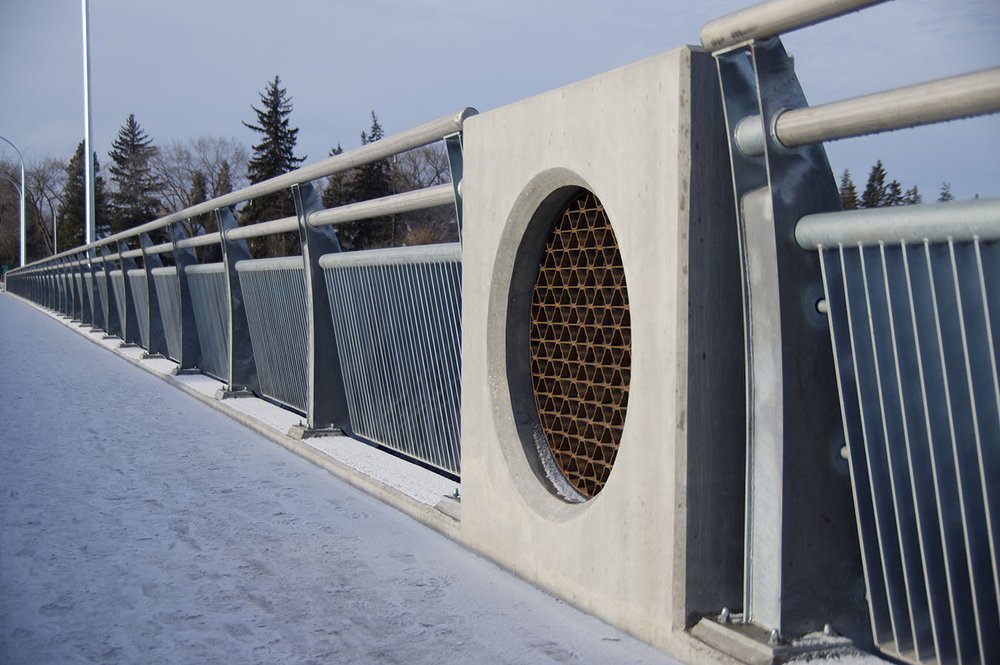
Reign by Mary Anne Barkhouse, INIW River Lot 11, 10380 Queen Elizabeth Park Road. Connor McNally still. https://www.edmontonpublicart.ca/#!/details/190

Comment or contribution

Please note that articles may not reflect the position of NSRVCS. River Valley News is meant to be a clearinghouse for the wide variety of opinions and ideas about Edmonton’s River Valley. Email river valley photos, event information, comments, or questions to nsrivervalley@gmail.com

Sincerely yours,

Harvey Voogd

North Saskatchewan River Valley Conservation Society

780.691.1712

River Valley News - Feb 9, 2023

United Nations features Sherilee Harper from University of Alberta

February 11 is International Day of Women and Girls in Science. Did you know women are typically given smaller research grants than their male colleagues and, while they represent 33.3% of all researchers, only 12% of members of national science academies are women. In cutting edge fields such as artificial intelligence, only one in five professionals (22%) is a woman.

A significant gender gap has persisted throughout the years at all levels of science, technology, engineering and mathematics (STEM) disciplines all over the world. Even though women have made tremendous progress towards increasing their participation in higher education, they are still under-represented in these fields.

One of the women featured by the United Nations is Sherilee Harper, Associate Professor in the School of Public Health at the University of Alberta. Her research investigates associations between weather and Indigenous health in the context of climate change. She collaborates with Indigenous partners to prioritize climate-related health actions, planning, interventions, and research.

Harper co-leads the Indigenous Health Adaptation to Climate Change (IHACC) program, an international research initiative that works closely with Indigenous peoples and their organizations in the Canadian Arctic, Ugandan Impenetrable Forest, and the Peruvian Amazon. The program aims to utilize science and Indigenous knowledge to strengthen health systems in a rapidly changing climate, within three areas: food security; malaria; and foodborne and waterborne disease. Learn more https://www.un.org/en/observances/women-and-girls-in-science-day?mc_cid=ac785272d1&mc_eid=b02c6f60ed

Are Hawrelak Park trees the canary in the coal mine

Bob Priebe, former Director of Parks Planning at the City of Edmonton, asks in a recent post if the proposed Hawrelak Park tree cutting may be the proverbial ‘canary in the coal mine’. He says “The loss of trees at Hawrelak represents a symptom, the expansion of neoliberal policy applied to community projects, that prioritize efficiency of the construction process, and minimizing the cost of government.

The real and human cost of relocating festivals borne by our park co-production partners, festival goers and park visitors is hard to quantify, but nevertheless real. It appears there was no single voice for parks, it was passed between silos.

I have confidence in this group of councillors who have demonstrated a broad people orientated approach to sustainable city building. Has that message been adopted by the Administration?” Read complete piece at https://robertpriebe.substack.com/p/william-hawrelak-park-closure-are 

Three easy to grow wildflowers plus one challenging plant

Wild Bergamot, Slender Blue Beardtongue and Golden Aster are easy to grow perennial native plants. They can be grown from seed but will be small plants the first year because they like to establish a strong root system before they put energy into top growth. In their second year they put on a nice growth spurt and flower.

Wild bergamot is a member of the mint family but will not spread like mint. This is a bushy, medium-tall plant that adds more flowering stems each year. Slender Blue Beardtongue is a short, spring-blooming plant and the blooms come in an array of shades of blue, purple and even pink. Golden Aster is a small plant with sunshine yellow flowers and soft grey-green leaves.

Purple Prairie Clover are medium height and have fine textured foliage and narrow spikes of vivid pink flowers. If you would like to take on the challenge of growing this vibrant flower you will need a south-facing sunny slope, and sandy soil. Add some gravel and a good amount of compost to the planting hole. Plant information https://cdn.sanity.io/files/d59screl/production/a09af6fe35d8efb0ec2e662c3f03009f8349a5ac.pdf

ABMI hiring up to 40 summer field techs

Are you interested in being part of a world-class biodiversity monitoring program? Do you want to spend your summer travelling through Alberta’s landscapes, contributing to understanding of Alberta’s natural world, potentially helping discover new species, and getting paid for all of it? Then apply by February 27 to the Alberta Biodiversity Monitoring Institute (ABMI)

Summer field technologists are the backbone of the ABMI. Every spring the ABMI’s Monitoring Centre hires field technologists to collect information on the state of biodiversity across the province of Alberta. This information is used by various stakeholders, including government and industry, to facilitate responsible management of Alberta’s living resources.

Summer field technologists conduct surveys at confidential ABMI site locations. Successful applicants may work in the Ecosystem Health Program, or Oil Sands Monitoring program. Sites are located across a wide range of terrain, from boreal forests in the north, to the Rocky Mountains in the west, to prairie and grasslands in the south. Information https://abmi.ca/home/careers/field-monitoring-positions.html?mc_cid=ac785272d1&mc_eid=b02c6f60ed

Let’s rethink Hawrelak Park plan

Sandra writes “Cutting down trees that help the environment is unacceptable. Thank you for posting.”

now & then by Faye HeavyShield, 102 Avenue Bridge. Doyle C. Marko photo. https://www.edmontonpublicart.ca/#!/details/213

Comment or contribution

Please note that articles may not reflect the position of NSRVCS. River Valley News is meant to be a clearinghouse for the wide variety of opinions and ideas about Edmonton’s River Valley. Email river valley photos, event information, comments, or questions to nsrivervalley@gmail.com

Sincerely yours,

Harvey Voogd

North Saskatchewan River Valley Conservation Society

780.691.1712