NSRVCS News - November 5, 2020

logo.jpg
photo.jpg

Photo worthy viewpoints in the river valley
A favourite part of travel for many people is finding great views, maybe views you’ve seen shared on Instagram or the internet and capturing them with a camera to savour the memory forever. Of course, this year is not a normal time for travel, and maybe you’re left craving those views and Instagram-worthy spots.

The truth is, there is no better time to explore your own backyard. Edmonton’s river valley is home to a multitude of great views and vistas. River Valley Alliance staff, ambassadors and photographer friends have put together a list of some of the best viewpoints the river valley has to offer. See photos and locations at https://rivervalley.ab.ca/news/photo-worthy-viewpoints-in-the-river-valley/
emily.jpg

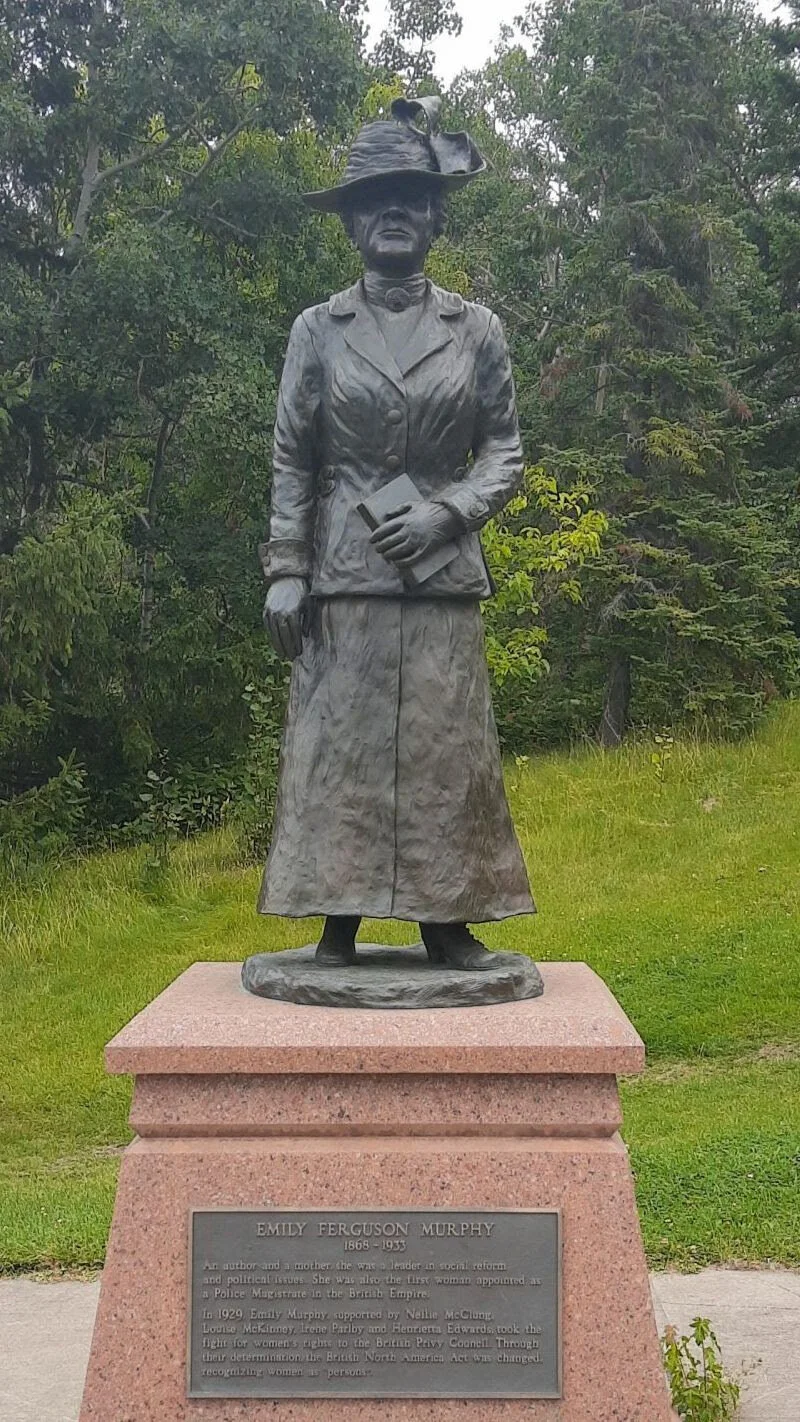
Other side of Emily Murphy
Shortly after entering Emily Murphy Park, which sits on the banks of the North Saskatchewan River between Groat Bridge and the main campus of the University of Alberta, there is a dark grey statue of Emily Ferguson Murphy, who lived from 1868 to 1933.

In many ways this is a very conventional historical monument. It reminds present day citizens of the lead role she played as a member of the Famous Five, and their successful fight to have women declared “persons” in Canada and therefore eligible to serve in the Senate. Each of the Famous Five have a park named after them in Edmonton’s North Saskatchewan River Valley.

Like so many historical figures, the life of Emily Murphy is being re-examined and re-evaluated. Increasingly, historians have begun to shed light on her beliefs about racial superiority and eugenics. Since the 1980s, historians have shown how many first wave feminists like Murphy fought for equal rights for predominantly white women, or more precisely, white, educated, upper-class, Protestant women. Read more at https://citymuseumedmonton.ca/2020/10/21/the-other-side-of-emily-murphy/

trail.jpg

Gold Bar park to Rundle park trail
This trail lets you enjoy two gorgeous footbridges over the North Saskatchewan River, with sweeping views both east and west, plus easy strolls in two well-treed parks. This walk could make a great adventure day for the whole family and dog. It is also a great bike ride.

For an extra long adventure, you could extend the route from Gold Bar park up the ravine to Tiger Goldstick park, or cross the Rundle footbridge to Strathcona Science park for further exploration.

Ainsworth Dyer Memorial Bridge is named after one of four Canadian soldiers who were killed in a friendly fire incident in Afghanistan. There is a monument to Dyer and his fellow soldiers once you cross the bridge.

At the Rundle park footbridge, turn around to head back the way you came, walk to the middle to get more river views, or continue onwards by crossing the bridge into Strathcona Science Park. Parking and directions at https://rivervalley.ab.ca/trail-treks/trail-trek-how-to-gold-bar-park-to-rundle-park/

gull.jpg

This gull really likes French fries
There are many types of gulls in Alberta, but the most abundant is the ring-billed gull. There is one thing we all know about this gull; it really likes French fries. It is rare to see a fast-food restaurant without a pack of gulls in the parking lot, squabbling over food scraps.

The ring-billed gull is a strong, acrobatic flyer that has been known to snatch food from human hands while in flight. In addition to human food the bird eats earthworms, rodents, fish, bird eggs, and grains.

The ring-billed gull is a commuter, nesting along lake shores and open fields, and making its way in and out of the city daily. Like Canada geese, they fly together in groups in a V-formation. In the fall some of these gulls will still be seen in Edmonton into October or early November. Learn more at https://www.allaboutbirds.org/guide/Ring-billed_Gull/overview

beaver.jpg

Know someone who should get this weekly newsletter
Sign up for this newsletter at https://www.edmontonrivervalley.org/

If you have a photo, news, an event, volunteer or employment opportunity involving Edmonton’s river valley and want to see it in this newsletter, please email the material to nsrivervalley@gmail.com

Sincerely yours,
Harvey Voogd
North Saskatchewan River Valley Conservation Society
nsrivervalley@gmail.com
https://www.edmontonrivervalley.org/
Facebook @NSRVCS
Instagram @nsrvcs

NSRVCS News - October 30, 2020

logo.jpg
ravine trail.jpg

Mill creek ravine trail – the Mill Woods edition
This trail is a great option if you live in Edmonton’s south east and do not want to travel far for a beautiful walk in nature. Drive south on 50 St and turn left at 40 Ave. Park along 47 St and 40 Ave.

Head down the slight hill to the ravine entrance, which is marked with a sign. One direction leads you to the Jackson Heights neighbourhood, the other to the South Ravine. Turn right to follow the South Ravine trail.

After 2.5 km, you will have reached the end of this section of ravine. This is marked by a trail fork, where you can either go to 34 St or into the Silverberry neighbourhood. There is more trail on the other side of 34 St, but to keep this route 5 km long, turn around here and go back the way you came.

If you have a dog that still needs to burn off energy, you can extend your walk once you return to the green space out of the ravine. Walk north on 50 St to reach Jackie Parker Park, an off-leash area with a few small sections of trail. Trail info at https://rivervalley.ab.ca/news/trail-trek-how-to-mill-creek-ravine-the-mill-woods-edition/

coal mine.jpg

Last Edmonton coal mine in Whitemud
Situated adjacent to Snow Valley Ski Hill and Rainbow Valley Campground, the Whitemud Creek Coal Mine was the final one in Edmonton. It opened in 1952, the same year the last coal mine closed in Beverly.

The underground mine extended from 45th Avenue on the southside (now Whitemud Freeway) to 52B Avenue on the north and from 142 Street on the west to roughly 126 Street on the east. The slope into the hill was at fifteen degrees, and the air shaft or manway was seventy-two feet. The coal seam was substantial, six to eight feet in depth, so miners could work standing up.

The mine operated behind a single “No Trespassing” sign adjacent to a busy natural area that provided skiing in the winter and camping and day picnic use in the summer. Bert’s Saddle Club, which offered horse rides, was also nearby in Rainbow Valley.

The mine lease extended under two neighbourhoods, South Brookside and Lansdowne, and despite “considerable ground movement,” including a cave-in, a squeeze and heaves, a stability study prepared in 1974 cited “no evidence that the coal mining activity north of 45th Avenue affected the slope stability of the creek valley.” The closure of the Whitemud Creek Coal Mine in 1970 marked the end of underground coal mining in Edmonton. Learn more at https://citymuseumedmonton.ca/2020/10/14/the-last-edmonton-coal-mine-whitemud-creek/

lemming.jpg

Northern bog lemming not just a tundra resident
Lemmings are not just an Artic mammal. Northern bog lemmings are found in wet northern forests, bogs, tundra, and meadows, including in Edmonton and area. They are a small rodent related to gerbils and hamsters.

Female lemmings have two or three litters of four to six young in a year. The young are born in a nest in a burrow or concealed in vegetation. They feed on grasses, sedges, mosses, other green vegetation, as well as snails and slugs. Predators include owls, hawks, mustelids and snakes.

Lemmings are active year-round, day and night. They make runways through surface vegetation and dig burrows. In winter, they burrow under the snow. These animals are often found in small colonies. Lemming populations go through a 3 to 4-year cycle of boom and bust. Read more at https://wildernessclassroom.org/wilderness-library/northern-bog-lemming/

NSRVCS now on Instagram
We are now on Instagram @nsrvcs

You can also find us on Facebook @NSRVCS

Know someone who would enjoy receiving this weekly newsletter? You can sign up for this newsletter at https://www.edmontonrivervalley.org/

If you have a photo, news, an event, volunteer or employment opportunity involving Edmonton’s river valley and want to see it in this newsletter, please email the material to nsrivervalley@gmail.com

Sincerely yours,
Harvey Voogd
North Saskatchewan River Valley Conservation Society
nsrivervalley@gmail.com
https://www.instagram.com/nsrvcs/
https://www.facebook.com/NSRVCS/
https://www.edmontonrivervalley.org/

NSRVCS News - October 22, 2020

logo.jpg
solar.jpg

Council votes to tear down green to fabricate green
On Monday, City Council voted 7 to 6 to approve rezoning which allows Epcor to industrialize and clutter up Edmonton’s river valley with 45,000 solar panels, to create a giant solar power plant.
 
Thank you to Councillors Cartmell, Dziadyk, Knack, McKeen, Nickel and Paquette who voted against it. Mayor Iveson and Councillors Banga, Caterina, Esslinger, Hamilton. Henderson and Walters voted for the proposal.
 
Graham Hicks summed it up best in a 2019 Edmonton Sun column stating, “All this, because council wanted Epcor to follow its The Way We Green environmental plan, that 10% of the power used in EPCOR’s Edmonton operations (electricity distribution, water treatment, water/sewage infrastructure) be produced from local, renewable energy sources.
 
Our river valley’s contemporary history is of the triumph of maintaining and developing pristine parkland over repeated attempts, by real estate developers, industry and organization to construct large facilities/buildings in the river valley.
 
Why make an exception for a solar farm? Multiple bylaws and policies are in place to ensure the river valley stays as pristine as possible. Some exemptions exist. Century-old river valley neighbourhoods have grandfather rights. Some industrial facilities – water and sewage treatment plants – have to be close to the river.
 
Here’s why Edmonton’s city council should not allow Epcor’s solar farm proposal.

  1. The land in question was originally zoned to be river valley park for reasons still sound today … to stop further industrialization/development of the North Saskatchewan river valley.

  2. The solar farm is totally unnecessary. The E.L. Smith Plant functions just fine on electricity now coming in on transmission wires. To meet sustainability “quotas”, EPCOR could easily purchase “green energy” from providers like Bullfrog Power, or from Capital Power’s Halkirk wind farm.

  3. Why would city council willfully approve such industry in the river valley, with its visual pollution, in the guise of cleaning up atmospheric pollution? Sorry, but covering acres of parkland with solar panels constitutes an industrial use and would create an industrial look that’s the antithesis of an urban wilderness park.

  4. To approve this project is to tolerate the gradual, incremental intrusion of non-park uses into the river valley. If EPCOR can change the zoning, how about all the property developers holding river valley land upstream from the Henday Bridge, patiently waiting for the day they too can get zoning exemptions?

There’s enough intrusion into the river valley as it is – golf courses, existing neighbourhoods, the Kinsmen Fieldhouse, the Convention Centre, water treatment facilities, transportation corridors and the spilling of downtown past the Chateau Lacombe into the downtown river valley.”
 
If you feel the same as Hicks, remember Edmontonians get to express their feelings on this decision in October 2021 city elections. Until then, you can thank or criticize your Councillor and the Mayor by emailing them at council@edmonton.ca

park.jpg

Should river valley be a national urban park
Under the Parks Canada Agency Act, the Minister invites Canadians to share their views and perspectives on the work of Parks Canada every two years. In 2020, the Minister’s Round Table will be held from October 8 to October 30 beginning with small discussion forums and concluding with a public consultation held from October 19 to 30.
 
The consultation’s five themes include urban parks, ecological corridors, and diversity, inclusion, and accessibility. In September, urban parks figured prominently in the federal government’s Speech from the Throne.
 
Our society supports that Parks Canada consider a number of options for playing an even greater role in urban conservation, including: creating a number of new national urban parks modelled on Toronto’s Rouge National Urban Park; and partnering with municipal and other governments to support the creation and/or management of new or existing urban parks. Imagine Edmonton's river valley as a national urban park!
 
Details on the themes and focuses of the 2020 Minister’s Round Table and information on how to share your views at https://www.letstalkparkscanada.ca/index.php

blackburn.jpg

Smith Blackburn homestead conservation land
Edmonton and Area Land Trust announced the public opening of Smith Blackburn Homestead, a 73-acre land donated to the Trust in 2018 to honour the memory of Cec Blackburn. The land was homesteaded, lived on, and cared for by the women, men and children of the Averell and Smith families between 1903 and 1989.

Cec was a dedicated walker and community builder who would be pleased that people can come here to experience the inspiration, solace, and lessons of the natural environment. Three boardwalks have been installed on the land to allow access while protecting sensitive habitat, and now the land is ready for visitors.

The Smith Blackburn Homestead is in the Beaver Hills UNESCO Biosphere Reserve. With close proximity to Elk Island National Park, the Cooking-Lake Blackfoot Recreation Area, and Beaverhill Lake, it is part of a close network of conserved areas in this region, which provide a large area of connected habitats, wildlife corridors, and stepping stones for wildlife, in a region that is otherwise highly fragmented.
 
The Smith Blackburn Homestead is an additional piece to this mosaic of natural areas that provides homes for breeding waterfowl and songbirds, large mammals, carnivores, and plays an important overall role in maintaining biodiversity in this region. Information at https://www.ealt.ca/smith-blackburn

art garden.jpg

Hawrelak Park art garden celebrates community
There’s a new public art playground in Edmonton, and it’s built on a human scale, meant to be climbed all over — and very Instagrammable by design. What’s more, it’s an easy-to-fathom symbolic celebration of one of Edmonton’s greatest assets: community engagement.
 
The multi-station artwork was designed and fabricated by Alberta’s Heavy Industries and is part of a larger newly-designed public space on the south side of the Heritage Amphitheatre in Hawrelak Park, commissioned by the Edmonton Federation of Community Leagues (EFCL), in advance of Canada’s first community league program — ours — turning 100 next year.
 
The space includes a smartly designed plaza with covered semicircle roofs around a cylindrical stone fireplace, a nice echo of the historic Canada Packers Smoke Stack on Fort Road. Read more at https://edmontonjournal.com/news/local-news/new-hawrelak-park-art-garden-celebrates-community-in-six-sculptures

Newsletter sign up and contributions
Know someone who would enjoy receiving this weekly newsletter? You can sign up for this newsletter at https://www.edmontonrivervalley.org/
 
If you have a photo, news, an event, volunteer or employment opportunity involving Edmonton’s river valley and would like to see it in this newsletter, please email the material to nsrivervalley@gmail.com
 
Sincerely yours,
Harvey Voogd
North Saskatchewan River Valley Conservation Society
780.691.1712
nsrivervalley@gmail.com
https://www.facebook.com/NSRVCS/
http://www.edmontonrivervalley.org/