River Valley News - March 17, 2022

Hawrelak park closure and construction plan continues
Executive Committee’s agenda on March 23, includes agenda item William Hawrelak Park – Environmental Impact Assessment and Site Location Study. Council approval is needed so construction can begin in 2023. The current construction plan includes a full park closure for a duration of up to 3 years.

This would start in spring 2023 with most of the work being completed by fall 2024. Many people are concerned about this lengthy loss of park space. The city says although a full park closure is impactful, it allows the best opportunity to minimize park downtime for day users and avoid impacts to festival organizers over an extended period of years as in a staged approach.

Hawrelak Park opened in 1967 and is the most intensively used park in Edmonton. Prior to the park opening, the area served as a gravel pit in the 1950s. Small portions of the park are located within the City’s Flood Protection Overlay.

Members of the public may participate at Committee meetings in person or remotely. To present, contact the City Clerk at city.clerk@edmonton.ca or 780-496-8178. Executive Committee begins at 9:30am on March 23.

To read the three reports, click on agenda item 6.4 at
https://pub-edmonton.escribemeetings.com/Meeting.aspx?Id=ab98dfb3-b8d3-487a-b0d2-370c6fbd308b&Agenda=Agenda&lang=English
Edmonton region national urban park process formally begins
On March 10, Randy Boissonnault, Minister of Tourism and Edmonton MP, announced the launch of the pre-feasibility phase to explore the creation of a national urban park in the Edmonton region.

Parks Canada and the City of Edmonton will work closely with Indigenous partners to ensure that a national urban park in the Edmonton region showcases Indigenous stewardship, voices, and stories, and offers opportunities for connections to the land and water based on Indigenous knowledge and values.

A national urban park in the Edmonton region will mean better access to quality green space for Edmontonians and promote better mental and physical wellbeing as people spend more time in nature. It would also create jobs, strengthen the local economy, and compliment the City of Edmonton’s tourism.

For nature, urban green spaces provide habitat for animals, including species at risk, and can serve as crucial corridors for wildlife. They are great examples of nature-based climate solutions, helping to cool cities and absorb rainwater during extreme weather events. They can contribute to Canada’s climate change objectives by sequestering carbon, and to Canada’s commitment to conserve 25 per cent of its lands and waters by 2025, working toward 30 percent by 2030. Watch announcement at https://www.youtube.com/watch?v=heIW6MiECfE

Howling coyote sculpture part of the fun at this playground
Sir Wilfrid Laurier Park, more commonly known as Laurier Park, is named after Canada’s eighth Prime Minister. Its amenities include a natural playground, which was the first of its kind in Edmonton. The elongated playscape features the iconic howling coyote sculpture alongside a timber tower, multiple log climbers and other kinetic play pieces.

The desire for a natural play space evolved through public engagement with neighbourhood residents. Neighbours indicated a strong preference for natural materials and non-prescriptive play opportunities.

The one-of-a-kind howling coyote is a unique sculptural play piece to represent a prevalent predator in the River Valley. The design of the coyote maximizes play value in a relatively small footprint. Children can explore the inside of the canine as well as crawl and climb up multiple routes on the exterior of the sculpture. Learn more about the playground at https://www.earthscapeplay.com/project/sir-wilfrid-laurier-park-edmonton-coyote-playground/

Gray Catbird able to mimic other birds
Eric writes “When Environmental Impact Assessments were done for the Funicular and Valley LRT, they showed a fairly high incidence of bird life on the north bank, which was covered with shrubbery. The grey catbird was identified as one of the birds occupying the north bank of the river. Both projects, which are close to each other, required the removal of shrubbery. Unfortunately, measuring cumulative effects was not one of the features of either of the EIAs. One hopes the modernization of the river valley ARP process will correct this.”

An Ode to Spring
Vicky says “My son took this video https://youtu.be/-hwo4uKeESw in Spring 2021 at Beaverhill Lake, approximately 60 km southeast of Edmonton. Beaverhill Lake formerly drained through a creek in its north end to the North Saskatchewan River, but no longer due to recent drought conditions. Conservation of wetlands is so important; more than 20,000 shorebirds land on this lake annually. I call this video An Ode to Spring.”
Comment or contribution
If you have a comment, concern, or question, contact us at nsrivervalley@gmail.com Please also email us river valley photos or event information. Your friends, neighbours and colleagues can sign up for this newsletter on our web site https://www.edmontonrivervalley.org/

Sincerely yours,
Harvey Voogd
North Saskatchewan River Valley Conservation Society
780.691.1712

River Valley News - March 10, 2022

Mayor Sohi wears his superhero cape to talk about zoning
The Builders is a one-of-a-kind superhero comic book inspired by the imaginations of students across Edmonton. As part of the Zoning Bylaw Renewal Initiative, the City engaged with youth from grades one through six, inviting them to view their city through the eyes of a superhero and consider where they would live, work and play, to inspire the comic book’s plot.

NSRVCS is concerned the proposed revised zoning bylaw introduces a simplified and streamlined process for any decisions on developments in river valley and ravine lands, potentially both removing protection considerations and potential need for consultation.

Consequently, we recommend there be no decisions on any rezoning of the River Valley and Ravine System until the Ribbon of Green planning process has been completed. Until that time, the current zoning should be maintained and applied.

NSRVCS is also concerned the proposed New Zoning Bylaw makes no reference to the need to incorporate Edmonton Metropolitan Region Growth Plan principle “7. Protect natural living systems and environmental assets. We will practice wise environmental stewardship and promote the health of the regional ecosystem, watersheds, and environmentally sensitive areas.”

The Builders comic book is at https://www.edmonton.ca/sites/default/files/public-files/assets/PDF/The-Builders.pdf

Prairie Buttercup one of the first flowers to bloom
One of the first flowers to bloom in April, the Prairie Buttercup is a low-growing perennial. Look for tiny shining buttercups peeking out from under the dead grass. It prefers dry sandy prairies and open woods.

It sets a single, 5-8-petaled, yellow flower from the axils of the upper leaves at the end of a hairy stalk. Flowers are usually a third-inch to half-inch across. Most plants have three to twelve flowers. Prairie Buttercup also produces a fruit from the flower center. Stalks can grow to a final height of ten inches.

Prairie Buttercup is useful in rock gardens as it prefers dry, rocky conditions. Pollinators and insects enjoy this plant for its nectar, and many birds and small mammals eat the seeds. This plant can be found in the native plant garden at the John Janzen Nature Centre https://www.facebook.com/yegnature/

History of Laurier and Buena Vista Parks
The stories of how Laurier and Buena Vista Parks came into being spans a period from the end of the fur trade era to the present. The land on which they are located was originally the home of Indigenous Peoples, specifically the River Cree. Though the fur trade was essentially over when settlement began, a new resource drew fortune seekers.

In 1862, over 170 gold seekers known as overlanders (in contrast to those who took maritime routes) passed through Edmonton in July. While the majority were heading to BC, about 60 stayed in Edmonton to pan for gold along the river. The transition from gold seekers to residents happened in the next 10 to 15 years.

The signing of Treaty 6 in 1876 enabled gold seekers and others to file for homesteads. On the Miner’s Flats, now Buena Vista and Laurier parks, three gold-seekers and friends claimed land: Gilbert John Anderson, Thomas Charles Stephenson, and James Gibbons.

In 1873 Gibbons married Mary Isabel Anderson, a stepdaughter of Gilbert Anderson. With the help of his wife, who was Métis, he made several trips to Winnipeg to bring back trade goods. Gilbert Anderson, who grew up among Cree relatives in the Enoch band, inherited his name from a Métis great-grandfather who was an HBC employee; but he was also great-grandson of Chief Michel Callihoo.

The last of the three friends to file for a homestead, in 1885, was Stephenson. His witnesses were his friends and neighbours James Gibbons and Gilbert Anderson. Stephenson was born in England in 1838 and died in 1923 in Edmonton and is buried in the municipal cemetery.

These words are by Adriana A. Davies and the artwork, titled Outing in Laurier Park 1913, is by Marlena Wyman, who are Artists-in-Residence at Yorath House. More words and art at https://yegarts.tumblr.com/post/677459133706928128/yorath-house-artist-residency-blog-post

Gray Catbird able to mimic other birds
Gray Catbirds can be found in all provinces. They migrate south to the southeastern United States and eastern portions of Mexico and Central America as well as the Caribbean.

They eat a variety of insects including ants, grasshoppers, beetles, caterpillars, and moths. They also feed on small fruit like wild grapes, rosehips as well as berries from bushes such as dogwoods, elderberries, and viburnums.

Gray Catbirds nest and feed in dense shrubby areas in gardens, woods, and hedgerows along farm fields. They belong to the family Mimidae which includes thrashers and mockingbirds. These birds are all able to mimic other birds, incorporating those sounds into their own variable song.

While Gray Catbirds are not listed as a species at risk, you can help keep it that way by growing shrubs and trees for both nesting and providing food. Canadian native species include dogwoods, junipers, serviceberries, elderberries, wild roses, cherries, and Mountain Ash. More information at https://www.allaboutbirds.org/guide/Gray_Catbird/overview

Thank You
Sharon emails “Thank you for your most informative reports about our river valley. I enjoy reading the updates and support the causes you advocate for. Keep up the great work!”

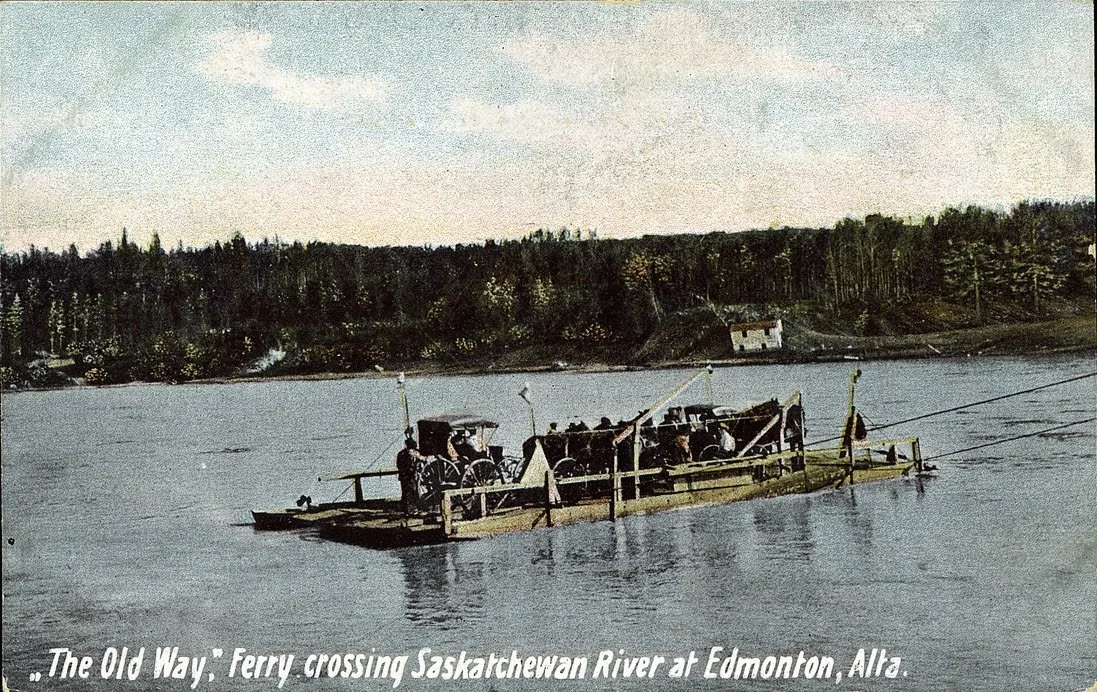
A postcard showing a panoramic view with the completed High Level Bridge and Alberta Legislature, 1917-1918, Glenbow Archives

Comment or contribution
If you have a comment, concern, or question, contact us at nsrivervalley@gmail.com Please also email us river valley photos or event information. Your friends, neighbours and colleagues can sign up for this newsletter on our web site https://www.edmontonrivervalley.org/

Sincerely yours,
Harvey Voogd
North Saskatchewan River Valley Conservation Society
780.691.1712

River Valley News - March 3, 2022

Mill creek park movement and citizen activism in Edmonton
NSRVCS board member PearlAnn Reichwein is co-author of a chapter in the recently published Bucking Conservatism-Alternative stories of Alberta. She and Jan Olson write about the 1964-75 fight by citizens against a city plan to re-engineer Mill Creek Ravine as an automobile corridor to link suburbs and downtown.

Town planners advised Edmonton council in 1907 to set aside deep ravines that were valued as community public resources and parks. Planner Frederick Todd recommended protection of Edmonton’s river valley lands and emphasized the importance of nature in urban life and health. Public parks were seen as the green lungs of the city.

As he put it, “a crowded population, if they are to live in health and happiness, must have space for the enjoyment of that peaceful beauty of nature, which because it is the opposite of all that is sordid and artificial in our city lives, is so wonderfully refreshing to the tired souls of city dwellers.”

Mill Creek Ravine near Connor’s Road had become the community of Ross’s Acreage. Twenty-five families and bachelors lived there, which was seen as a problem in 1934, when the city declared the ravine to be parkland. By 1950, all had been evicted except for one elderly resident. Then came the freeway push.

Read about this fight and how Mill Creek became a focal point for the concept of building a park as an expression of the commons and of a larger civic sense of public space as home. Debates over the ravine manifested an ongoing struggle to maintain both public space and the public’s role in municipal governance and change. This story begins on page 253 at https://www.aupress.ca/app/uploads/120286_Crane_Bear_et_al_2021-Bucking_Conservatism.pdf

Purple martins a favourite of backyard birders
The purple martin is North America’s largest swallow and Edmonton is at the northern edge of its range. Known for their speed and agility in flight, these birds tuck their wings and dive at high speeds while hunting insects. Alberta lists the species as sensitive due to concern over loss of nest sites and competition from House Sparrows and European Starlings. Their neotropical wintering grounds are also under threat.

They are a favourite of backyard birders, and people enjoy installing specially designed bird houses in their backyards to assist in recovering the species. In Camrose, which celebrates the Camrose Purple Martin Festival every June, there are 100+ purple martin houses on city land and private property.

Martins arrive in Alberta from late April to early May and begin their southward migration within three weeks of the young leaving the nest. The southward migration normally begins in July, and most birds have gone by the end of August. They often gather in enormous flocks during the trip

Martins consume a variety of the larger flying insects, including dragonflies, moths, butterflies, house flies, horse flies, and deer flies. Since they tend to feed on whatever is most easily available, their diet varies with the time of year and time of day. Learn more at https://www.hww.ca/en/wildlife/birds/purple-martin.html

Defend river valley from industrialization
Edmonton River Valley Conservation Coalition (ERVCC) has filed a notice of appeal to the January decision by Alberta Court of Queen’s Bench Justice George Fraser to deny its court application to overturn City Council’s approval of Epcor’s planned 51-acre solar farm in the river valley.

ERVCC filed for a judicial review of the past city council’s decision to rezone 99 acres of river valley parkland for an industrial solar farm without subjecting it to the River Valley Bylaw. The judge said the claim was “moot” because the Alberta Utilities Commission had approved the project. But the AUC’s approval stated the project would be subject to the city’s River Valley Bylaw. So how did that condition just disappear?

If the judge’s decision holds, this would mean that two years of public hearings, thousands of pages of reports produced by city administration, and a vote by city council were for nothing, and that the project was subject to zero environmental review.

ERVCC needs to raise $35,000 for legal fees for its appeal. Learn more at its GoFundMe page https://www.gofundme.com/f/defend-yeg-river-valley-from-industrialization

Joy to read
Sydney says “Every time this newsletter arrives, I just feel joy. It is such a pleasure to read something so values driven and balanced. The fact that you periodically advocate and yet you also share stories about animals make it a true pleasure not a pain to read it. My love for Edmonton and our river valley is reinforced by every issue.”

Mountain bike trails
Marilyn writes “I just read your newsletter this morning and am in complete agreement with the senior who wrote in about unauthorized mountain bike trails. We have been confronted by very rude, inconsiderate behaviour by mountain bikers in the Goldbar and Goldstick area where a lot of trails are located.

Warning bells are not used and intersections with walking trails are often crossed at high speed. We have been told by bikers that it is up to us walkers to watch out for them, not the other way around! Last spring, we witnessed severe erosion due to the tracks caused by mountain bike tires creating deep ruts that channel the spring melt. There is no consideration by this group to not cycle when conditions are muddy. The City needs to step in and resolve this situation.”

Comment or contribution
If you have a comment, concern, or question, contact us at nsrivervalley@gmail.com Please also email us river valley photos or event information. Your friends, neighbours and colleagues can sign up for this newsletter on our web site https://www.edmontonrivervalley.org/

Sincerely yours,
Harvey Voogd
North Saskatchewan River Valley Conservation Society
780.691.1712