River Valley News - July 20, 2023

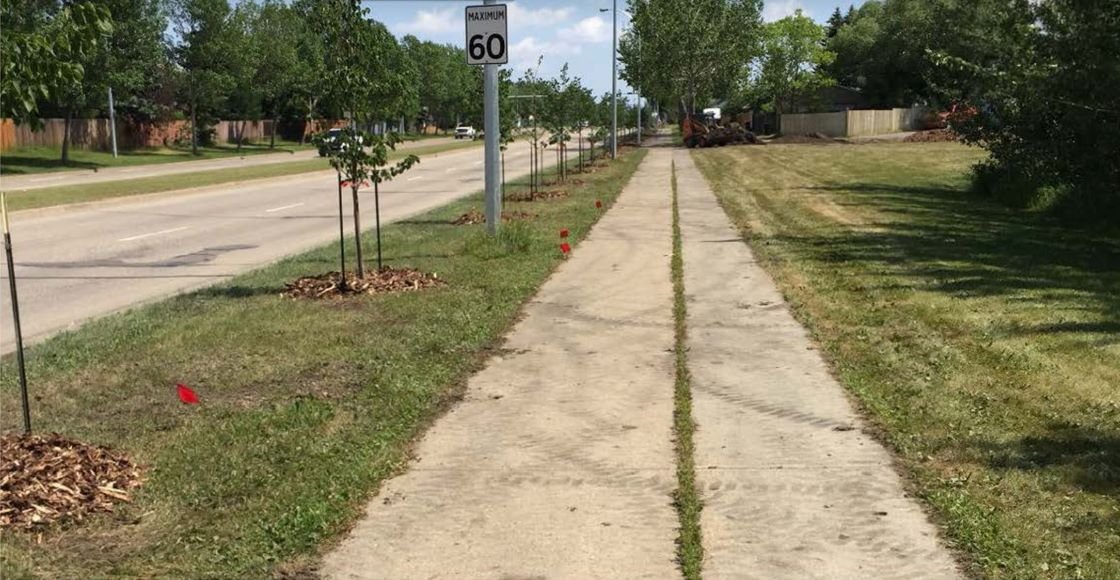
Many YEG trees planted in circumstances constrained by concrete and other infrastructure

The Wildflower News July edition features information that Jim Hole, a well-known horticulturalist, submitted to the City’s Integrated Pest Management Advisory Committee, of which he is a member. Hole writes, “Construction impacts are cumulative. Trees do not heal, they just compartmentalize damage, wall it off. Each event adds up over time: demolition, grading, and construction. Cumulative damage sends trees into a death spiral.

Tree preservation requires space. Compacting soil around trees with construction equipment causes serious damage. Tree roots do not grow like carrots. They spread wide and most are in the top two feet of soil. Most fine roots are in the top 18 inches. Compaction reduces water infiltration and dramatically reduces oxygen infiltration.

Tree root zone volumes and soil consistency are critical. Two cubic feet of structured soil for every square foot of crown projection at maturity is needed for healthy trees. Crown projection is the area under the dripline of a tree. If you think of a circle of foliage and do the math, a canopy diameter of 20 feet would be around 300 square feet and require 600 cubic feet of good soil.

The typical urban tree pits in concrete sidewalks might have a volume of 100 cubic feet. Tree roots are unable to grow properly in these ‘tree coffins’ and are, invariably, short-lived. Each successive replacement tree will also be short-lived. Costs in the long term are higher and environmental and aesthetics losses are also high.” https://speakerscanada.com/keynote-speaker/jim-hole/

Edmonton valley zoo breeding program includes endangered northern leopard frog

Northern leopard frog populations across western Canada started declining sharply in the 1970s, with the Edmonton region population estimated to have been completely lost by the 1980s. Due to upland habitat destruction, wetland loss, pollution, and the spread of diseases, the species is now considered gone from the entirety of the North Saskatchewan River basin.

In late June 2023, two zookeepers made the trek to a protected wetlands area outside of Kimberley, B.C. to release 277 zoo-born and raised endangered Rocky Mountain northern leopard frog tadpoles. This work is part of a breeding program with the goal of preventing the local extinction of the species in order to support the recovery of the broader western Canadian northern leopard frogs, which are considered at risk in Alberta.

The northern leopard frog program was established at the zoo in 2018 as part of the broader Northern Leopard Frog Recovery Team, which runs in cooperation with the Wilder Institute/Calgary Zoo, the Vancouver Aquarium, and the Province of British Columbia. The team is establishing new self-sustaining populations of frogs in BC, conducting conservation research, and maintaining assurance populations.

For every person who visits the Edmonton Valley Zoo, a small portion of their admission goes to conservation.

https://www.edmonton.ca/attractions_events/edmonton_valley_zoo/northern-leopard-frog-breeding-program

New conservation easement in Parkland County near Wabamun Lake

The Edmonton and Area Land Trust (EALT) has announced that a new conservation easement was finalized earlier this year with landowners in Parkland County. This property near Wabamun Lake provides mixed woods habitat for many types of wildlife: moose, deer, bear, dozens of songbirds, and even the endangered Little Brown bat.

In addition to the generous landowners who made this possible, funding support was also received from the Alberta Land Trust Grant. Land Trusts can apply for funding from this provincial program to conserve ecologically important areas to prevent habitat fragmentation, maintain biodiversity and preserve native landscapes.

Conservation easements are an excellent tool for landowners to achieve conservation of their land while still being able to use and sell their land in the future. Ecologically significant lands may also be eligible for significant tax benefits through the Ecological Gifts program, a program of the Government of Canada.

If you are interested in conserving your land with EALT, check out its Planning Your Conversation Legacy guide https://www.ealt.ca/conserve-nature/  

YEG will keep control if river valley becomes a national urban park

Miriam emailed “Always interesting news! Would love a follow up on the Edmonton park control issue.”

Still Life by Andrew French, Belgravia Art Park

https://www.edmontonarts.ca/public-art/still-life-2

Comment or contribution

Please note that articles may not reflect the position of NSRVCS. River Valley News is meant to be a clearinghouse for the wide variety of opinions and ideas about Edmonton’s River Valley. Email river valley photos, event information, comments, or questions to nsrivervalley@gmail.com

Sincerely yours,

Harvey Voogd

North Saskatchewan River Valley Conservation Society

780.691.1712

River Valley News - July 13, 2023

YEG will keep control if river valley becomes a national urban park

Harmony Wolgemuth photo

Urban planning committee voted to recommend that council proceed to the planning stage of the National Urban Park initiative. While Mayor Sohi advocated for the river valley’s national urban park status, he said certain things are non-negotiable for him.

“One of them is there will not be a transfer of river valley lands to the federal government,” he said during the meeting. “That Edmontonians will retain ownership and control of the river valley, that land use and other permitted activities are determined by the City of Edmonton as we do now, and that access to the river valley will be same for Edmontonians as it has always been, which is free of charge.”

Theo Peters, spokesperson for Métis Nation of Alberta, told councillors a survey found a majority of its citizens approve of the river valley as a national urban park, as well as preserving the nature there. “There was a large consensus toward retaining the natural features of the park … and a focus on minimal development to avoid anything that had the potential to change the naturally occurring landscape,” he said.

Linda Duncan with the North Saskatchewan River Valley Conservation Society was mostly supportive but said there needs to be more transparency with the public throughout this process. https://edmontonjournal.com/news/local-news/edmontons-mayor-says-city-must-keep-control-if-river-valley-becomes-national-urban-park

Trees the silent heroes of Fort Saskatchewan

Fort Saskatchewan says trees provide calm and quiet amidst urban noise, even in the city center. That's the difference nature makes, and it is palpable. Supported by the Federal Government and in collaboration with the Two Billion Trees initiative, it wants to bring more of these calming spaces to Fort Saskatchewan for everyone to enjoy.

Think of an urban forest as the city’s lungs. Encompassing trees, shrubs, gardens, parks, and more. These living, breathing spaces offer extensive ecological, economic, and social benefits. The Urban Forest Protection and Enhancement Plan seeks to cultivate more of these lush pockets, all while considering the requirements of the growing community.

By collaborating with Indigenous community members, the city will gain valuable insights into traditional ecological knowledge, shaping its urban forests. By reviving and nurturing indigenous plant species, it can strengthen native ecosystems, bringing them to life.

As climate change becomes more significant, the advantages of urban forests to Fort Saskatchewan grow increasingly vital. The plan offers future-focused guidance on nurturing the urban forest, especially as the city expands and the climate shifts. https://mysay.fortsask.ca/urban-forest   

Tar-like substance seeping out of ground at valley park

The Alberta government is trying to identify the risks and liabilities of continuing to operate Strathcona Science Park an Edmonton-area provincial park in the river valley. A Phase 1 environmental site assessment, conducted last year, revealed environmental concerns over potentially harmful contaminants in the park.

Before the land was turned into a park, it had a long history of industrial activity. The Great West Coal Company operated the Black Diamond coal mine on the site during the first half of the 20th century. Educational signs at the park show many coal mines were in the area, along both sides of the river valley. The park was also used for sand and gravel extraction, a concrete plant, industrial waste disposal and a landfill.

The provincial park opened in July of 1980, and included a museum with six octagonal science pavilions. The pavilions closed in 1988, and the park's archeological centre closed in 1991. These days, the park is home to the Sunridge Ski Area, the Edmonton Nordic Ski Club's Biathlon Centre and the Strathcona Remote Control Flyers Association. https://www.cbc.ca/news/canada/edmonton/tar-like-substance-strathcona-science-park-1.6894035

Lake Wabamun a natural treasure since the end of the ice age

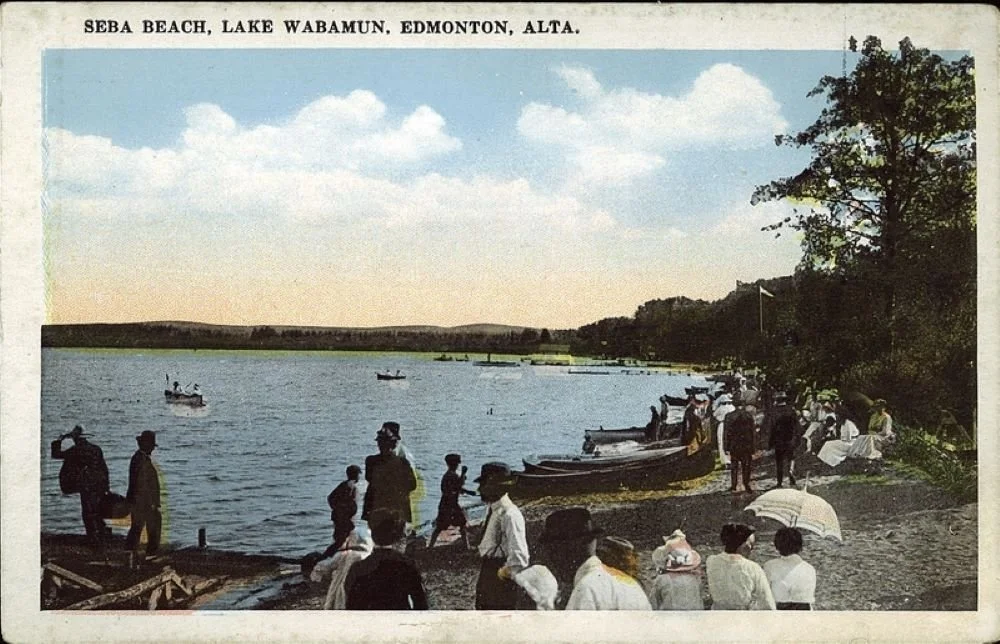
In July 1930, Seba Beach pavilion, on the shore of Lake Wabamun, opened with advertisements stating “Dancing tonight and every Saturday. 53 miles west on the new gravelled Jasper Highway. Road good rain or shine.” Sailboat racing was also a popular pastime and the lake was home to several small sailing clubs.

Lake Wabamun was formed by the retreat of the Laurentide Ice Sheet, which left behind a lake that was both shallow and long, 20 km from end to end. The lake became rich in fish and a popular spot for migrating birds, providing a reliable food source for Indigenous people, including the ancestors of the Paul Band.

The first European homesteaders built cabins on the water in 1906. Construction of the railroad nearby made the lake much easier to access from Edmonton and use of the lake and surrounding area exploded. By 1914, Lake Wabamun had “the largest fleet of motorboats and launches of any lake in the province,” according to the Edmonton Bulletin.

The railway brought tourism but also industrial development. A commercial fishing industry began to flourish, harvesting the lake’s whitefish to be shipped off to customers in Canada and the United States. The demand was so great that a cannery opened for a time in Seba Beach. During the winter, the ice covering the lake was cut and transported by rail for refrigeration. More at https://edmonton.taproot.news/tags/seba%20beach

Speeding motorboat in Whitemud Creek prompts investigation

Karen emailed “Time to ban speed boats on the creek.”

Sara wrote “This looks like the same group that were on the Sturgeon a few weeks back. I really hope they’re caught. So disruptive to the wildlife and dangerous for paddlers.”

Iskotew by Amy Malbeuf, INIW River Lot 11.

https://www.edmontonarts.ca/public-art/iskotew

Comment or contribution

Please note that articles may not reflect the position of NSRVCS. River Valley News is meant to be a clearinghouse for the wide variety of opinions and ideas about Edmonton’s River Valley. Email river valley photos, event information, comments, or questions to nsrivervalley@gmail.com

Sincerely yours,

Harvey Voogd

North Saskatchewan River Valley Conservation Society

780.691.1712

River Valley News - July 6, 2023

National Urban Park initiative recommended to proceed to planning stage

On July 12, Council’s Urban Planning Committee will discuss a recommendation that Edmonton proceed to the planning stage of the National Urban Park initiative. Since 2022, the City of Edmonton, Parks Canada and Indigenous partners have explored the possibility of designating a national urban park in the Edmonton region.

A national urban park would provide an opportunity to contribute to biodiversity protection and climate change adaptation, provide access and recreation opportunities for current and future Edmontonians and visitors, and support reconciliation with Indigenous peoples.

The planning phase will develop a park vision, refine its boundaries, determine a governance model, begin more detailed planning, and facilitate potential access to federal funding to support the development of the national urban park. The planning stage would not commit the City to designating a national urban park.

The report and attachments going to the committee are at https://pub-edmonton.escribemeetings.com/Meeting.aspx?Id=646222f3-1d97-40da-a9af-429d5cc5b71e&Agenda=Agenda&lang=English&Item=24&Tab=attachments

Speeding motorboat in Whitemud Creek prompts investigation

River valley users and officials are reacting after a video surfaced on social media of a motorboat speeding down Whitemud Creek. The area is a wildlife corridor, home to various types of fish, birds, and animals, and is widely used by canoeists and kayakers. Video shows the boat with multiple people on board narrowly missing a canoe travelling in the opposite direction.

"The point where the jet boat goes past the individual in the canoe, it appears to me to be within a foot and a half, maybe two feet at the most, and the canoeist was tucked right into the bank. That doesn’t give much room for safety," said naturalist Wayne Oakes who not only worries about the people that use the creek, but the animals who live there.

"It's not uncommon to see deer in the middle of the creek, moose, all kinds of waterfowl, beaver, muskrat. They don't have the ability to quickly get out of the way when something is zooming up the creek." He says motorized boats should stick to the river. "With a great, big, beautiful open river just a few metres downstream from us, that's the place for your big, high-powered vessels. Not up a little, tiny, picturesque creek like the Whitemud."

The Edmonton Police Service and the city of Edmonton's Marine Unit are investigating the incident.

https://edmonton.ctvnews.ca/video-of-fast-motorboat-in-edmonton-creek-prompts-investigation-1.6460497

RVA trail walk with the Fort Saskatchewan Naturalist Society

Join the River Valley Alliance and the Fort Saskatchewan Naturalist Society on Saturday, July 29 from 10am to Noon as they walk a trail from the Sheep Shack at the Fort Heritage Precinct to an area near the new Hwy 15 Bridge.

The walk will include descriptions of the dozens of natural plants, shrubs, trees, and berries that grow in the community. The trail is also habitat for birds of many species and their nests. Along the trail we will search for a tree to place a bird house donated by the Naturalist Society.

The walk is 2.2km on paved trail and will be walked at a leisurely pace with plenty of time to take in nature and snap photos. Space is limited. Free registration and event information at

https://www.eventbrite.ca/e/rva-july-community-trail-walk-with-the-fort-saskatchewan-naturalist-society-tickets-667070143757?aff=oddtdtcreator

Thank You

Asha writes "I love the newsletter. I learn something new with every edition. Thanks for putting it together."

Pumpkins and Moons by Ken Macklin, Belgravia Art Park. DCM Photography. https://www.edmontonpublicart.ca/#!/details/118

Comment or contribution

Please note that articles may not reflect the position of NSRVCS. River Valley News is meant to be a clearinghouse for the wide variety of opinions and ideas about Edmonton’s River Valley. Email river valley photos, event information, comments, or questions to nsrivervalley@gmail.com

Sincerely yours,

Harvey Voogd

North Saskatchewan River Valley Conservation Society

780.691.1712